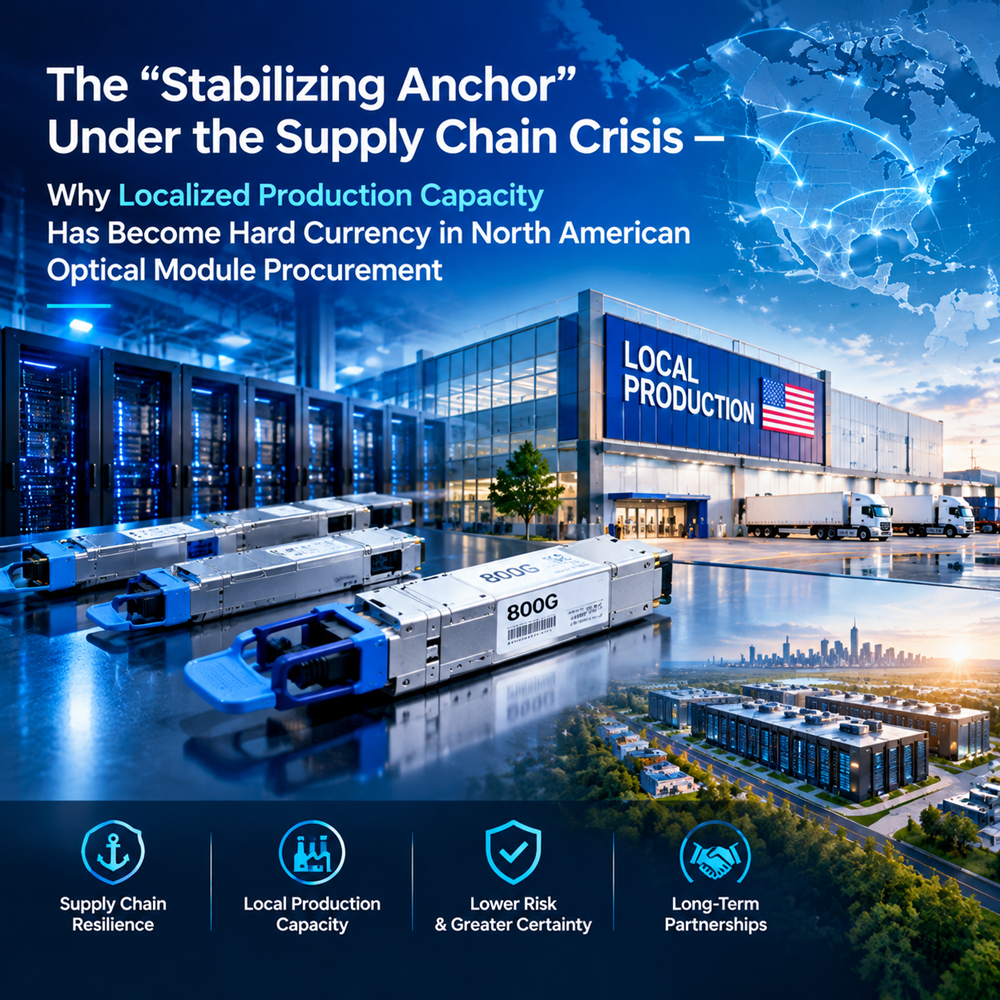

In 2026, the global AI optical transceiver module market is experiencing unprecedented explosive growth. According to the latest research from TrendForce, the market size will jump from $16.5 billion in 2025 to $26 billion, a year-on-year increase of more than 57%. The core engine of this growth points, without a doubt, to North America.
Traffic in North American hyperscale data centers has long maintained annual growth of more than 30%, driving cloud giants such as Google, Microsoft, and Meta to continue increasing their deployment of GPUs and AI servers. Take Meta as an example: its total optical module demand in 2026 will reach 8.5 million units, and is expected to jump to 18.1 million units in 2027—more than doubling within a year. This is not simple linear expansion, but an "arms race" centered on AI computing power. The competition in network bandwidth is ultimately written into orders for 800G and 1.6T optical modules, one module after another.
800G optical modules have now become the mainstream specification for backbone interconnection in AI data centers, while the mass production process for 1.6T products is accelerating. Google and Microsoft have combined demand of about 12 million units, and Amazon about 5.5 million units. Customer feedback from leading manufacturers shows that major customers have already provided orders and demand guidance for 2027, and demand for 800G and 1.6T products is expected to remain on a rapid growth trajectory.
From the perspective of technology routes, silicon photonics solutions are becoming the core direction for high-speed optical modules. It is expected that in 2026, silicon photonics solutions will account for more than 50% of 800G optical modules, and as high as 70% to 80% of 1.6T optical modules. With the advantages of low power consumption and low cost, silicon photonics technology is reshaping the cost structure of the entire industry. For North American buyers, choosing suppliers with mass production capabilities in silicon photonics technology means not only better energy efficiency performance, but also more stable delivery assurance during periods of supply chain tightness.