
1. The Hidden Cost Behind Compute Scaling: When Optical Modules Become Power Hogs
For the past two decades, the optical communications industry has followed the growth logic of “higher transmission rates drive hardware upgrades.” The arrival of the AI large model era has fundamentally changed the game. Training and inference with large models demand not only extreme bandwidth but also approach physical limits in power consumption.
An undeniable reality is that the number of optical modules in AI data centers is growing at an astonishing rate. In the NVIDIA GB200 NVL72 architecture, a single rack system requires thousands of high-speed optical interconnect ports. When scaling from tens of thousands to hundreds of thousands of GPUs, the total number of optical modules can easily reach hundreds of thousands. The cumulative power consumption of these modules operating simultaneously has become a significant component of total data center operating costs.
According to the latest research from TrendForce, the global AI optical transceiver market is projected to expand from 16.5billionin2025to16.5billionin2025to26 billion in 2026, representing over 57% year-on-year growth, with North American hyperscale data center traffic sustaining over 30% annual growth. Behind this rapid market expansion, power and thermal management challenges continue to affect system design and deployment timelines. As single-port speeds leap from 400G to 800G and 1.6T, the power consumption of individual optical modules climbs from several watts to over 20 watts, dramatically increasing thermal density. Cooling issues are rapidly moving from “engineering details” to “core architectural challenges.”
2. The Technical Dilemma of Thermal Management: When 800G Hits the Power Ceiling
The power consumption of optical modules comes primarily from two sources: the intrinsic power consumption of optoelectronic devices such as lasers, and the power consumption of digital signal processors required for signal processing. As per-lane rates evolve from 50G to 100G and 200G, DSPs consume power at a super-linear growth rate to compensate for signal loss and distortion during high-speed transmission.
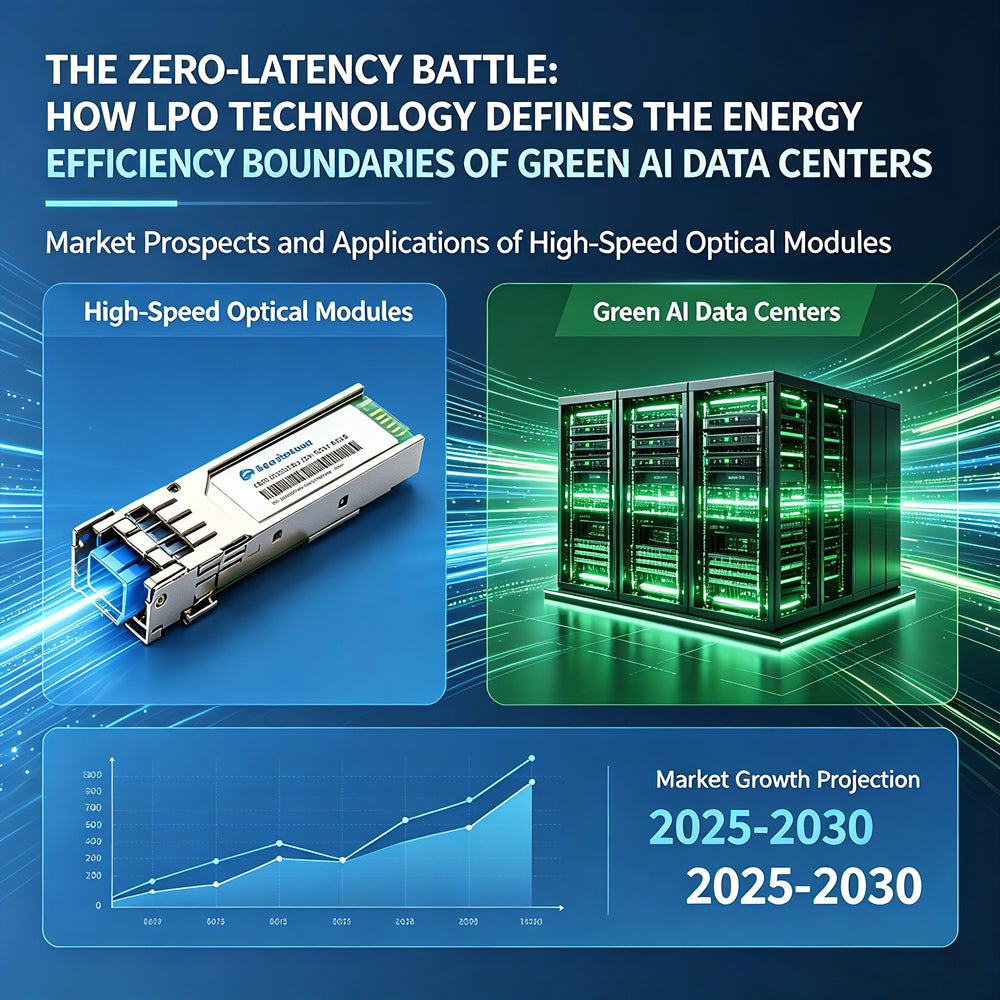
The industry is actively exploring multiple technical paths to break through this bottleneck. Silicon photonics integration consolidates discrete optoelectronic devices onto silicon platforms, reducing packaging complexity and helping control power consumption—silicon photonics penetration has already reached about 50% in 800G modules. More forward-looking approaches include Linear Pluggable Optics and Co-packaged Optics. LPO removes or simplifies DSPs, integrating linear drive functions directly into the module, significantly reducing both power consumption and latency. LPO and CPO are projected to capture over 30% of the data center optical module market within the next five years. However, CPO full-scale commercialization is facing headwinds—major players such as Broadcom and Arista generally believe that CPO commercialization timelines will be postponed to 2028-2029.
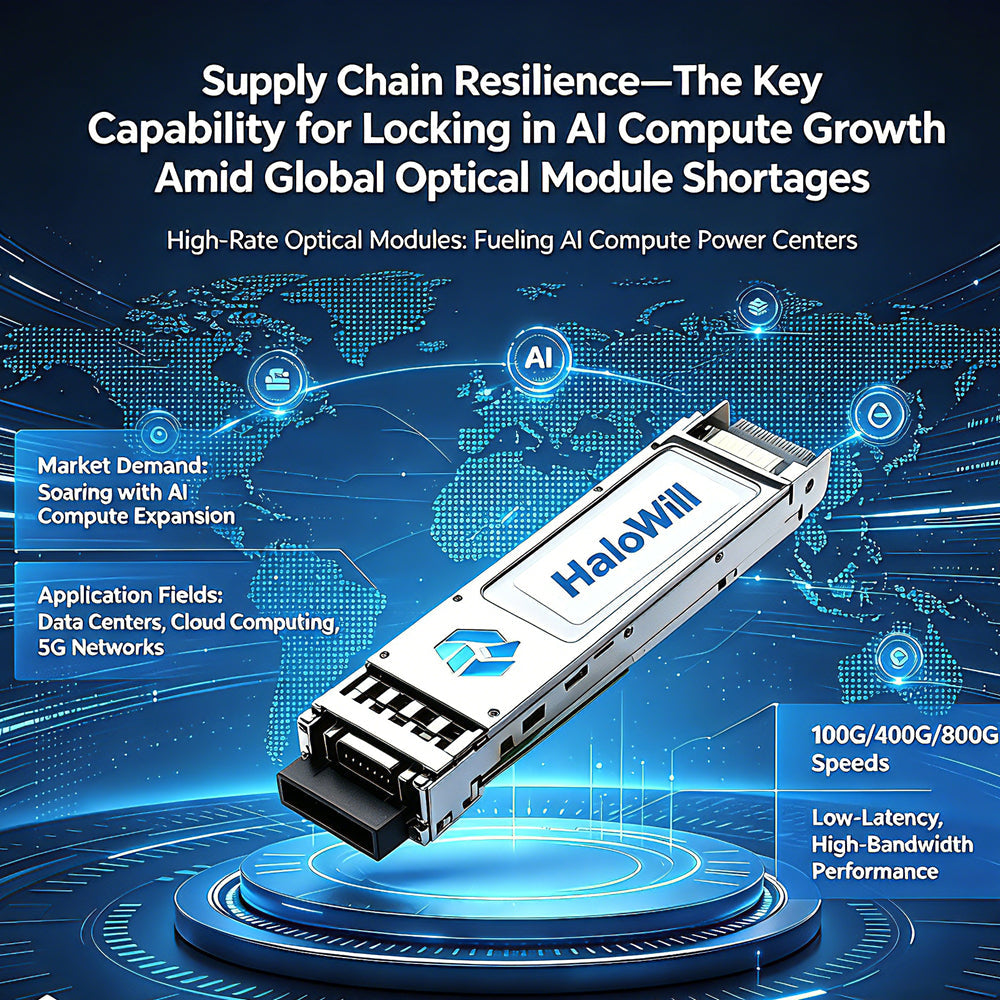
Given this lack of technical consensus, data center operators face a practical choice: how to control this “hidden cost” of power consumption while ensuring reliable deployment. This is precisely where HaloWill optical modules have found their differentiated value proposition in the North American market.
3. HaloWill Low-Power Design Philosophy: Accountable for Every Watt
HaloWill has made low-power design one of its core technical directions since its founding. The company core strengths include unique low-power design solutions, multi-channel optical component packaging technology, and proprietary automated testing platforms. This positioning carries profound strategic significance in the current industry environment.
At the device level, HaloWill has systematically refined its approach across optical chip selection, driver circuit optimization, and packaging thermal design. In data center environments, the reliability of optical modules is paramount—a single port failure can lead to substantial compute cluster loss. HaloWill maintain comprehensive testing and burn-in equipment, well-established manufacturing processes, and rigorous inspection procedures to ensure high product reliability and stability.
At the system level, HaloWill low-power characteristics deliver more than just reduced electricity bills—they provide greater deployment flexibility and expansion headroom within rack power density constraints. For AI data center operators, decisions ultimately come down to cost and space. Whoever can deliver the same transmission performance with lower power consumption holds a competitive advantage.
4. Key Technology Roadmap: Energy Efficiency Leap from 800G to 1.6T
Current 800G optical modules adopt an 8×100G parallel optical architecture, while next-generation 1.6T products are evolving toward 8×200G or 4×400G configurations. In power control, HaloWill technology roadmap emphasizes balancing core component localization with mature packaging processes—avoiding over-reliance on CPO technology, which is still in the validation phase, while achieving optimal power consumption through refined design within mature pluggable frameworks. Pluggable optical modules remain the dominant AI data center solution in the current and medium term, and the industry consensus is to find balance across bandwidth density, power efficiency, latency, cost, and reliability.
HaloWill low-power solutions are built on this pragmatic philosophy, offering North American data center customers a “ready-to-deploy, reliable-enough” upgrade option—enabling them to complete infrastructure upgrades before the large-scale arrival of 1.6T deployment.
5. Long-Term Perspective: How Low-Power Design Translates into Business Value
For purchasers, choosing HaloWill is not just about selecting a supplier—it is about adopting a clear energy efficiency optimization path. In today’s intensifying global AI race, whoever achieves the “highest compute output per watt” at the infrastructure level first holds a decisive competitive advantage. HaloWill focuses on the fast-growing data communications, data center, and cloud computing sectors, committed to providing customers with optical modules that combine high performance with low operational costs. With North American cloud giants significantly raising their 2026 capital expenditures, HaloWill low-power leadership and cost-competitive supply chain position it to continue winning attention from North American purchasers.