
In the eyes of a Wall Street analyst, data center optical modules are among the fastest-depreciating IT assets. Standard accounting practices classify them as networking equipment, depreciating them over three to five years with a residual value that usually defaults to zero. This means that a purchase order for ten thousand 400G optical modules loses several thousand dollars in value on the books every single day. As the expansion pace of North American data centers is pushed onto a steeper curve by AI demand, optical module procurement is evolving from a purely technical decision into a financial proposition: How can the asset life of optical modules keep pace with that of the buildings and power infrastructure, while maintaining technological leadership?
The answer HaloWill provides is a product philosophy that defies Moore's Law. It does not push customers to replace their hardware every two or three years. Instead, it enables already-deployed modules to continuously evolve, retaining their competitiveness and book value over a much longer period. This philosophy is built upon three pillars: the EverGreen lifetime firmware evolution program, SmoothGrade cross-generational rate compatibility technology, and the CircularOptics decommissioning and closed-loop recycling system. Together, they weave an asset-preservation net that redefines optical modules from "consumables" to "durable assets."
The first pillar, EverGreen, solves the problem of functional obsolescence. Under the traditional model, once an optical module leaves the factory, its protocol support capabilities are permanently frozen. When a network operating system is upgraded, a security vulnerability is disclosed, or a new telemetry standard is released, already-deployed modules cannot evolve accordingly and must be retired prematurely. Through its encrypted over-the-air upgrade mechanism, EverGreen allows HaloWill 400G and 800G modules to receive firmware updates during live operations, gaining support for new protocols, new security patches, and even power consumption optimization algorithms. Last year, when a security organization disclosed a vulnerability affecting the management interface of a certain DSP chip, HaloWill pushed a remedial firmware update to all affected online modules within one week, while customers of several competitors were forced to initiate a months-long physical replacement process. For a procurement manager, this means that an optical module on the asset sheet will not be turned into electronic waste because of a single software vulnerability.
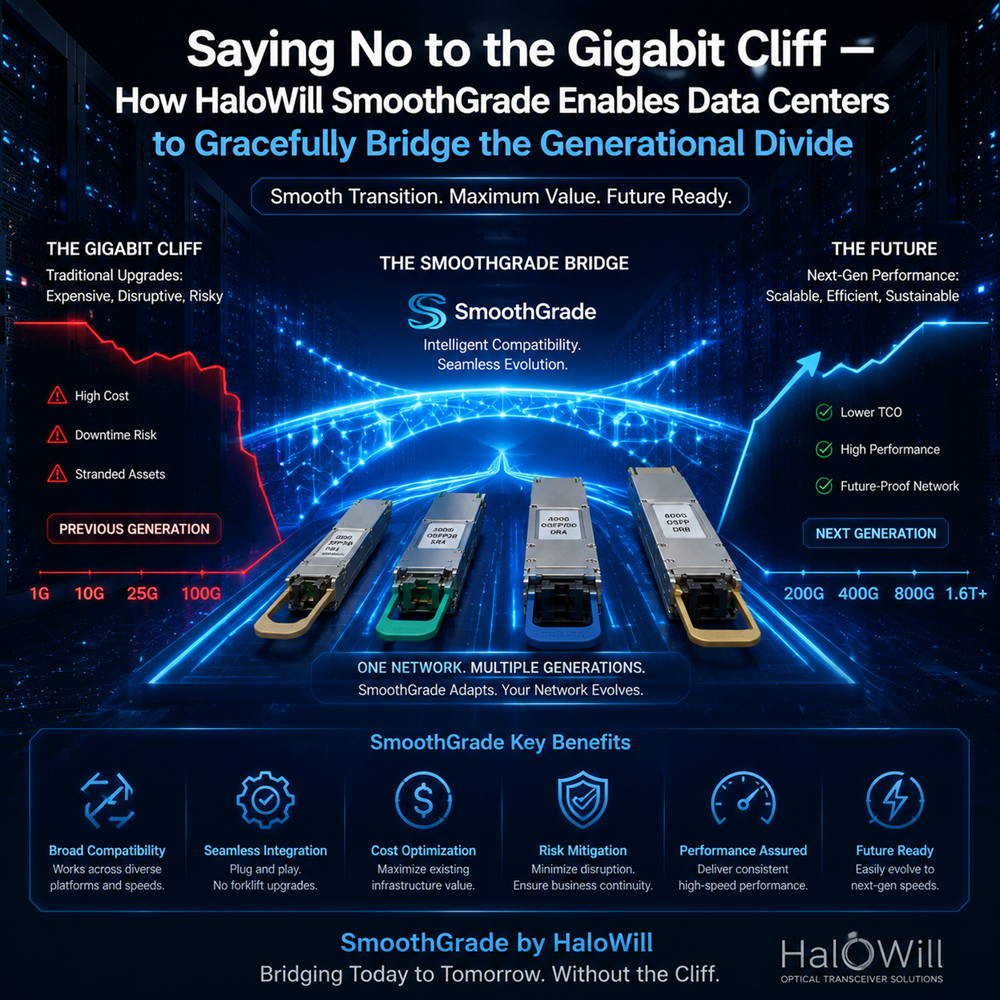
The second pillar, SmoothGrade, tackles the problem of rate discontinuity. The core switching layer of a data center may undergo a speed upgrade every three to five years, but the refresh rhythm of the access and edge layers is often much slower. SmoothGrade allows the same HaloWill module to operate adaptively at multiple speeds, such as 100G, 200G, or 400G, and switch automatically as switch ports are progressively upgraded, without the need for a wholesale replacement at each partial upgrade. A financial services data center in Chicago, during its migration from 100G to 400G, used SmoothGrade to pre-deploy sixty percent of its modules in downgraded mode, then switched them to full speed after the backend upgrade was completed. This transformed the project's capital expenditure curve from a sharp impulse peak into a gentle staircase.
The third pillar, CircularOptics, addresses the problem of end-of-lifecycle value going to zero. Even when a module is eventually retired due to physical aging or because its performance ceiling is surpassed by new speed requirements, it is still not a zero-residual-value piece of waste. HaloWill's closed-loop recycling system re-transforms retired modules into raw materials or certified refurbished products through precious metal refining and functional refurbishment certification. Customers who participate in the program receive a discount rebate linked to the recovered valuation on their next purchase. This rebate is reflected directly on the invoice of the new order, rather than remaining as a vague "green contribution" in the wording of an ESG report. The CFO of a managed service provider in Texas, after receiving the first CircularOptics rebate, required the procurement department to include "end-of-life recovery value" as a mandatory evaluation item in all future optical module purchases, because he realized that this constituted the module's implicit residual value.
When these three pillars work in synergy, the effective economic life of a HaloWill optical module can be extended from the traditional three to five years to seven years or even longer. In financial accounting terms, this means a significant reduction in the average annual depreciation cost, and a substantial extension of the business operation time supported by every dollar of capital expenditure. HaloWill's North American customer success team can provide every procurement leader with a customized TCO comparison model, quantifying the financial impact of the anti-depreciation strategy into specific cash flow improvements and asset turnover rate increases.
In the North American data communications market, the procurement decision for optical modules is shifting from a one-time comparison of price-performance ratios to a comprehensive, lifecycle asset management perspective. HaloWill invites you to re-examine the value curve of optical modules through a lens that spans more than five years, and to see what kind of structural improvements a product philosophy that refuses to be carried along by Moore's Law can bring to your balance sheet.