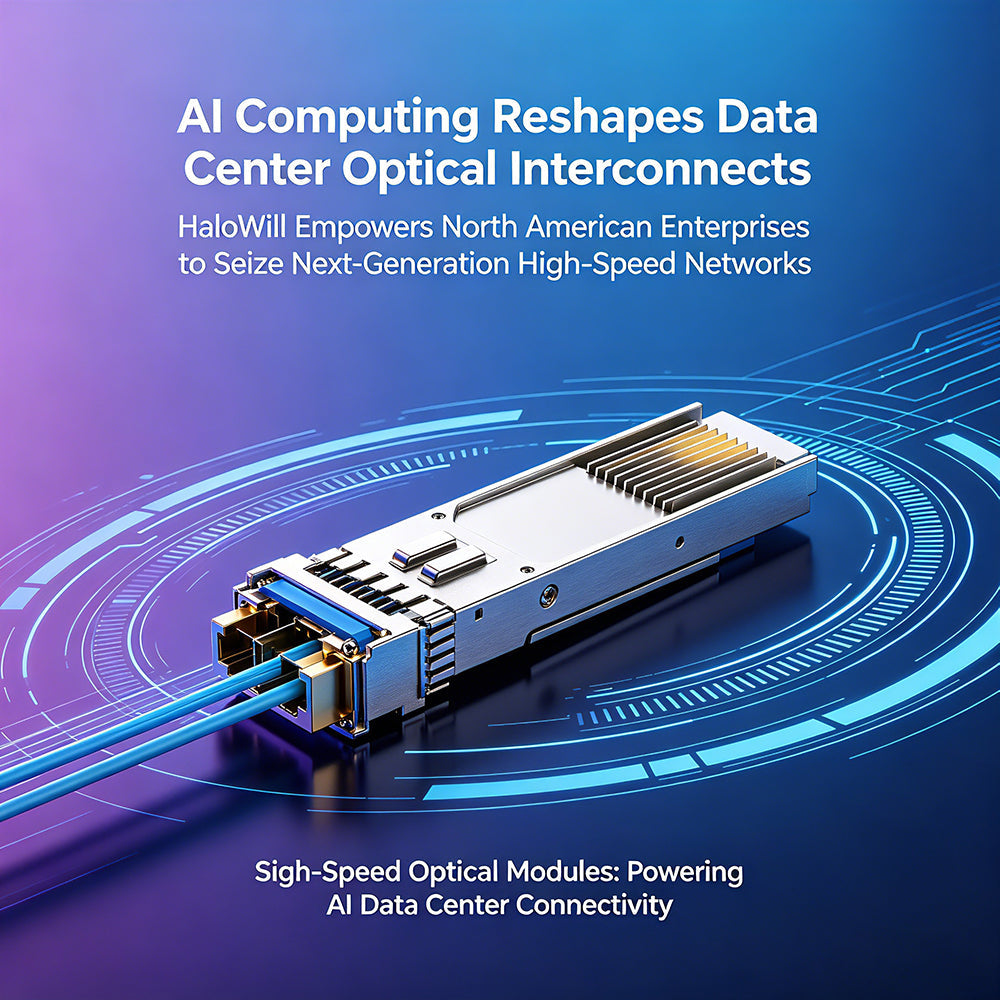

In March 2026, the most influential OFC Conference in the global optical communications field was held as scheduled in Los Angeles, USA. Compared with previous editions, this year's conference sent a clear signal: AI computing power has upgraded from an "important factor" driving optical communication technology development to a "core rigid demand." High-speed optical modules are no longer auxiliary components of traditional communication networks, but critical infrastructure that directly determines the upper limit of AI computing cluster efficiency. For procurement decision-makers in the North American market, understanding the current technological frontier is not only about product selection but also about the competitive landscape for years to come.
The core themes of this year's OFC covered everything from the commercial deployment of 1.6T and 3.2T high-speed optical modules, to the iteration of advanced packaging technologies such as LPO and CPO, and to breakthroughs in silicon photonics integration and optical circuit switching. This technology landscape reveals an accelerating technology upgrade curve — the optical module industry is undergoing generational shifts at a pace far faster than any previous decade.
800G optical modules have now become the mainstream specification for AI data center backbone interconnects, while 1.6T products are accelerating into the mass production phase. In the third quarter of 2025, shipments of datacom optical modules at 400G and above surpassed 10 million units for the first time, and the 800G module shipment forecast for that quarter was revised upward to over 20 million units. This leap in scale clearly indicates that the expansion speed of AI data centers has exceeded most analysts' expectations.
However, speed upgrades are only one side of the story. More profound changes are taking place within the internal architecture of optical modules. Traditional pluggable optical modules rely on DSP chips for signal processing. This architecture works well at 400G and below, but at 800G and above, power consumption rises sharply, putting immense pressure on rack thermal design. Facing this bottleneck, the industry is exploring multiple innovative paths. LPO (Linear Pluggable Optics) technology removes the DSP chip from the optical module, allowing the module to focus solely on optical-to-electrical conversion, reducing power consumption by approximately 50% and cost by about 15% to 20%. Silicon photonics integration technology, by integrating optical devices on a silicon substrate, achieves significant reductions in size and substantial power optimization.
But new technologies bring not only allure but also risk. Although LPO solutions offer excellent power performance, they impose higher requirements on the high-precision linear drive capability of switch ASIC chips, and transmission distances are currently mainly suitable for short-reach interconnects of under 500 meters within data centers. Silicon photonics solutions, on the other hand, require substantial R&D resources to overcome yield bottlenecks. For data center buyers in North America, the question is not which technology is more "advanced," but which solution can provide the optimal "performance-cost-reliability" triangle balance in current deployment scenarios.
HaloWill's understanding of technology roadmap selection is built on a fundamental principle: technology serves the application scenario. Our 800G product line encompasses both traditional DSP architecture solutions and optimized LPO solutions, allowing customers to choose the best-fit product based on their data center architecture, power consumption targets, and deployment scale. On the silicon photonics front, HaloWill's 1.6T silicon photonics modules have undergone rigorous reliability and yield verification, meeting the stringent demands of hyperscale data centers for high-volume consistent delivery. We do not use "technological advancement" as our sole marketing label; instead, we help customers understand the real trade-offs between different technology solutions, enabling them to make procurement decisions that truly align with business needs.
For North American distributors, HaloWill offers not just products, but also differentiated market positioning capability. In the current market landscape, while procurement demand from North American hyperscale cloud service providers is highly concentrated, a large number of mid-sized data center operators, enterprise-level AI deployment projects, and regional cloud service providers are also actively seeking optical module supply channels that combine quality assurance with cost advantages. The needs of these customers are often overlooked by tier-one suppliers due to long lead times and high minimum order quantities — and this is precisely the blue-ocean space where HaloWill distributors can deliver value.
HaloWill has accordingly established a supporting channel partnership system. We provide North American distributors with professional technical training, flexible product portfolio solutions, and competitive pricing strategies, ensuring that partners can demonstrate professional expertise and commercial value when serving customers. From pre-sales solution selection consultation, to in-sales logistics and delivery coordination, to after-sales technical support response, HaloWill is committed to making every link a plus for the distributor's reputation.
From the perspective of long-term market certainty, the demand for optical modules driven by AI is not a short-lived pulse. LightCounting data shows that the Ethernet optical module market grew 93% in 2024, followed by 82% growth in 2025, and is projected to maintain strong 65% growth in 2026. With the large-scale deployment of AI inference applications and the continuous release of demand for data center interconnect bandwidth from distributed AI clusters, the market demand for high-speed optical modules will remain at a high level for the long term. At the same time, the rise of 800G ZR/ZR+ coherent optical modules is opening up the incremental data center interconnect (DCI) market, injecting new growth momentum into the optical module industry.
Facing this booming market, the competitive barrier for North American buyers and distributors lies not in "whether they can buy optical modules," but in "whether they can obtain a proven, continuously upgradeable solution at the optimal total lifecycle cost." HaloWill looks forward to in-depth dialogues with every North American partner who values long-term value and professional service. Whether you are concerned with the stability of bulk delivery for 800G products or the forward-looking technology layout of 1.6T products, we will, with a pragmatic attitude, professional capability, and sincere willingness to cooperate, provide you with products and services that stand the test of the market.next-gen optical networking