
Introduction: From Copper to Fiber—A Quiet Revolution
You may not realize it, but every click, every video stream, and every AI assistant interaction is supported by an invisible “information superhighway.” At the nodes of this highway sits a small yet crucial device — the optical transceiver module.
As the AI era unfolds, data center traffic is surging at over 30% annually. Traditional copper-based transmission, akin to a congested two-lane road, is no longer sufficient. Optical modules replace copper with fiber optics, converting electrical signals into optical signals for transmission — effectively upgrading that “two-lane road” into a “lightspeed superhighway” with higher bandwidth, lower latency, and reduced power consumption.
What Exactly Is an Optical Module?
In simple terms, an optical module is an optoelectronic converter. Comprised of a transmitter optical subassembly (TOSA), receiver optical subassembly (ROSA), and electronic chips, it sits between servers and switches to convert electrical signals from computing devices into optical signals for fiber transmission, and back again at the destination.
By data rate, optical modules are classified into low-speed (1G-10G), mid-to-high-speed (25G-100G), and ultra-high-speed (400G/800G/1.6T) categories. Currently, 800G has become the mainstream specification for AI data centers, with 1.6T products accelerating into mass production.
A Booming Market: The $26 Billion Super-Track
The explosive development of large AI models has ignited demand for high-speed optical modules. According to the latest research from TrendForce, the global AI optical transceiver market is projected to expand from $16.5 billion in 2025 to $26 billion in 2026, representing a year-over-year growth of over 57%. LightCounting‘s forecast is even more optimistic, estimating the global optical module market will approach $60 billion by 2031, with a CAGR exceeding 20%.
In terms of specific products, global demand for 800G optical modules is expected to reach 45–50 million units in 2026, maintaining steady growth. The real growth engine — 1.6T optical modules — has already surpassed 25 million units in annual demand, leading the industry in growth rate. NVIDIA (approximately 15 million units) and Google (approximately 10 million units) account for the vast majority of this demand.
However, surging demand has created structural supply challenges. Core optoelectronic chips, particularly EML (electro-absorption modulated lasers), remain in tight supply and have become the primary bottleneck for capacity expansion. In 2026, 1.6T optical module shipments are expected to reach only about 15 million units due to upstream chip shortages, creating a supply-demand gap of approximately 10 million units. NVIDIA has already invested $2 billion each in Lumentum and Coherent to secure upstream laser chip capacity — underscoring the strategic importance of core chips.
Technology Evolution: Beyond “Faster”
The technological evolution of optical modules can be summarized in three keywords: higher bandwidth, lower power consumption, and better integration.
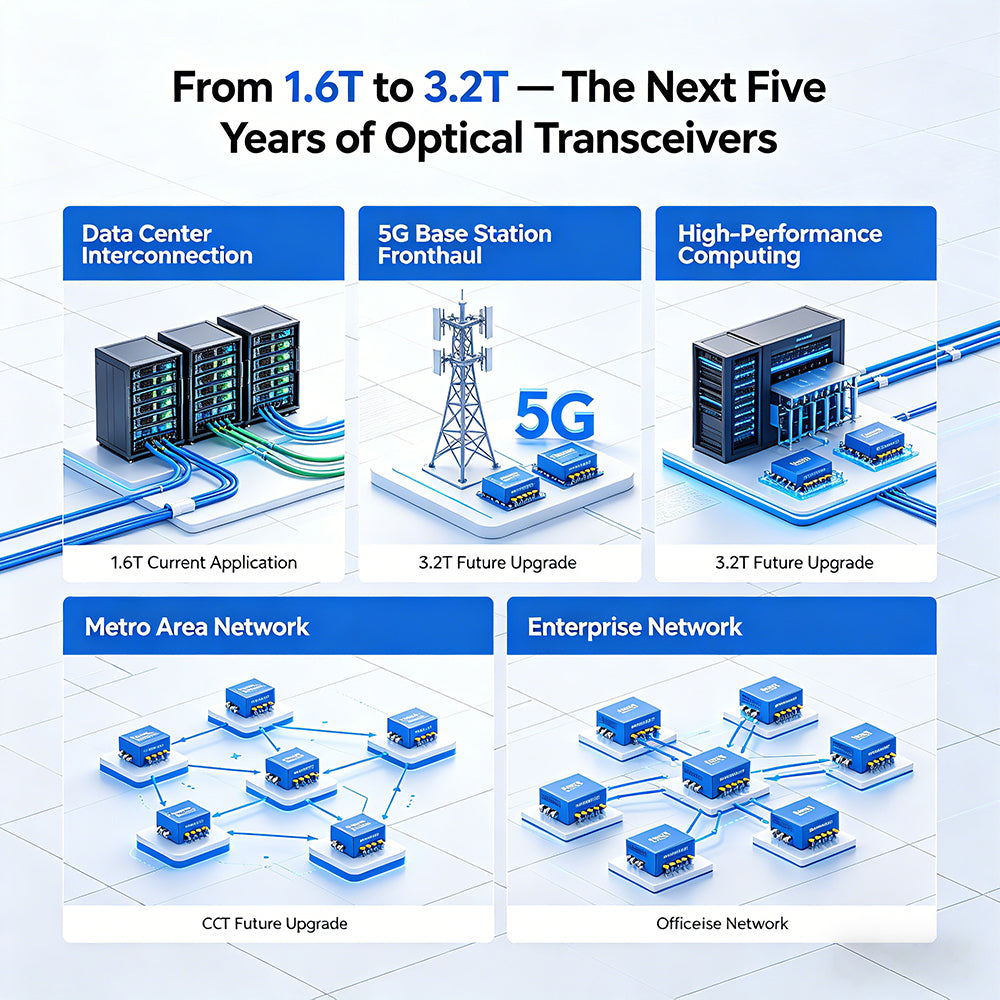
Bandwidth: 800G is now standard, 1.6T is ramping up rapidly, and 3.2T has entered the research and development pipeline. The generational upgrade cycle has shortened from 3–4 years to roughly 2 years — an unprecedented pace of technological iteration.
Power Consumption: Traditional optical modules rely on DSP (digital signal processor) chips for signal processing, which consume considerable power. Emerging LPO (linear-drive pluggable optics) solutions remove the DSP chip, reducing 800G module power consumption by approximately 50% and cutting end-to-end latency from 100ns to below 10ns — perfectly aligned with the real-time requirements of AI training.
Integration: CPO (co-packaged optics) technology packages the optical engine and switching chip within the same substrate, reducing power consumption by over 40%, tripling bandwidth, and halving latency compared to traditional solutions. CPO has the potential to fundamentally reshape data center optical interconnect architectures. Meanwhile, the rapid maturation of silicon photonics technology is opening new pathways for large-scale, low-cost manufacturing of optical modules.
Where Optical Modules Shine
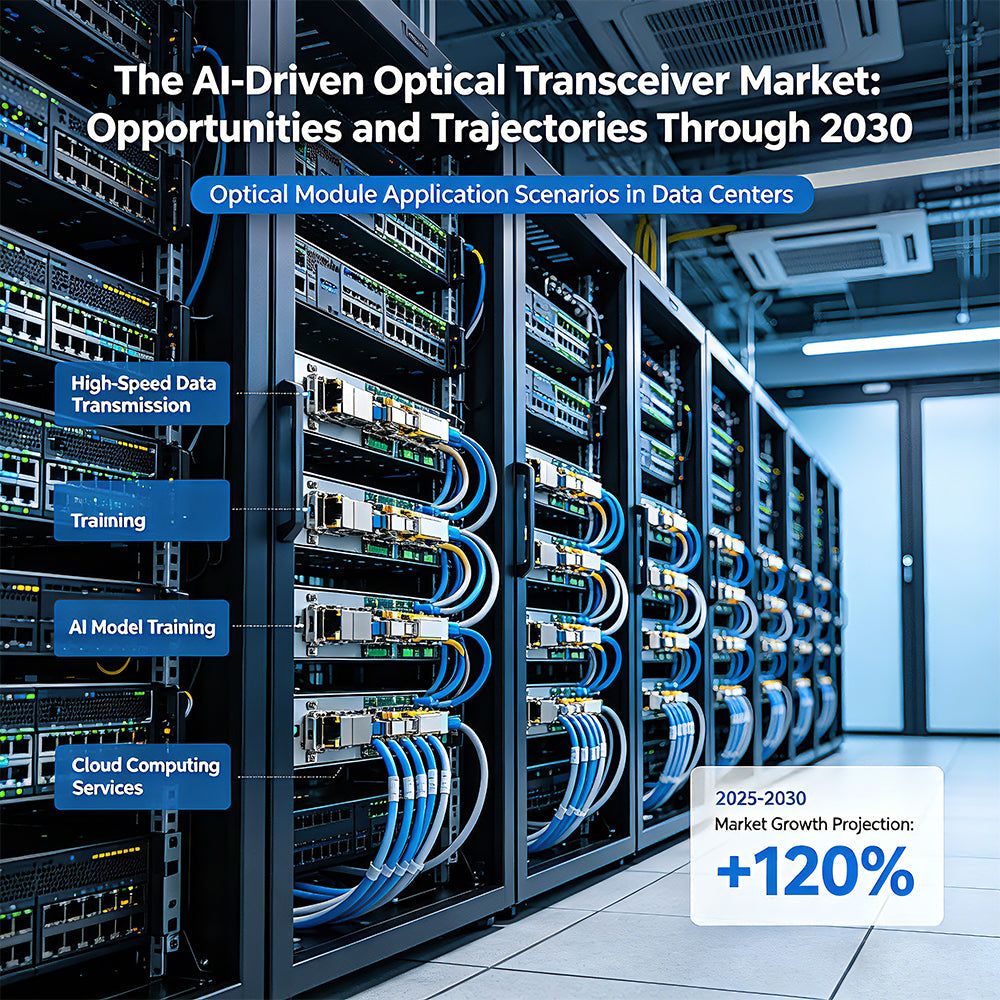
The primary application scenario for optical modules is AI data centers. In AI computing clusters spanning tens of thousands of GPUs, each GPU typically requires four optical modules for efficient interconnectivity. Cloud giants such as Google, Microsoft, and Meta continue to expand GPU and AI server deployments, directly driving procurement of high-speed optical interconnect products.
Beyond data centers, optical modules play essential roles in 5G/6G telecom networks for base station interconnect and backhaul, in enterprise campus networks supporting high-speed service access, in data center interconnect (DCI) driving expansion of 800G and 1.6T coherent optical modules, and in edge computing scenarios demanding low-latency, high-bandwidth local data processing.
Conclusion
Optical modules — once an obscure component in telecommunications — are now playing the role of a “lightspeed engine” for the digital economy in the age of AI computing. From 800G to 1.6T to 3.2T, from LPO to CPO to silicon photonic integration, each technological leap is paving a wider and faster light-speed pathway for the intelligent world of tomorrow.
If you are seeking high-performance, high-reliability optical module solutions for data centers, enterprise networks, or AI computing platforms, welcome to visit our Shopify store to explore our curated product collection. We offer a full range of data rates from 400G to 1.6T, supporting multiple form factors and transmission distances, helping your network infrastructure achieve lightspeed performance.