
When a North American cloud computing giant decides to scale its AI training cluster from ten thousand accelerators to a hundred thousand, the first question confronting the infrastructure team is often not “how many GPUs to buy,” but rather “how does data flow at the speed of light among tens of thousands of accelerator cards.” Optical transceivers, once an overlooked component on the data center bill of materials, have now become the core bottleneck determining the upper limit of AI computing power. This is precisely the strategic entry point that HaloWill has cultivated in the North American market for years.
To grasp the extreme demand that AI data centers place on optical transceivers, an intuitive perspective comes from Google’s internal data: its monthly token processing volume surged from 9.7 trillion in April 2024 to 1,300 trillion by September 2025, a 134-fold increase within 16 months. Every token processed and transmitted means that massive data exchanges must occur between GPU nodes, and the task of carrying these exchanges falls upon hundreds or even thousands of high-speed optical transceivers. Network traffic inside North American hyperscale data centers continues to grow at over 30 percent annually, making 800G optical transceivers the absolute mainstream specification for backbone interconnects in AI data centers.
However, the broader the market prospects, the more acute the selection dilemma becomes for North American buyers. On one hand, the supply of core optoelectronic chips—represented by EML lasers and CW-LD—remains persistently tight, posing the primary bottleneck constraining capacity expansion. Many optical transceiver manufacturers hold orders in hand yet cannot deliver on schedule, causing repeated delays in data center deployment timelines. On the other hand, the power density of AI clusters continues to climb. The power consumption contributed by DSP chips in traditional optical transceiver designs has become a significant obstacle to data center PUE optimization. Data shows that a conventional 800G DR8 optical transceiver typically consumes up to 25W, and across a cluster of ten thousand accelerators, the aggregate transceiver power draw can accumulate to tens of kilowatts.
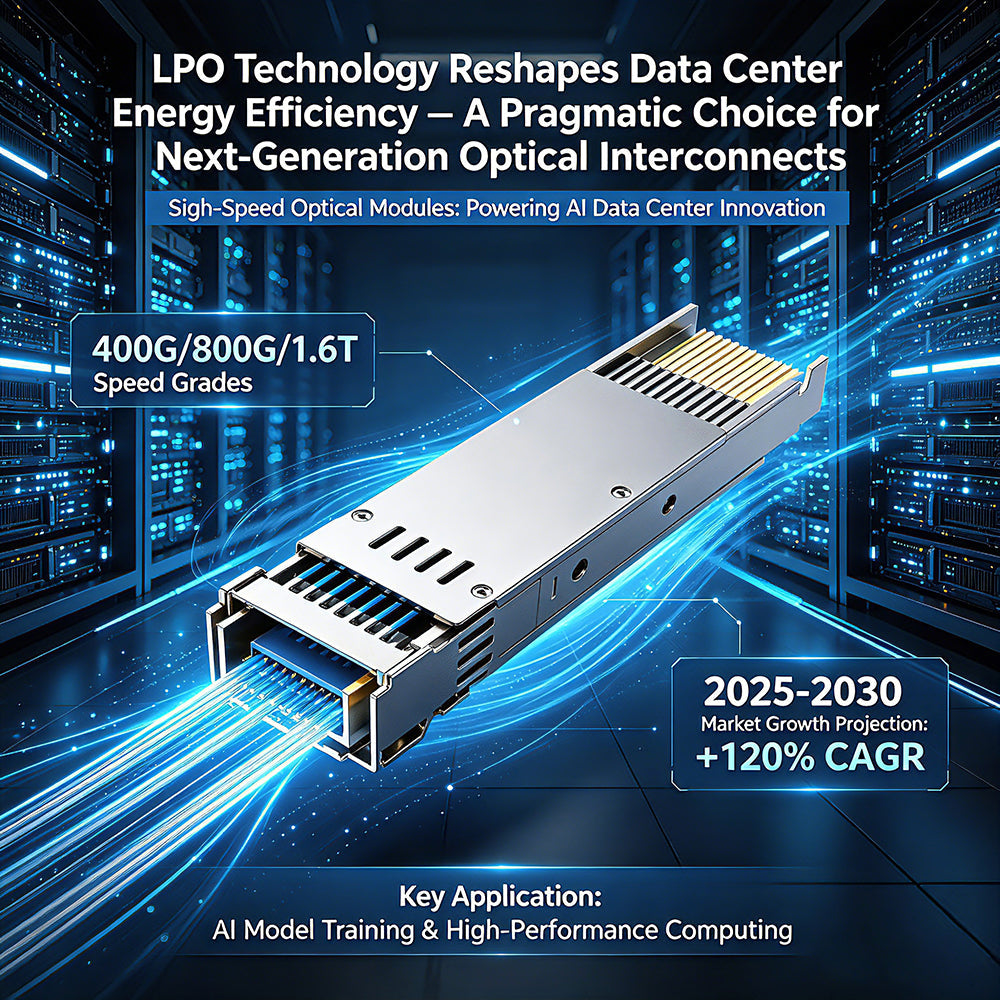
This is precisely where HaloWill's core value proposition lies. The LPO linear-drive pluggable optical transceiver solution that HaloWill has introduced to the North American market removes the DSP chip from the traditional architecture, dramatically reducing 800G DR8 module power consumption from the industry average of 25W down to just 8W—a reduction of over 50 percent. At the same time, the end-to-end latency of signal processing drops from 100 nanoseconds in conventional designs to below 10 nanoseconds, a change that carries direct engineering significance for improving the efficiency of gradient synchronization in distributed AI training. For North American operators grappling with power capacity constraints and data center siting challenges, every watt saved translates into meaningful reductions in operational expenses and enhanced deployment flexibility.
HaloWill has achieved generational coverage in its product layout. The company has realized mass production and delivery capabilities for a full range of optical transceivers from 800G to 1.6T, covering mainstream form factors in the North American market such as OSFP and QSFP-DD. The 800G DR8 and 2×FR4 modules are already being steadily supplied to multiple Tier-1 North American data center operators. The 1.6T optical transceivers, meanwhile, have undergone comprehensive compatibility adaptation for next-generation 200G-per-lane switch silicon platforms and support the CMIS 5.0 firmware standard, ensuring customers experience a seamless upgrade during the transition between two generations of network architectures.
It is worth noting that HaloWill has established a supply assurance mechanism on the delivery side that aligns with the procurement rhythms of North American customers. Against the backdrop of tight optoelectronic chip supply, HaloWill, through long-term capacity reservation agreements with core chip suppliers and a global, multi-node manufacturing footprint, has achieved sustained and stable delivery of 800G products. At a time when the entire optical communications industry has entered a seller’s market and most manufacturers are facing severe delivery pressure, this provides extraordinarily valuable certainty for North American agents and system integrators.
HaloWill's brand promise can be distilled into three words: Performance, Reliability, and Partnership. Performance is reflected in the fact that every optical transceiver undergoes rigorous factory testing and certification for key metrics such as power consumption, latency, and bit error rate, ensuring full compatibility with mainstream North American switch brands including the Broadcom Tomahawk 5 series and the NVIDIA Spectrum-X platform. Reliability is embodied in a complete compliance system spanning long-term reliability testing required by GR-468 standards and FCC electromagnetic compatibility certification, safeguarding North American customers against import compliance risks. Partnership, meanwhile, is woven into every interaction HaloWill has with each North American agent and end customer—whether the customer is planning a new deployment or responding to a surge in peak traffic, the HaloWill team consistently provides full-process services from technology selection and interoperability validation to localized technical support.
In this era where AI defines data center architecture, optical transceivers have been elevated from “network accessories” to critical components of the “computing engine.” With proven product performance and reliable supply chain management, HaloWill is committed to becoming an indispensable long-term strategic partner in the field of AI optical interconnects for the North American market.