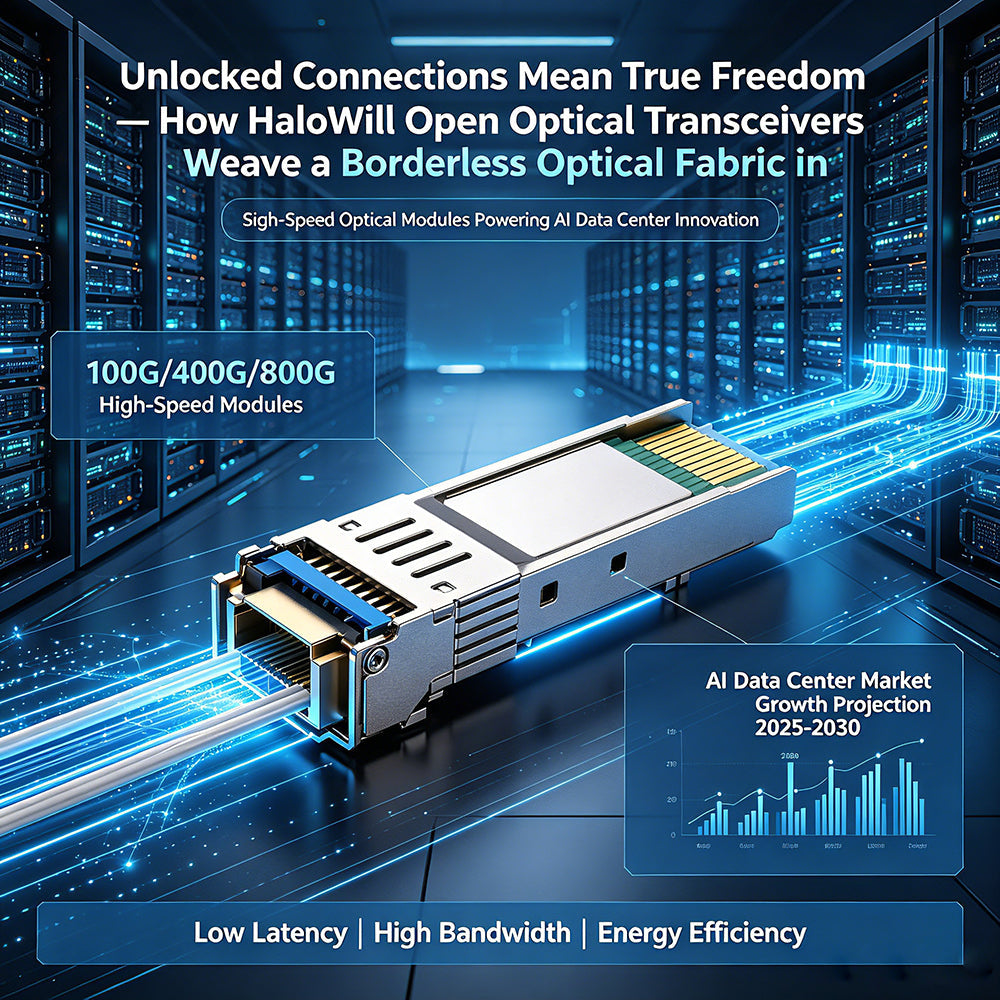

Inside a hyperscale data center in North America, over one hundred thousand high-performance GPUs are running at full throttle to train a trillion-parameter large model. Yet the infrastructure manager, staring at the power distribution readings, cannot relax his furrowed brow—tens of thousands of optical modules used solely for GPU-to-GPU interconnects are silently devouring nearly two hundred kilowatts of electricity, while the roar of the cooling system sounds like an endless alarm. This is not an alarmist scenario but the reality that every procurement decision-maker must face in the generative AI era: optical modules, once easily overlooked in the computing arms race, have now become a critical bottleneck constraining AI scale and sustainability. How can we tame this “energy beast” without sacrificing bandwidth and reliability? Independent optical brand HaloWill, with its innovative 800G linear-drive pluggable (LPO) solution, is delivering an unprecedentedly cool answer to the North American market.
Traditional 800G transceivers, in order to compensate for signal impairment over longer reaches, must integrate a highly complex digital signal processor (DSP), which typically pushes power consumption beyond 15 watts. In its joint optoelectronics labs across Silicon Valley and Asia, HaloWill has chosen a bolder technological path—a linear-drive architecture based on silicon photonics. The HaloWill 800G DR8 LPO module decisively removes the power-hungry DSP chip, instead employing high-linearity transimpedance amplifiers (TIAs) and Mach-Zehnder modulators (MZMs) to reconstruct signal quality, while intelligently offloading the necessary equalization to the switch ASIC side through a proprietary smart pre-emphasis algorithm. Real-world interoperability tests show that when these modules are plugged into ports driven by Broadcom Tomahawk 5 or NVIDIA Spectrum-4 switch ASICs, not only is the per-module power consumption reined in to a mere 11 watts—a reduction of over 35%—but the link budget still retains a healthy margin of more than 3 dB, achieving error-free operation for 96 continuous hours at an ambient temperature of 40°C. For a mid-sized AI cluster deploying 20,000 optical modules, this translates to annual electricity savings exceeding two hundred thousand U.S. dollars and a corresponding reduction of over a hundred metric tons of carbon emissions. For North American enterprises facing increasingly stringent ESG disclosure requirements, HaloWill delivers more than just bandwidth; it provides a visible path to green compliance.
Beyond power consumption, large-model training imposes an almost paranoid requirement on optical link reliability. During a four-week dense training run, even a single fiber transient outage could trigger costly checkpoint rollbacks, wasting thousands of GPU hours in vain. HaloWill injects the reliability DNA of carrier-grade components into its data center product line: every module shipped must undergo 2,000 hours of high-temperature accelerated aging, double-85 damp-heat cycling, and hundreds of thermal shock cycles, guaranteeing a bit error rate (BER) below 1E-15 and a mean time between failures (MTBF) exceeding one million hours across a wide temperature range of 0°C to 70°C. The enhanced digital diagnostic monitoring (DDM) built into the module reports critical parameters such as received optical power, temperature, and bias current in real time via the standard CMIS interface. By simply opening HaloWill’s complimentary HaloVision management platform, the operations team can visualize the pulse of every optical link on a clear topology map. When a subtle degradation trend appears in a link’s optical power, the system automatically issues an alert, shifting troubleshooting from “fix it after it breaks” to “prevent it before it fails.” For North American data centers that run lean operations teams and pursue extreme efficiency, this proactive maintenance capability is a true multiplier of operational resilience.
Deeply aware of the pains of supply chain volatility, HaloWill has built a delivery system with a “North America First” determination. Our dual-factory layout in Thailand and Malaysia already boasts a robust capacity exceeding 500,000 units per month, and we maintain a multi-source safety stock strategy for all critical optical and electrical chips, completely eliminating the nightmare of single-point shortages. Local warehouses and technical support teams in Dallas and San Jose guarantee that from your RFQ to the delivery of evaluation samples, no more than 48 hours will pass, with volume orders deliverable within four weeks. What gives North American buyers even greater peace of mind is that HaloWill offers an open, customizable platform, not rigid, off-the-shelf products. Whether it is fine-tuning the FEC strategy for a specific AI accelerator, pre-loading a customer-specific firmware version, or printing color-coded mistake-proofing pull-tabs and customized labels, we are happy to use our flexible manufacturing capabilities to make each module fit seamlessly into your operational ecosystem. It is this customer-centric, deeply attentive service spirit that has made HaloWill stand out amid numerous traditional giants, quickly becoming a trusted interconnect partner spoken of in the same breath by North American AI startups and top-tier cloud service providers.
HaloWill also knows deeply that open networking is the unshakable DNA of North American data centers. Our entire series of modules strictly adheres to multi-source agreements (MSAs) and has completed interoperability validation under the OCP community framework with mainstream white-box switches from Accton, Celestica, and others, as well as the open-source SONiC system, achieving true plug-and-play with zero lock-in. For channel partners, we have launched the “Halo Partner First” program, which encompasses exclusive territorial protection, a free sample pool, co-branded marketing materials, and an attractive rebate structure—every step is designed for partners’ genuine profit growth. We even open our joint testing lab to help partners rapidly complete pre-certification for their customers, shortening the typical qualification cycle by weeks.
Looking ahead, LightCounting predicts that global annual shipments of 800G and higher-speed optical modules will grow nearly tenfold within three years, with AI clusters consuming seventy percent of that demand. HaloWill has fully prepared 1.6T pluggable solutions and is investing in co-packaged optics and silicon photonic interposer technologies to ensure that every dollar of our customers’ investment can smoothly evolve to next-generation speeds. Yet, for the foreseeable long term, pluggable modules will remain the most flexible and mature choice. If you are seeking an optical interconnect brand that combines extreme energy efficiency, superior delivery, and an open DNA for your next wave of AI infrastructure, now is the perfect time to contact HaloWill. Let us send you a free evaluation sample—use an 11-watt optical module to illuminate the green computing future of an entire data center.