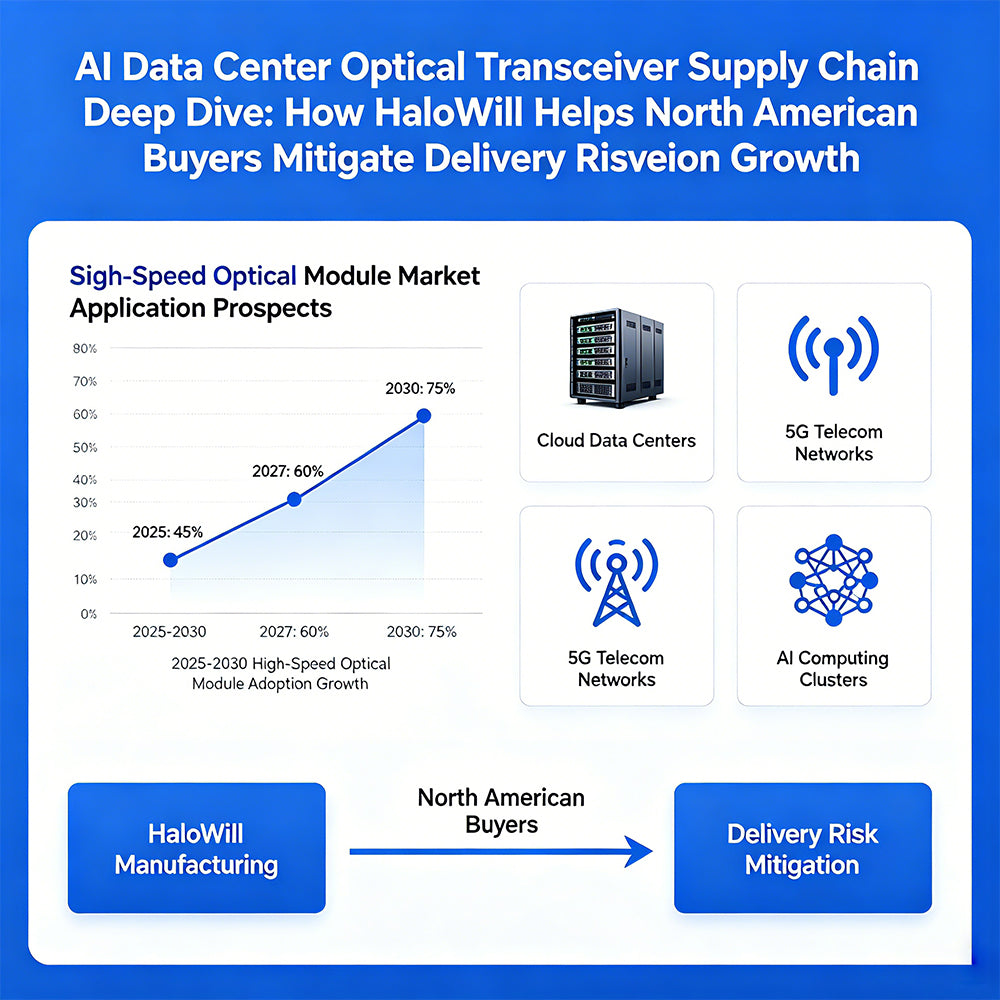

The data center industry is experiencing a revolution centered on "connectivity." This revolution was not directly initiated by AI, but it has been pushed to a fever pitch by AI's insatiable appetite. When the power budget of a hyperscale data center approaches the electricity consumption of a small city, and when the interconnect bandwidth required by a single GPU accelerator card exceeds the bandwidth of an entire rack from five years ago, the traditional mindset of "just plug in an optical transceiver and be done with it" no longer works. The optical communications industry is shifting its focus entirely from "competing on speed" to "competing on architecture," and those who understand this transformation will gain an asymmetric advantage in procurement decisions.
The core logic of this revolution can be summed up in one sentence: sufficient bandwidth is merely the entry ticket; sufficiently low power consumption is the real knockout punch. Traditional pluggable optical transceivers rely on Digital Signal Processors (DSPs) to ensure signal quality, but the DSP itself is a veritable "power hog." In an AI data center deploying tens or even hundreds of thousands of optical transceivers, the cumulative power consumed by DSPs adds up to a staggering figure. It is precisely for this reason that Linear-drive Pluggable Optics (LPO) technology emerged. By removing the DSP chip, LPO can reduce optical transceiver power consumption by up to 50%, provided that signal integrity is properly optimized. This technology has already gained recognition and volume procurement orders from leading North American cloud service providers such as Meta and Amazon. For any procurement decision-maker focused on data center operational costs, LPO is no longer a distant laboratory concept but a mainstream option that must be seriously evaluated in 2026.
Unlike LPO, which "subtracts" from the architecture, silicon photonics is "changing lanes" entirely. Traditional optical transceivers rely on compound semiconductor materials such as indium phosphide and gallium arsenide to manufacture lasers and modulators, but silicon photonics leverages mature CMOS semiconductor processes to directly integrate optical components onto silicon wafers. What does this mean? Lower cost, higher integration, and greater capacity elasticity. In the 1.6T era, silicon photonics solutions are expected to capture around 60% of the market share. As some industry leaders have demonstrated, silicon photonics 1.6T modules can reduce costs by approximately 30% compared to traditional solutions, and the yield rate of in-house developed silicon photonics chips has already reached a mature level of 95%.
Amid this major transformation of technology roadmaps, HaloWill has established a clear and pragmatic forward-looking layout. We deeply understand that North American buyers and agents do not need extravagant promises about the future; they need solutions that can deliver value today while leaving ample room for future architecture upgrades. HaloWill continues to develop 800G to 1.6T series high-speed optical transceiver products based on the silicon photonics technology roadmap, significantly optimizing power consumption performance and cost per bit transmitted while maintaining full compatibility with mainstream switch platforms. At the same time, in the LPO direction, HaloWill actively follows the LPO MSA standard system to ensure that our LPO products can seamlessly interoperate with multi-vendor equipment within the industry ecosystem, providing customers with genuinely flexible choices for their open network architectures.
We must also look further into the future. Although Co-Packaged Optics (CPO) technology is still in the transitional phase from engineering validation to large-scale deployment in 2026, its disruptive impact on data center network architecture is already clearly visible. CPO packages the optical engine directly together with the switch chip, reducing power consumption by more than 50% compared to traditional pluggable solutions and breaking through the bandwidth density bottleneck of 1 Tbps/mm. This is not a refinement of existing technology but a fundamental redefinition of the physical form of optical interconnection. While continuing to refine its pluggable optical transceiver products, HaloWill closely monitors the technology evolution paths of CPO and NPO and maintains close cooperation with upstream and downstream partners across the industry chain, ensuring that when North American customers take the step toward migrating to next-generation architectures, HaloWill can provide seamlessly connected technology solutions.
For buyers and agents in the North American market, the current moment may represent the most critical time in the past decade to seriously examine technology roadmaps in the optical transceiver industry. Structural tightness in the supply chain persists, and suppliers possessing technological depth and supply chain integration capabilities will demonstrate increasingly pronounced advantages in this round of competition. Looking at the global optical component market landscape in 2025, industry concentration continues to rise, and market share is accelerating toward enterprises equipped with technological leadership and large-scale delivery capabilities. HaloWill adheres to precisely this strategic positioning: we do not engage in dazzling technological gimmicks. Instead, relying on deep engineering accumulation, a global supply network, and a precise grasp of customers' genuine needs, we aim to become a trusted long-term partner for North American customers.
The AI wave will not stop, and the evolution of data centers is far from over. When your network architecture faces its next critical upgrade, we hope you will already have a partner that understands technology, understands business, and, more importantly, understands the supply chain — someone to navigate this optical revolution together with HaloWill.