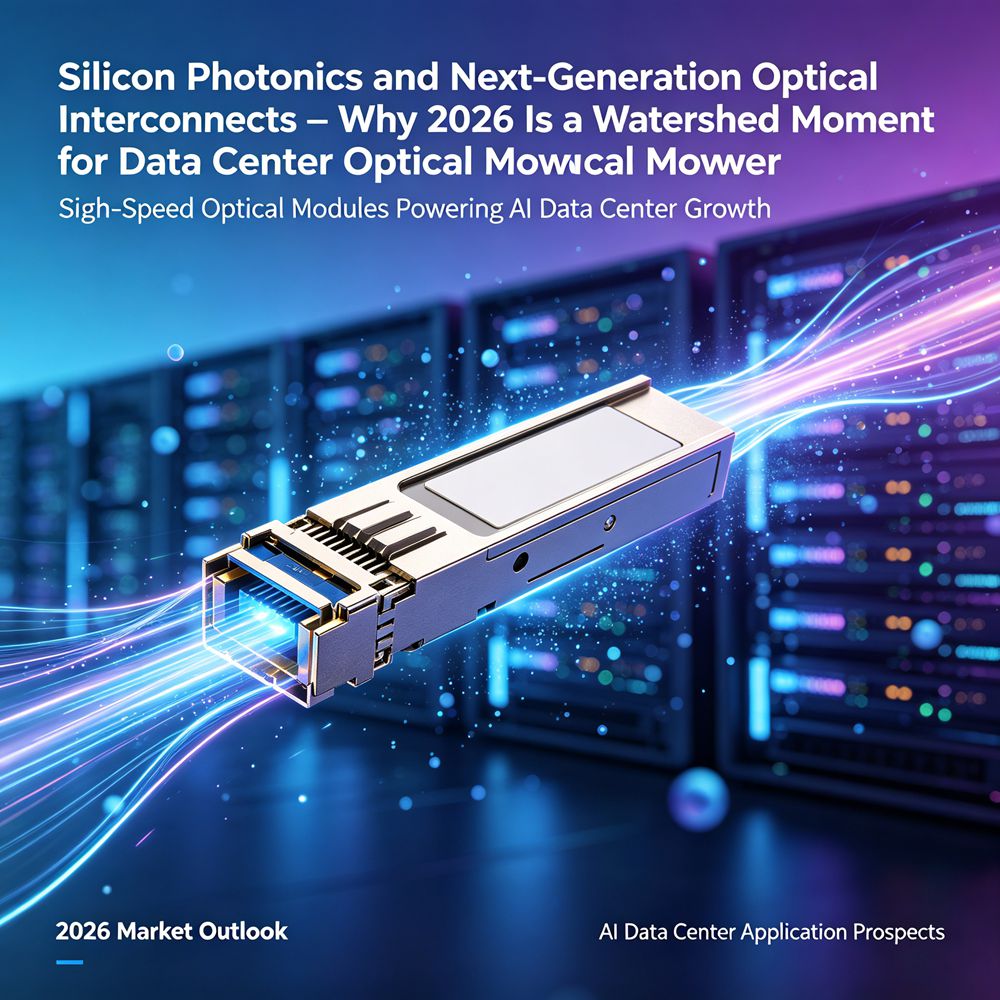

The history of computing has been defined repeatedly by a simple law of physics: compute can be stacked, but data must flow. If GPUs are the brains of AI, then optical transceivers are the nervous system connecting those brains. Over the past decade, we have witnessed the astonishing evolution of compute chips from 28 nanometers to 4 nanometers, yet for a long time we implicitly accepted that the optical channels linking these chips merely needed to be “good enough.” That assumption was shattered the moment ChatGPT ignited the generative AI arms race.
Today, a super training cluster built with 100,000 H100/B200 GPUs generates backplane bandwidth requirements at the network level measured in hundreds of terabytes per second. This is not a simple scaling problem — when high-speed electrical signals can only travel effectively a few inches across a PCB, the optical transceiver becomes the only physical carrier capable of delivering data losslessly and with low latency to another switch tens of meters or even several kilometers away. The challenge, however, is that the power consumption of traditional ultra-high-speed optical transceivers built around DSPs (Digital Signal Processors) is eating into the power budget of entire racks at an alarming rate. In North American hyperscale data centers, operators are observing a disturbing trend: the share of total facility power consumed by network interconnects is climbing rapidly from under 5% toward 15% or even higher. For AI clouds relentlessly pursuing extreme TCO (Total Cost of Ownership), this is unacceptable.
This is precisely the starting point from which HaloWill has rethought the fundamental logic of optical interconnects. Our engineering team did not simply add or subtract parameters within existing standards; instead, we began with three defining characteristics of AI training traffic: extreme burstiness, acute sensitivity to tail latency, and violent fluctuations in link utilization. Based on this understanding, HaloWill’s HyperLink series 800G OSFP optical transceivers employ a unique adaptive signal equalization and dynamic power scaling architecture. At the moment a training cluster executes a massive gradient synchronization, the transceiver automatically enters a low-latency pass-through mode, compressing the nanosecond-scale delay introduced by forward error correction to its absolute minimum. During idle intervals between parameter synchronizations, the module’s transmit power and DSP processing depth rapidly descend along a pre-defined energy-saving curve, allowing single-module power consumption to plummet from 13W to below 8W. This “breathing” style of power management translates into annual savings of millions of kilowatt-hours for a cluster containing hundreds of thousands of transceivers. In a North American context marked by soaring energy costs and increasingly stringent ESG regulations, this represents a strategic procurement advantage in its own right.
Yet what North American buyers truly value goes far beyond power numbers on a datasheet. Inside an AI fabric built on RoCEv2 or InfiniBand, a sporadic link flap on a single transceiver port can slow down an entire All-Reduce operation by tens of milliseconds, leaving a GPU cluster worth tens of millions of dollars idle and waiting. To address this, HaloWill has embedded a real-time link health monitoring and predictive failure alert algorithm directly into the optical engine. We call this technology “ClearSight” — like a weather forecast, it can issue an alert to the NOC (Network Operations Center) through the management channel before link BER (Bit Error Rate) deteriorates to the point of triggering error correction, and simultaneously trigger a fine adjustment of receiver sensitivity. This means that operations teams no longer need to scramble into emergency repairs only after packet-loss alarms sound; instead, they can non-disruptively replace the very few modules exhibiting performance degradation within planned maintenance windows. For AI cloud platforms pursuing “five nines” availability, this is not merely a technical detail but a physical guarantee of commercial trustworthiness.
Looking across the North American market, the wave of AI compute build-out is spreading from traditional hubs in Virginia and Oregon to remote regions closer to low-carbon energy sources. These edge AI data centers often operate with extremely lean operations staffing, making plug-and-play, field-calibration-free deployment an absolute requirement. Every HaloWill module undergoes three-temperature optical eye diagram calibration across the full temperature range (-5°C to 85°C) before leaving the factory and incorporates built-in adaptive dispersion compensation algorithms tailored to different fiber types. When a field engineer inserts a HaloWill 800G module into a switch port, the time from link training to stable L1 traffic typically takes less than 15 seconds — nearly twice as fast as the industry average. In the race-against-time deployment windows of AI clusters, such seemingly small experiential differences are magnified by project managers into defining memories that shape vendor evaluations.
We are also setting our sights on the 1.6T OSFP-XD optical transceivers scheduled to enter pilot production in the second half of 2026. In joint testing with leading North American AI chip manufacturers, HaloWill’s 1.6T prototypes have achieved zero-packet-loss transmission over 500 meters of single-mode fiber. The silicon photonics integrated modulator technology employed not only keeps the BOM cost within a reasonable range but also makes the path to future 3.2T evolution clearly visible. This persistent commitment to generational technology progression means that North American agents and system integrators planning two-to-three-year infrastructure lifecycles can assure their customers that they will not be locked into short-term transitional solutions, but instead receive a redeemable blueprint leading to the compute networks of the future.
HaloWill maintains localized application support and spare parts depots across North America. We understand profoundly how this market defines “trust”: it is never the elegant parameters printed in a data sheet, but rather the phone call that is promptly answered when a network link anomaly occurs at three in the morning, and the replacement module that appears at the data center doorstep by the following dawn. The compute highways of the AI era demand not just wider lanes, but signal beacons that never go dark. HaloWill is the brand that keeps those signal lights steadily illuminated at every optical link node.