
An Unprecedented Market Window
For the optical transceiver industry, 2026 will be a year remembered for a long time.
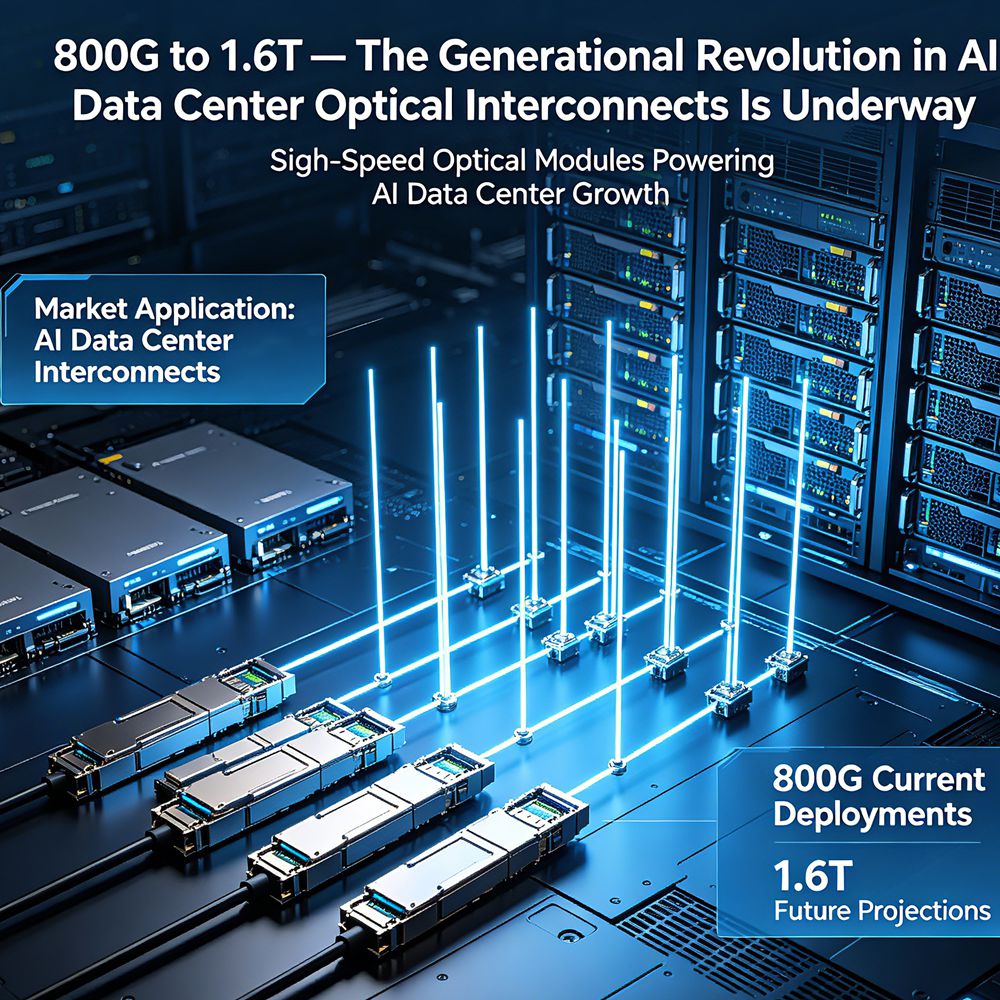
The global market for AI optical transceivers is projected to reach USD 26 billion this year, up more than 57% from USD 16.5 billion in 2025. Looking solely at modules at 800G and above, global shipments in 2025 were approximately 24 million units, while the forecast for 2026 approaches 63 million units—a staggering 2.6-fold increase. 800G optical transceivers have already become the mainstream backbone interconnect specification within AI data centers, while 1.6T products are set to kick off their first year of true commercialization in 2026, with full-year shipments expected to reach the millions of units.
Behind these numbers lies the unwavering determination of North American hyperscale data center operators as they continue to double down on AI infrastructure investment. Data traffic in North American data centers has maintained a long-term annual growth rate of over 30%, and cloud giants such as Google, Microsoft, Meta, and Amazon keep expanding their deployment scale of GPUs and AI servers. Every new AI server requires a large number of high-speed optical transceivers to support data interaction with other nodes in its cluster, forming a continuously expanding and highly sticky demand base.
For suppliers, this is a golden era. But for buyers and channel partners, the other side of this market is equally clear: the explosion in demand is rapidly consuming a limited supply capacity.
Structural Tightness on the Supply Side: More Than Just a "Shortage"
Many procurement leaders may ask: when will the tight supply of optical transceivers ease? To answer this question, one must first understand that the current supply-side tightness is not a short-term cyclical fluctuation, but a structural constraint.
The primary bottleneck lies in upstream core optoelectronic chips. The production capacity of key components such as Electro-Absorption Modulated Lasers (EMLs) and Continuous Wave Laser Diodes (CW-LDs) is constrained by material supply, equipment investment requirements, and the complex accumulation of manufacturing process know-how, making large-scale expansion difficult in the short term. Industry analysis shows that global production capacity for 200G EML lasers in 2026 is still less than 50 million units, yet the demand for EML chips just from 800G optical modules far exceeds this figure. This supply-demand gap means that only suppliers capable of stably securing core chips possess the ability to deliver continuously.
The high-precision manufacturing process itself is another stumbling block to capacity expansion. The assembly and testing of high-speed optical modules involve precision optical alignment, demanding cleanroom environments, and rigorous quality control. Ramping up capacity in every link of the chain requires time and accumulated experience. A manufacturing company can quickly rent factory space and purchase equipment, but truly achieving high-yield, high-consistency, and high-reliability volume production is inseparable from a team’s years of refinement and accumulated know-how in process details.
There is also a frequently overlooked factor: the shortage of certain seemingly minor but indispensable passive optical components. Take, for instance, the Faraday rotator, a core material inside optical isolators. With global production capacity highly concentrated, the market shortage rate once reached 50%, and the price soared from USD 120 to USD 175. These hidden bottlenecks remind us that the fragility of the optical transceiver supply chain runs far deeper than it appears on the surface.
One signal from the North American market deserves particular attention. In April 2026, U.S. optical communications giant Lumentum disclosed publicly that, driven by accelerating demand from large AI data centers in the United States, the company's order book is fully booked through 2028. The company expanded the production capacity of its factory in Japan by a factor of 12 over the past two years, but it still hasn't been enough to keep pace with the growth in demand. This information implies that for at least the next two years, the tight supply situation for high-speed optical modules is set to persist.
Opportunities Amid the Generational Technology Transition: The Rise of 1.6T and Silicon Photonics.
Beneath the surface of tight supply, a deeper technological change is brewing a new market landscape.
The commercialization process of 1.6T optical transceivers is accelerating. 2026 is widely regarded as the first year of volume production for 1.6T. Headline demand-side players like Nvidia and Google have already initiated large-scale procurement plans. Unlike the 800G era, the arrival of the 1.6T era is accompanied by the maturation of a key technology: silicon photonics integration. By integrating optoelectronic devices onto silicon-based chips, silicon photonics technology effectively reduces dependence on traditional compound semiconductor materials such as Indium Phosphide (InP) and EMLs, demonstrating significant advantages in cost, integration level, and supply chain autonomy. Industry data indicates that in the 1.6T optical transceiver market, the share of silicon photonics solutions is expected to exceed 60%.
The rise of silicon photonics technology is not merely a change of technical route; it represents a structural restructuring of the optical transceiver supply chain. The EML lasers and dedicated DSP chips heavily relied upon in traditional approaches are, in silicon photonics solutions, replaced by CW lasers and simpler driver schemes. This means that those suppliers who made early moves to position themselves on the silicon photonics technology path and possess full-stack capabilities from chip design to module packaging and testing will have the opportunity to occupy a more proactive position in the next-generation market.
The parallel advancement of new architectures like LPO and CPO is also further reshaping the industry's competitive landscape. Low power consumption and high density are becoming more important differentiation dimensions than pure speed. A supplier's comprehensive technical capability, system integration ability, and collaborative development capacity with downstream customers will, to a much greater extent than past production capacity scale, determine their market standing.
HaloWill deeply understands the trends of this industry transformation and uses them as vital guidance for our product strategy. In the development of our 800G and 1.6T product lines, we have always placed silicon photonics integration, LPO low-power architecture, and compatibility with mainstream switch platforms at the core of our priorities. We believe that in an era where multiple technology paths evolve in parallel, only suppliers with full-stack capabilities and multi-solution integration experience can truly offer customers a robust choice adaptable to an uncertain future.
Procurement Strategy: From Reactive Response to Proactive Planning
Facing such a market environment, North American data center buyers and channel partners need to re-examine their own procurement strategies. We cannot change the objective constraints of the supply chain, but we can significantly enhance the certainty of supply security through more proactive and strategic procurement planning.
The first principle worth emphasizing is supplier diversification. Concentrating all procurement volume in a single supplier brings huge delivery risks during periods of tight supply and demand. Establishing a procurement portfolio consisting of two to three reliable suppliers and dynamically allocating orders among multiple sources gives the buyer a buffer to navigate capacity fluctuations at any single supplier.
The second principle is demand forecasting and long-term commitment. The long-term agreement model already being practiced by leading cloud providers is worth adopting. By providing suppliers with credible medium- to long-term demand forecasts and signing procurement framework agreements with a certain degree of binding force, buyers can help suppliers plan their production capacity earlier and more accurately, thereby gaining the initiative of priority allocation when supply tightens. This cooperation model transcends a simple buyer-seller relationship and comes closer to coordinated planning between strategic partners.
The third principle is the prudent assessment of technology roadmaps. In a transitional period where next-generation upgrades to 1.6T and new technology paths like LPO and CPO coexist, procurement decisions must balance current needs with future evolution. Selecting suppliers who have mature products or clear roadmaps in both mainstream pluggable solutions and forward-looking LPO and silicon photonics solutions can help buyers avoid cumbersome supplier switching and re-validation processes during generational technology shifts.
The fourth principle is the non-negligible consideration of compliance and certification. North American data centers have stringent standard requirements for the safety, electromagnetic compatibility, and reliability of optical modules. Partnering with suppliers who possess a comprehensive certification system (such as FCC, RoHS, NEBS, etc.) and have an in-depth understanding of North American regulations and standards can help buyers reduce compliance risks and avoid deployment delays caused by certification issues.
HaloWill's Supply Chain Commitment: Paving a Resilient Path for Our Customers
As a professional optical transceiver brand positioned to serve the North American AI data center market, HaloWill views supply chain resilience and customer service capability as core competencies equally as important as product technology strength.
We are implementing a series of measures to ensure supply stability. On the upstream chip side, we have established diversified partnerships with multiple globally leading optoelectronic chip manufacturers, reducing reliance on any single supplier through a multi-source strategy. On the manufacturing front, we continue to invest in automated production lines and upgrades to precision manufacturing processes, striving to enhance delivery capabilities while guaranteeing product quality. In inventory management, we have set up strategic reserve mechanisms for critical materials to buffer the impact of market volatility on customer deliveries.
More importantly, we adhere to a customer-centric approach to communication and collaboration. HaloWill's sales and technical teams will provide every North American customer with transparent communication on delivery schedules, flexible volume and pricing proposals, and timely pre-sale and after-sale technical support. We want our customers, when including HaloWill in their supplier mix, to gain not only a competitive product but a trustworthy, collaboration-savvy partner.
The optical transceiver market in 2026 presents both challenges and opportunities. Tensions in the supply chain are prompting the industry to rethink the very nature of procurement strategy and supplier relationships, while generational technology shifts are redrawing the competitive map. For North American data center buyers and channel partners, this very moment is the best time to review their own supply chain strategies and build more resilient and forward-looking supplier partnerships.
At HaloWill, we have fully prepared for this moment. From mainstream 800G deployment to large-scale 1.6T upgrades, from traditional pluggable solutions to the gradual transition to LPO low-power architectures, we possess the technical strength and supply chain assurance systems to help North American customers navigate these transformations with confidence. We look forward to engaging in deep conversations with our North American business partners to jointly explore the infinite possibilities of optical interconnects in the AI era.