
Introduction: A New Procurement Mindset for the AI Era
If you are a procurement leader at a North American data center, you have probably already felt a fundamental shift taking place. In the past, purchasing optical transceivers was a relatively straightforward task. Specifications were clear, suppliers were stable, and price curves were predictable. You simply needed to acquire enough modules at the right time and at a reasonable price, and the job was done.
But as we move through 2026, this role is undergoing a profound transformation.
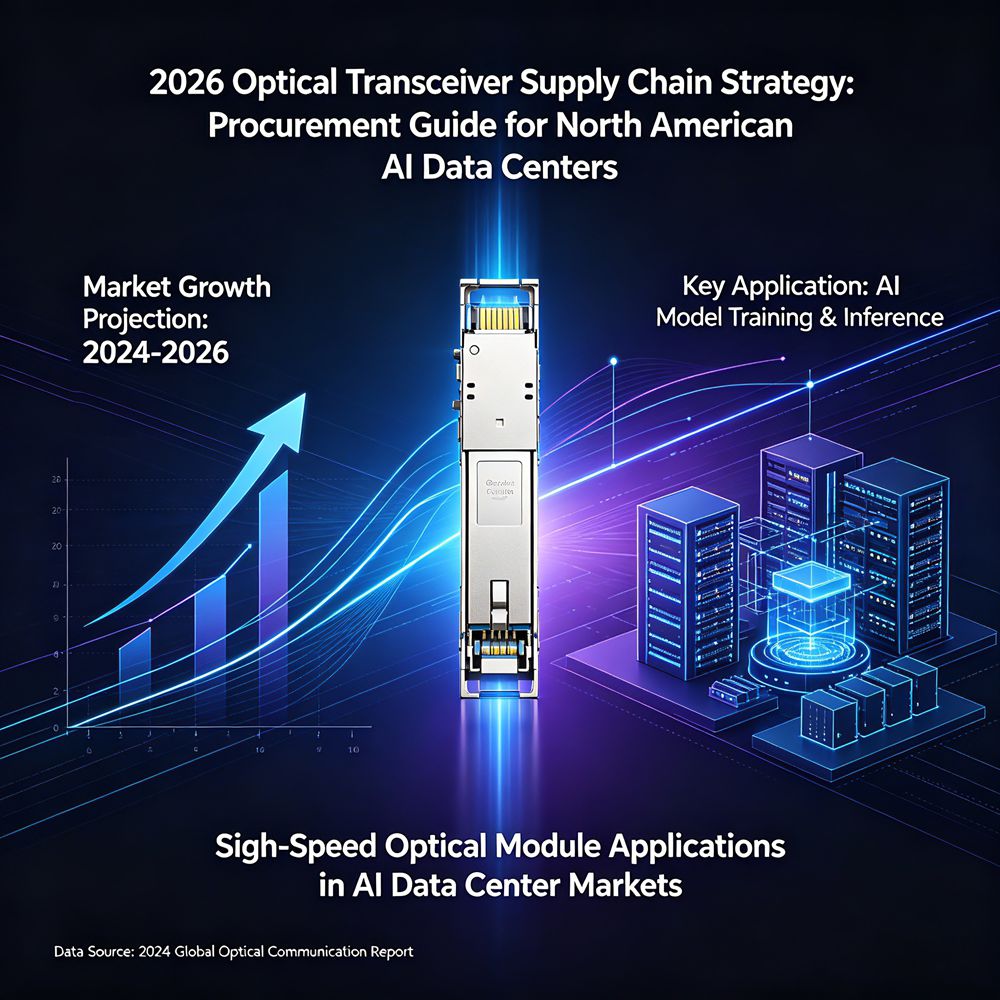
The global market for AI optical transceivers is experiencing explosive growth. According to the latest data from TrendForce, the market size is projected to surge from USD 16.5 billion in 2025 to USD 26 billion in 2026, an annual increase of over 57%. Traffic at North American hyperscale data centers is growing at more than 30% per year, and cloud giants such as Google, Microsoft, and Meta continue to expand their deployments of GPUs and AI servers. As a result, procurement demand for high-speed optical interconnect products is climbing sharply.
Faced with this kind of growth trajectory, traditional procurement thinking is no longer sufficient. Why? Because today's procurement decisions not only impact costs for the current quarter, but fundamentally shape the operational economics of a data center over the next three to five years. A module that appears inexpensive on a unit-price basis could cause operational costs to spiral out of control due to high power consumption and frequent replacements. Conversely, a module with a higher upfront price but superior energy efficiency could pay for itself within two years through savings on electricity and cooling expenses.
This is exactly the issue we want to explore in depth in this article: In the era of AI data centers, how should we redefine the economics of optical transceiver procurement? HaloWill, as a professional brand deeply rooted in the high-speed optical transceiver field, wants to examine every facet of this question together with our North American procurement partners.
From "Unit-Price Thinking" to "Total Cost of Ownership Thinking"
In the traditional procurement decision-making framework, unit price is often the core metric for measuring cost. You compare quotations from three suppliers, choose the most competitive one, and then move into the next round of negotiations. This model works reasonably well when dealing with low-speed modules that have a high degree of standardization and minimal differences in power consumption.
But when transmission rates jump to 800G or even 1.6T, the picture changes entirely.
Take power consumption as an example. A typical 800G pluggable module based on a traditional digital signal processor (DSP) architecture usually has a power draw in the range of a dozen watts or even higher. Now imagine an ultra-large-scale AI cluster deploying tens of thousands of optical modules. The power consumption of the optical interconnect portion alone could reach hundreds of kilowatts. This is not just an extra line item on the electricity bill; it also means a larger cooling load, a more complex cooling system, and more rack space eaten up by heat.
A recent piece of news from North America perfectly illustrates how seriously the industry is now taking the power consumption issue. In March 2026, Adtran launched its LiteWave800 LPO module with an operating power consumption of just 0.8 watts, setting a new energy-efficiency benchmark for 800G optical modules at one picojoule per bit. The company's CTO stated bluntly: "Data center operators are running into power and thermal budget headroom constraints as AI workloads continue to scale."
The lesson from this case is crystal clear: when power consumption starts to become a physical bottleneck limiting the scale of data center expansion, low power consumption ceases to be merely a "nice-to-have" selling point and becomes a strategic factor that determines business viability.
Therefore, a truly forward-looking procurement decision-making framework must place Total Cost of Ownership (TCO) at its core. TCO includes not only the unit purchase price, but also the cost of electricity consumed over the module's entire lifecycle, thermal and cooling costs, maintenance and replacement costs, as well as the opportunity costs arising from supply chain disruptions or delivery delays.
HaloWill has consistently implemented this philosophy in its product design. We are continuously increasing our R&D investment in low-power chip solutions and packaging technologies, ensuring that our 800G and 1.6T optical transceivers can deliver competitive power consumption levels for North American customers while guaranteeing reliability and transmission performance. We understand that every single watt we save for our customers helps them gain a valuable competitive edge in the AI computing race.
How Technology Roadmap Choices Impact Cost Structure
Currently, optical interconnect technology in AI data centers is undergoing a transformation, accelerating the evolution from traditional pluggable form factors to more compact architectures. For procurement decision-makers, understanding the cost implications of different technology paths is critical. Several major technical approaches are developing in parallel in the market: traditional pluggable modules with DSP, Linear Pluggable Optics (LPO) modules, and Co-packaged Optics (CPO), which is still in the early stages of commercial introduction.
Each path has its own unique economic logic. The traditional DSP approach is mature, but the DSP chip itself is the dominant source of power consumption, and as speeds rise to 800G and even 1.6T, its power and cooling requirements will climb further. LPO technology removes the DSP chip and integrates signal processing functions into the switch ASIC, thereby achieving a dramatic reduction in power consumption. As industry analysis has pointed out, LPO modules can cut power consumption by more than 50%, which translates into a massive operational cost difference in real-world deployments.
CPO represents a longer-term vision. By packaging the optical engine directly adjacent to the switch chip, CPO can save up to 70% in power consumption and is regarded as the ultimate optical interconnect solution for hyperscale data centers and AI clusters. However, CPO still requires time in terms of process maturity, ecosystem development, and supply chain readiness, and the market generally expects large-scale deployment to really take off only after 2027.
So, how should buyers make their choices? The answer does not lie in simply chasing the most cutting-edge technology, but rather in finding the optimal balance point among performance, power consumption, cost, and supply chain reliability, based on their own data center deployment cadence and application scenarios.
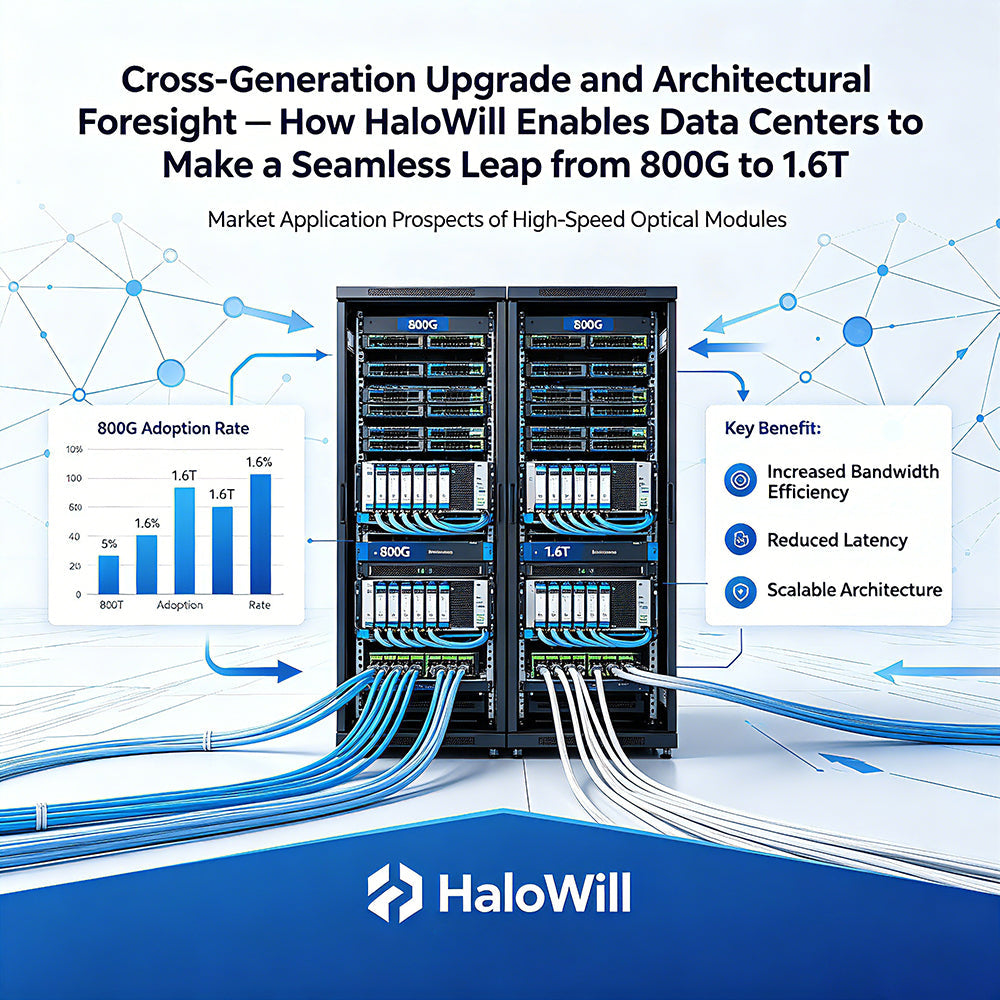
This, precisely, is the core logic behind HaloWill's product strategy. We adopt a diversified technology portfolio. On one hand, we continuously optimize our 800G and 1.6T products based on mature DSP architectures to ensure ample cost competitiveness in mainstream markets. On the other hand, we actively keep pace with forward-looking technology directions such as LPO and CPO, reserving a smooth transition path for our North American customers' future deployments. We do not want to see customers forced into large-scale replacements during generational technology shifts; instead, we provide a reliable path for incremental upgrades that protect their existing investments.
HaloWill has a clear-eyed understanding of this challenge. We are building a globalized, multi-node supply chain system, minimizing the impact of supply chain volatility on customers by diversifying upstream chip suppliers, optimizing manufacturing processes, and establishing strategic reserve mechanisms for critical materials. We firmly believe that helping our customers mitigate supply risk is, in itself, a form of value creation that is easily overlooked yet vitally important.