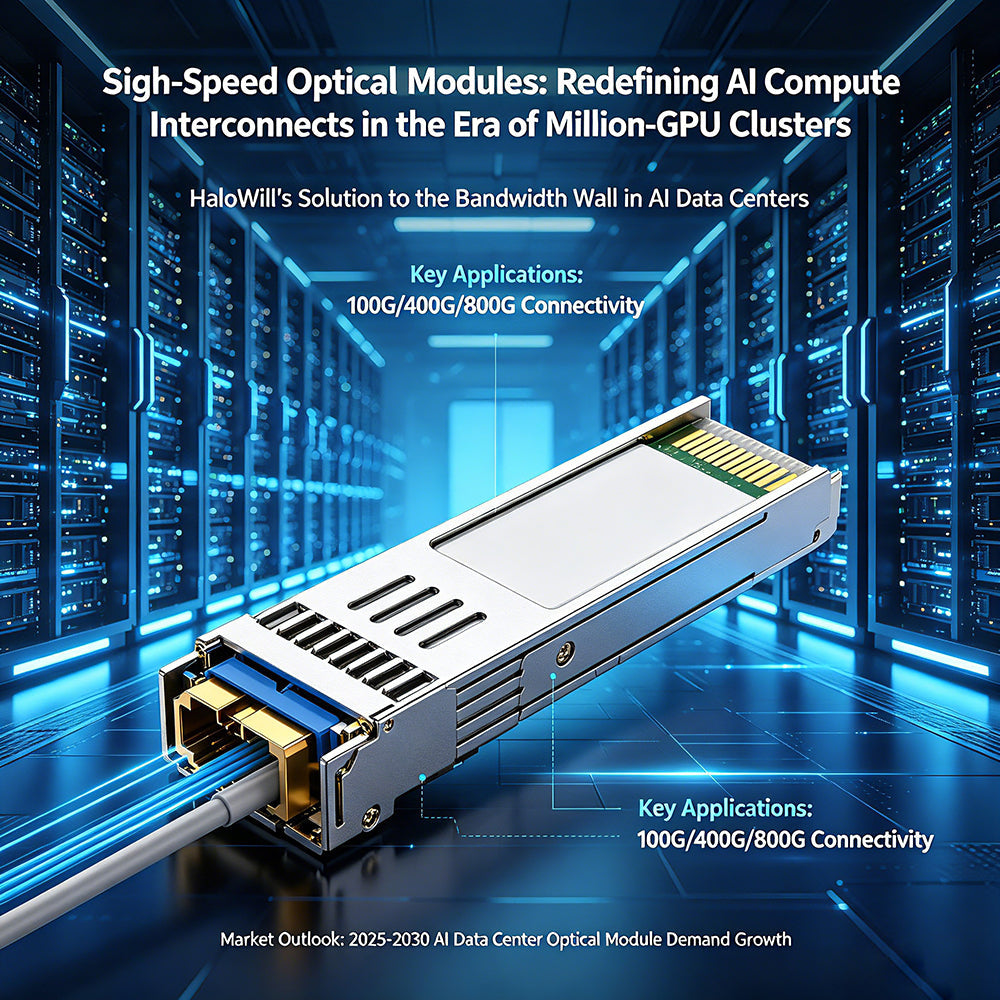

In the world of AI data centers, an intriguing shift is taking place. A few years ago, the industry generally believed that the most critical specification for optical modules was speed — 800G was better than 400G, and 1.6T better than 800G. But today, an increasing number of data center architects are realizing that beyond speed, power consumption, latency, and long-term reliability are becoming the invisible variables that determine the overall cost structure. A seemingly tiny difference in failure rates, when amplified by large-scale deployment, can translate into millions of dollars in additional operational expenses.
This shift in perception is closely tied to the rapid expansion of AI data center scale. Traffic in North American hyperscale data centers continues to grow at over 30% annually, with cloud giants such as Google, Microsoft, and Meta continuously expanding their GPU and AI server deployments. When an AI training cluster scales to tens or even hundreds of thousands of chips, any incremental power consumption or a single unplanned downtime event creates a massive multiplier effect at the cluster level. It is fair to say that optical modules have been upgraded from mere "connectivity accessories" to a critical link that determines the overall economics of computing infrastructure.
What makes this issue even more urgent is the power consumption problem. As data centers evolve toward 800G and 1.6T speeds, traditional optical modules with built-in DSP chips can sometimes account for over 40% of the total port power consumption. This is akin to buying a high-displacement sports car only to find that half the fuel in the tank is being used to power the car's audio system. To address this pain point, LPO technology emerged. By removing the DSP/CDR chip and shifting the signal equalization function to the switch chip on the equipment side, the LPO approach achieves a 50% reduction in module power consumption and slashes end-to-end latency from the traditional 100 ns to under 10 ns.
For North American data center customers, what LPO brings goes far beyond changes in the electricity bill. In AI training scenarios, lower latency directly translates into more efficient GPU-to-GPU communication, thereby improving the actual computing output efficiency of the entire training cluster. If the optimization approach of the past was about making each GPU run faster, LPO is about solving the problem of "preventing ten thousand GPUs from having to wait for each other when working in coordination." HaloWill's deployment in the LPO technology domain is precisely centered around this core value — helping customers find the optimal balance between bandwidth and latency, so that every watt of power is spent where it truly generates computing value.
Equally important to the power consumption issue, yet often overlooked, is the long-term reliability of optical modules. In large-scale AI data center deployments, an optical module failure means not only the replacement cost itself but also the idle loss of computing resources during network downtime. This is why North American customers increasingly value the sophistication of a supplier's reliability validation system when evaluating vendors. A responsible supplier should be able to provide full-chain quality traceability data, from component screening to finished product burn-in, not just nominal performance parameters. HaloWill has established a complete reliability validation process covering multiple critical nodes, including incoming material inspection, process control, and accelerated aging tests before shipment, ensuring that every optical module delivered to customers has undergone rigorous verification. For procurement managers and business leaders at distribution partners, this translates into a systematic reduction in post-sale failure rates and stable, controllable customer satisfaction.
Let's turn to the landscape of technology roadmaps. Currently, the optical module industry is at a critical stage where multiple technology paths are running in parallel — silicon photonics integration, LPO, and CPO each have their own applicable scenarios and development pace. Co-packaged optics is expected to enter the initial deployment phase between 2026 and 2027, while the penetration rate of linear-drive solutions is rapidly increasing in short-reach scenarios. HaloWill adopts a pragmatic multi-path parallel strategy: rather than betting on a single technology direction, it offers proven product solutions with optimal performance-per-watt ratios tailored to the different interconnect scenarios within AI data centers — whether it is intra-rack short-reach interconnects, inter-rack mid-range connections, or long-haul transmission across data centers.
The commercial value of such a full-stack layout for North American distributors is self-evident. In a market environment with increasingly diverse customer demands, the ideal state for a distributor is to have a product basket that covers multi-scenario requirements, rather than having to search for new suppliers every time they face a different customer need. HaloWill's product portfolio is built around precisely this logic. Whether it is mainstream 800G deployment requirements or future-oriented 1.6T upgrade needs, distributors can provide coherent solutions to their customers within a single brand system.
Finally, let us return to the question of economics. For North American data center customers, optical module procurement should not be viewed as a one-time hardware expenditure, but rather evaluated within a full lifecycle framework. A module with a lower unit purchase price may end up with a total cost of ownership that far exceeds expectations if, after deployment, it continuously drains the power budget due to excessive consumption or requires frequent replacement because of insufficient reliability. HaloWill defines its products and manages quality based on this very philosophy — focusing not only on performance specifications at the time of shipment, but also on how the module performs after several years of service in a real data center environment. Treating optical modules as a long-term infrastructure asset rather than a disposable consumable that can be swapped out at will — this is the core value proposition HaloWill aims to bring to the North American market.