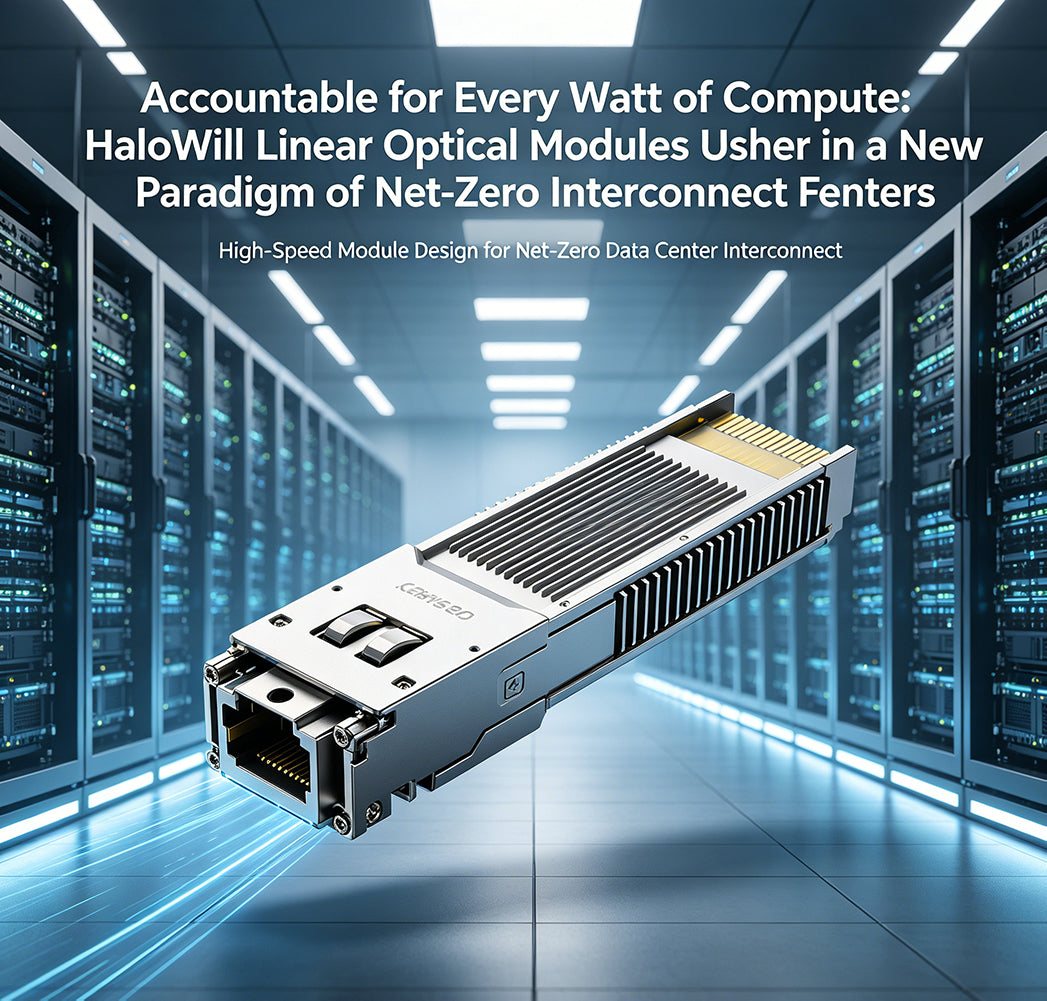

As generative AI models leap from hundreds of billions to trillions of parameters, the optical networks connecting GPUs are no longer mere accessories — they have become the structural force that dictates training cycle times and compute costs. Inside an AI supercluster, tens of thousands of GPUs must synchronize gradients and broadcast parameters through high-density optical interconnects. Packet loss, latency jitter, or thermal throttling at any single port triggers a proportional waste of compute across the entire synchronization ring. North American hyperscale data center operators are deploying 800G ports at unprecedented speed and evolving smoothly toward 1.6T. What they are searching for is not just optical modules, but a long-term technology ally capable of delivering a stable, low-power, high-speed optical engine across the entire AI lifecycle. This is the backdrop for the birth of the HaloWill brand: in an era suffused with compute anxiety, we counter transmission uncertainty with the certainty of optical engineering.
In the traditional pluggable optics market, procurement decisions are often reduced to “cost per Gbps,” but AI compute networks have exposed the fatal flaw in that logic. Training a GPT-4-class model requires hundreds of racks of GPUs to work in uninterrupted coordination for weeks. During that time, the operating temperature, signal integrity, and FEC (Forward Error Correction) margin of the optical modules drift. If a module is designed to chase only nominal data rate while neglecting eye-diagram margin under real-world load, an occasional link degradation appearing three months after deployment can slash the entire training cluster’s throughput by more than ten percent. HaloWill’s engineering team incorporated the sustained and bursty nature of AI workloads into the optical engine design from day one. Through a proprietary silicon photonics integration platform and adaptive DSP algorithms, every HaloWill 800G OSFP/QSFP-DD optical module delivers over 3 dB of signal-to-noise ratio margin under zero packet-loss conditions. For AI cluster architects, that number means the link stays reliably below the FEC limit even under the harshest cabinet thermal and vibration conditions, providing a hardware-level guarantee for compute orchestration.
A rate jump alone does not directly translate into efficiency gains for AI clusters unless it is accompanied by a density evolution that is both operable and maintainable. The power consumption of a typical hyperscale data center rack is climbing from 15 kW to 40 kW and beyond. Copper cables cannot bridge inter-rack distances, while active optical cables and optical modules must cool themselves within this dense thermal map. The 800G low-power series HaloWill launched for AI clusters employs an advanced 3D-packaged silicon photonics engine co-designed with a 7 nm-node DSP, driving typical power consumption per 800G port below 13 W. On a standard switch with 32 800G ports, the HaloWill solution frees up more than 150 W of power budget per full rack compared with the industry average. Those liberated watts feed directly back to the GPUs themselves or reduce pressure on the cooling infrastructure. In the total-cost-of-ownership models of large North American buyers, this translates into thousands of dollars saved per rack per year, and the cumulative cost advantage at scale can influence the siting and architecture of an entire regional data center.
HaloWill deeply understands the extreme supply-chain resilience requirements of North American AI infrastructure buyers. The CHIPS Act and shifting geo-economic landscapes have exposed the fragility of models that rely solely on long-haul ocean freight and concentrated manufacturing. By establishing localized warehousing, testing labs, and application-engineering teams in North America, HaloWill has built a rapid-response closed loop that spans from design verification to on-site fault diagnosis. When an AI infrastructure procurement director in Silicon Valley urgently needs to scale out 10,000 800G optical modules to meet a sudden large-model customer project, HaloWill’s North American inventory enables direct shipment from the regional spare-parts center within a week, instead of the eight-to-twelve-week lead times typical of traditional channels. This agility is more than a simple trade operation; it rests on HaloWill’s proactive adaptation to North American carrier certification regimes, including pre-tested compatibility with multiple mainstream switch OEM platforms and differentiated screening for power-grid quality and cooling environments across various U.S. states and Canadian provinces. What the buyer receives is no longer a string of part numbers, but an entire “plug-and-play, test-and-pass” interconnect solution.
Looking three to five years ahead, the AI compute infrastructure will enter a transitional period in which linear-drive pluggable optics and co-packaged optics coexist, but that does not signal the retreat of pluggable modules. On the contrary, 1.6T pluggable modules are becoming the standard companions for next-generation 51.2T and 102.4T switch silicon, and they must pack eight 200G electrical lanes into an even smaller QSFP-DD or OSFP-XD form factor. This amounts to managing signal integrity at near-microwave frequencies across a footprint roughly the size of a fingernail, where every decibel of return loss demands meticulous refinement in materials, structures, and processes. HaloWill’s labs are bringing elements of co-packaged optics down into the pluggable form factor, using miniaturized silicon photonic modulators and monolithic photonic-electronic integration to achieve, on 1.6T prototypes, a case temperature rise curve nearly identical to that of existing 800G products. The appeal of this technical path is that it allows North American data center customers to smoothly enjoy the next-generation speed dividend without disrupting existing operational workflows or optical cabling habits. For operators that have already invested millions of dollars in structured fiber infrastructure, a design that preserves those existing investments is itself a form of cost saving.
HaloWill's brand value does not reside solely on a datasheet. It is rooted in a shared engineering commitment to the AI era: not letting a single second of compute power sit idle because of optical link uncertainty. From wafer-level screening of laser chips to module-level accelerated aging tests, every HaloWill optical module shipped to the North American market carries a complete digital twin data file. Customers can trace the full-lifecycle parameter drift trends of any module at any time through the cloud platform. For pioneering AI companies deploying liquid-cooled cabinets and immersion cooling, HaloWill also offers liquid-cooling-compatible optical modules reinforced with specialized coatings and validated sealing, eliminating the risk of optical path shift caused by coolant penetration. This philosophy of treating the optical module as an organic part of the AI cluster rather than a simple peripheral is gaining increasing resonance along the North American procurement decision chain — from optical network architects to infrastructure VPs to CFOs, each role can find in HaloWill’s value proposition a benefit aligned with their own KPIs: architects gain margin, operations gain stability, and finance gains a predictable TCO curve.
The AI optical interconnect race is destined to be a sustained precision marathon. The optical module supplier chosen today determines the network smoothness and replacement cost during generational upgrades over the next three years. HaloWill’s product portfolio and local service ecosystem, built with North American customer needs at the center, are becoming an impossible-to-ignore new choice on the North American AI infrastructure procurement map. As compute density continues to double every two years and million-accelerator clusters move from science fiction into RFPs, HaloWill is ready to use the certainty of optical craftsmanship to underpin AI’s uncertain future. We welcome North American buyers and distributors to speak directly with our local teams and experience up close how a single optical module can accommodate the connectivity ambitions of an entire AI era.