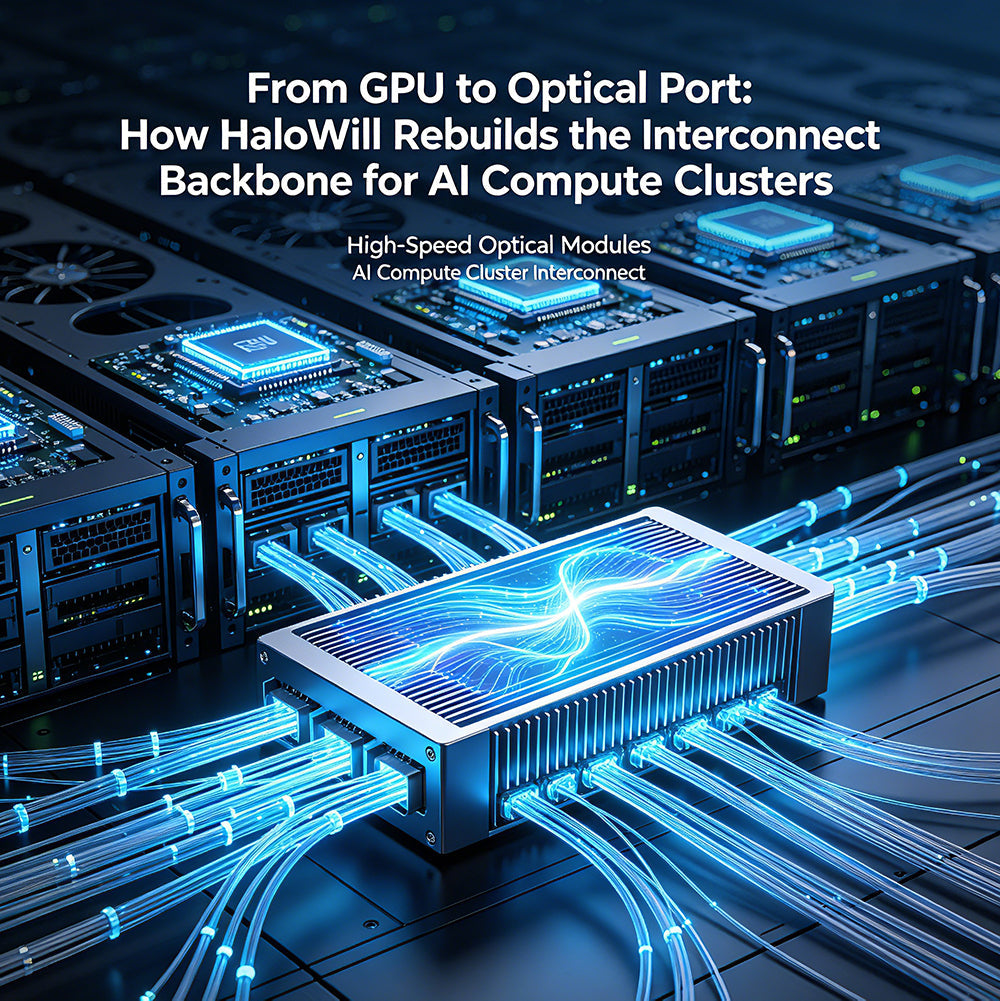

AI has transformed the data center from a mere warehouse for servers into a super-factory that gulps electricity and data by the second. In the operating-cost equation of such a factory, the energy consumption of optical interconnects was once treated as a rounding error. Today, however, the optical portion alone — modules and switch optics — of a 100,000-GPU cluster in North America can draw enough power to run a small town. This has rapidly shifted procurement attention from “cost per bit” to “cost per bit per Watt,” making energy efficiency the primary filtering criterion for network purchasing. It is precisely at this juncture that HaloWill enters the North American market, bringing with it an optical module portfolio systematically re-architected around energy efficiency and maintainability. The goal is not simply to supply parts, but to help AI factories keep scaling compute linearly even under tightening power constraints.
The power struggle of traditional PAM-4 pluggable optics stems largely from the heavy equalization and clock-recovery duties borne by the DSP chip. When speeds climb to 100 Gbps per lane, the DSP can consume more than half of the total module power, all of which is discharged as heat into the rack. HaloWill’s answer comes from an intersection of materials science and system architecture innovation: the linear-drive pluggable optics engine. By removing or dramatically simplifying the DSP between the switch ASIC’s SerDes and the optical engine, the bulk of signal equalization is handed back to the far more advanced and energy-efficient switch silicon, while the optical module itself becomes a near-passive, precision optical conversion device. The HaloWill 800G LPO series, built on a proprietary silicon photonics modulator and a dedicated low-drive-voltage design, consumes under 8 Watts in typical AI workload traffic patterns — nearly half the power of traditional DSP-based solutions. In the power and cooling designs of North American racks, the elimination of roughly 4 Watts of heat per module translates into more power headroom available for GPUs across the entire cluster, or the ability to defer a costly chilled-water expansion project.
While slashing power consumption, the linear-drive architecture also captures another fruit long desired by AI networks: ultra-low latency. The DSP's signal processing, however clever, creates a nanosecond-scale pipeline that accumulates a meaningful time barrier across multiple hops in AI all-reduce collective communication. HaloWill’s LPO modules compress port-to-port optical transmission latency to picosecond-level increments, essentially returning to the fundamental floor set by fiber propagation delay. In large-scale distributed training, saving even a few hundred nanoseconds per synchronization step, when compounded over tens of thousands of iterations, translates into tangible wall-clock training time reduction. One North American autonomous-driving AI company benchmarked a 5,000-node recommendation-model training cluster and found that the link latency compression reduced per-round model update time by roughly three percent, equivalent to several additional full training runs per year — a business value that far exceeds the purchase-cost delta of the optics themselves. It is with this systems-level thinking that HaloWill wins over AI procurement decision-makers who regard time-to-market as the ultimate currency.
Beyond energy efficiency and latency, another pain point repeatedly cited by North American data center operations teams is the reliable service life of optical ports. Optical modules in AI clusters operate at medium-to-high loads most of the time and frequently face micro-condensation risks in liquid-cooled environments, or accidental contamination during hot, high-density plug-and-maintenance operations. To address this, HaloWill developed a nano-coating and sealing process called “ArmorSeal,” purpose-built to protect the end-faces of optical modules designed for single-phase and two-phase immersion cooling. In North American third-party validation, after 2,000 thermal shock cycles and sustained contact with dielectric coolant, the insertion-return-loss variation of HaloWill immersion-grade optical modules remained within 0.15 dB, ensuring the link budget suffers no irreversible degradation. This means customers can confidently immerse their optical modules alongside expensive GPUs without fearing unexplained link degradation weeks later. This resilience to extreme cooling environments is fast becoming a critical litmus test for North American buyers evaluating whether a supplier truly carries “AI-native” DNA.
HaloWill's value proposition in North America extends well beyond product hardware. From Texas to Quebec, the geographical distribution of AI infrastructure clusters is vast, and data centers in different regions vary in altitude, temperature, humidity, and grid-frequency harmonics — environmental variables that can subtly modulate laser wavelength stability and receiver sensitivity. For this, HaloWill has built a cloud-based digital operations platform. Every batch of optical modules shipped to North America carries unified environment-aware firmware that, upon insertion, automatically matches and tunes optoelectronic parameters to local conditions, while allowing the buyer’s network operations team to access a per-port link-margin heatmap through standard APIs. This capability to upgrade operations from reactive troubleshooting to proactive prevention eases the “fix-on-failure” cost burden that North American AI companies have long endured with optical links, and it evolves HaloWill from a component supplier into an “interconnect health service provider.” For North American distributors, what is sold is no longer a one-time hardware SKU, but a recurring subscription value that bundles hardware, digital services, and local spare-part replacement.
Looking ahead, AI compute will continue its sprint along Moore’s Law’s extension cord, and the efficiency of bits-per-Watt in optical modules is becoming the new decisive battleground. HaloWill has already placed its bets on next-generation optical engines based on thin-film lithium niobate and ultra-high-density VCSELs, targeting 1.6T and 3.2T products that improve energy efficiency by an additional fifty percent. Concurrently, it is conducting pre-interoperability validation with major North American switch-chip vendors and ODMs, ensuring that customers face no optical module compatibility gaps when refreshing network equipment. In this race to define the future shape of AI infrastructure, HaloWill does not pursue the flashiest concepts, but instead insists on grounding every engineering decision in the power meters, link-budget sheets, and project timelines that North American customers can quantify. If you are screening optical interconnect partners for your next AI cluster and seek the optimal balance between performance and sustainability, we invite you to start a conversation with HaloWill’s North American technical team, and see firsthand how an optical module can generate a green efficiency dividend that reaches far beyond the spec sheet for the entire AI factory.