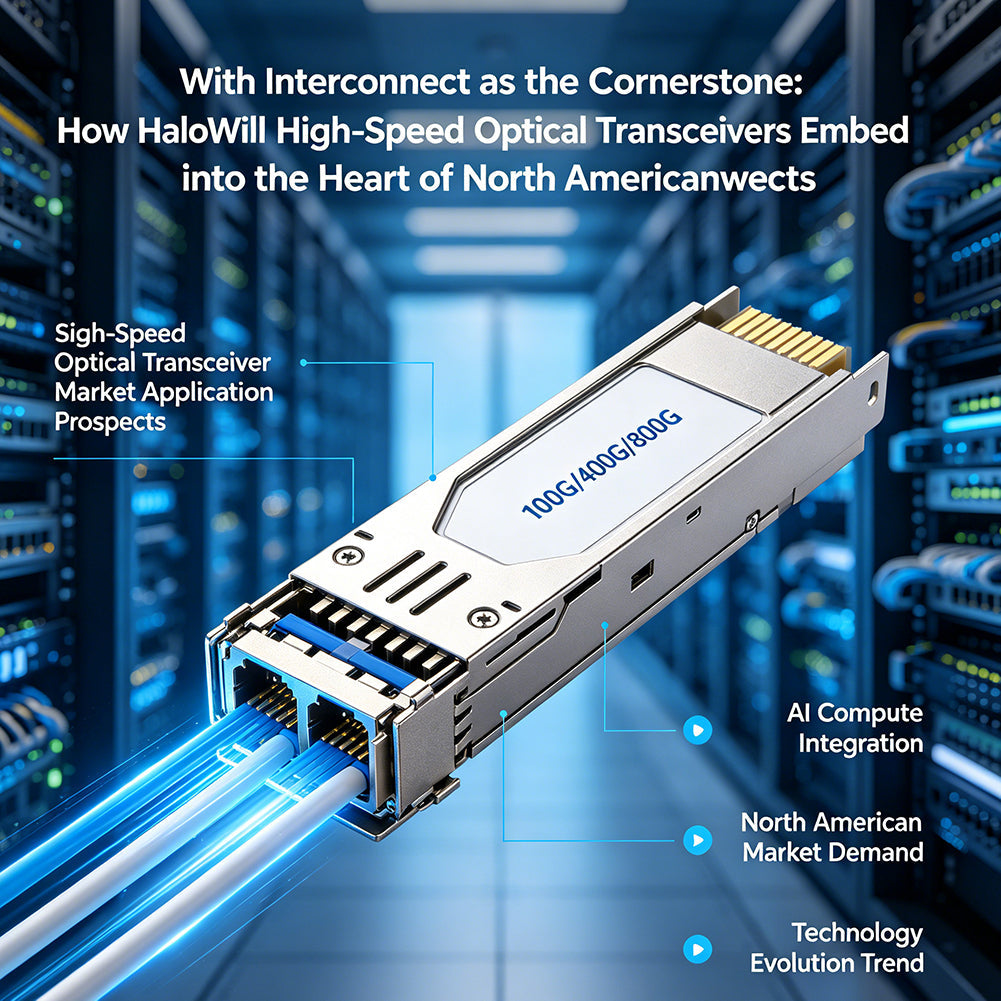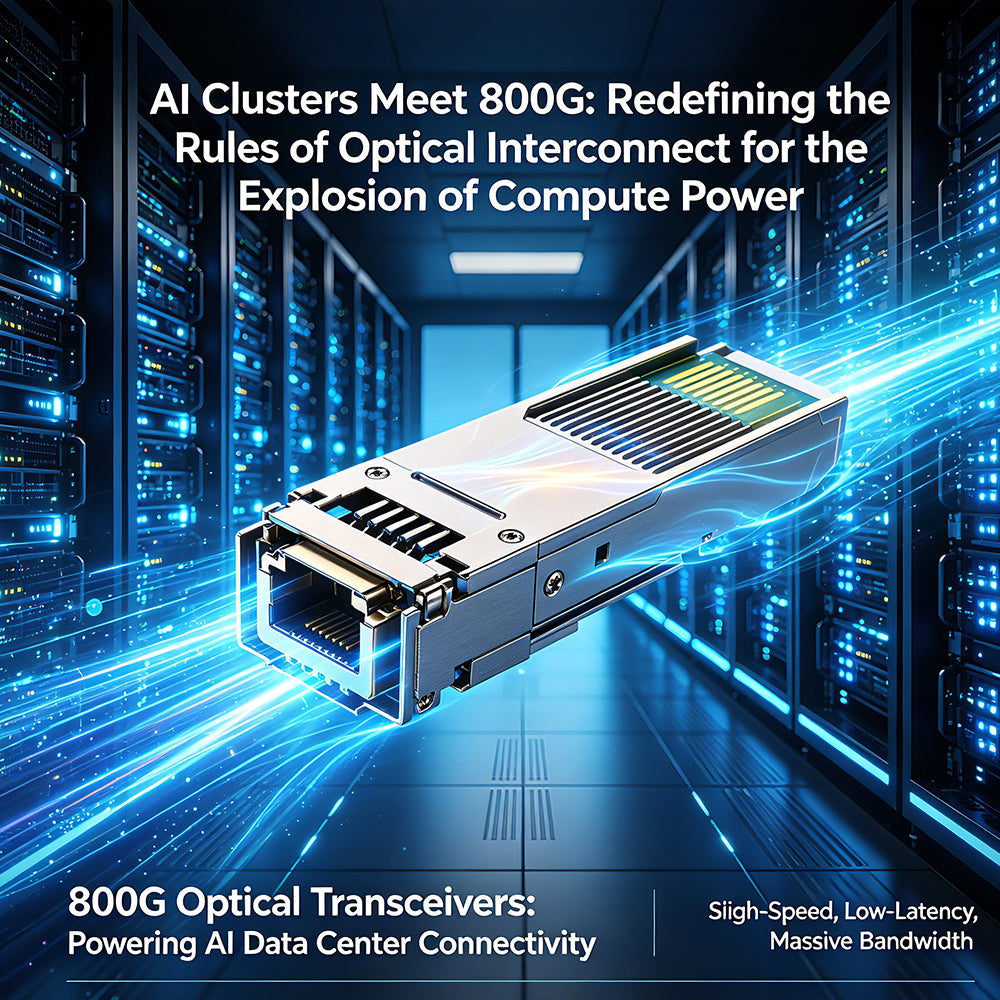

A surprising twist is quietly unfolding in the North American data center market. While the industry spotlight remains on massive training clusters, the center of gravity for commercial deployments has begun shifting toward distributed inference, retrieval-augmented generation, and vector databases. These new workloads no longer require the lossless full-interconnect of tens of thousands of GPUs, yet they impose entirely different demands on the flexibility, reach, and cost model of optical interconnects. If the training network is a precisely meshed internal combustion engine, then the inference and hybrid workload network is a liquid metal that needs to deform and flow at any moment. Having observed this trend, HaloWill has elevated its product philosophy from a pure speed race to flexible adaptation for multimodal traffic, helping North American customers find the optimal solution for their optical module investments across diverse workloads.
This flexibility is first embodied in the long-reach coverage of data center interconnect (DCI) links. In a typical North American cloud service architecture, the training cluster might be located in an inland region with cheap electricity, while inference instances are scattered across edge nodes in densely populated urban areas, with tens or even hundreds of kilometers of single-mode fiber connecting them. At such distances, traditional intensity modulation direct detection (IM-DD) schemes can no longer cope, necessitating the introduction of coherent optics. HaloWill’s 800G pluggable coherent optical modules compress the complex digital signal processing capability, originally belonging to large optical transport equipment, into a QSFP-DD form factor, supporting tunable wavelengths and sub-wavelength granularity bandwidth allocation. Buyers can now use interface standards consistent with client-side ports to establish end-to-end links from top-of-rack switches all the way to the DCI wavelength-division multiplexing platform, eliminating the need to maintain two separate spare parts systems and dramatically simplifying operational complexity.
Signal transmission inside the rack is also facing restructuring. With the exponential growth of PCIe Gen5/Gen6 and NVLink bandwidth, the weight, bend radius, and distance limitations of passive copper cables have become shackles. Active optical cables (AOCs) and on-board optics are moving from proof-of-concept to volume deployment. However, the high power consumption and poor maintainability of AOCs have long been criticized. HaloWill’s solution adopts a linear pluggable optics approach, removing the high-power DSP retimer from the AOC end and instead leveraging the SerDes within the switch ASIC to perform signal equalization. This seemingly simple subtraction actually imposes extremely stringent requirements on laser linearity and the impedance matching of the optoelectronic package. Through three-dimensional electromagnetic simulations and material optimization, our engineering team has compressed the power consumption of the linear direct drive 800G AOC to less than half that of traditional retimed solutions, saving nearly 5 watts per cable. In a fully loaded rack of AI servers, this translates to the capacity release of an entire power distribution unit, freeing up precious power budget for more accelerator cards.
Brand value is not an empty slogan but the trust accumulated through every customer risk decision. North American buyers generally hold an unwavering commitment to end-to-end system-level validation; they do not trust isolated specification sheets, only golden sample compatibility testing with their own switch and network interface card platforms. HaloWill has established a joint compatibility lab in Silicon Valley, maintaining a biweekly firmware alignment cadence with switch chip vendors like Broadcom and Marvell, as well as major white-box ODMs. Any new optical module firmware, before official release, must pass tests covering high-temperature BER stress, multiple hot-plug shock cycles, and accelerated aging lasting up to a thousand hours. This steady and meticulous style ensures that HaloWill modules have never experienced a batch-level compatibility incident during the peak-season expansions of top North American e-commerce platforms or the quarterly sprint deployments of renowned AI companies, becoming an internally recommended "no-surprise choice" among procurement managers.
As we look toward the future data center, a three-tier optical interconnect landscape is gradually emerging: 1.6T pluggable optical modules to address the extreme bandwidth demands of high-density training, coherent modules to bridge the distributed islands of compute power, and linear direct drive solutions to enable low-carbon, flexible interconnects at the rack level. HaloWill’s unique advantage lies in the fact that we do not bet on any single technology path; instead, with full-stack rate coverage and interface form factors, we provide North American customers with an elastic optical fabric that can breathe in rhythm with their business cadence. If you are seeking a long-term technology partner who deeply understands the logic of AI network evolution and can deliver with stability at critical junctures, HaloWill’s product matrix has already reserved your ticket to the next generation of infrastructure.