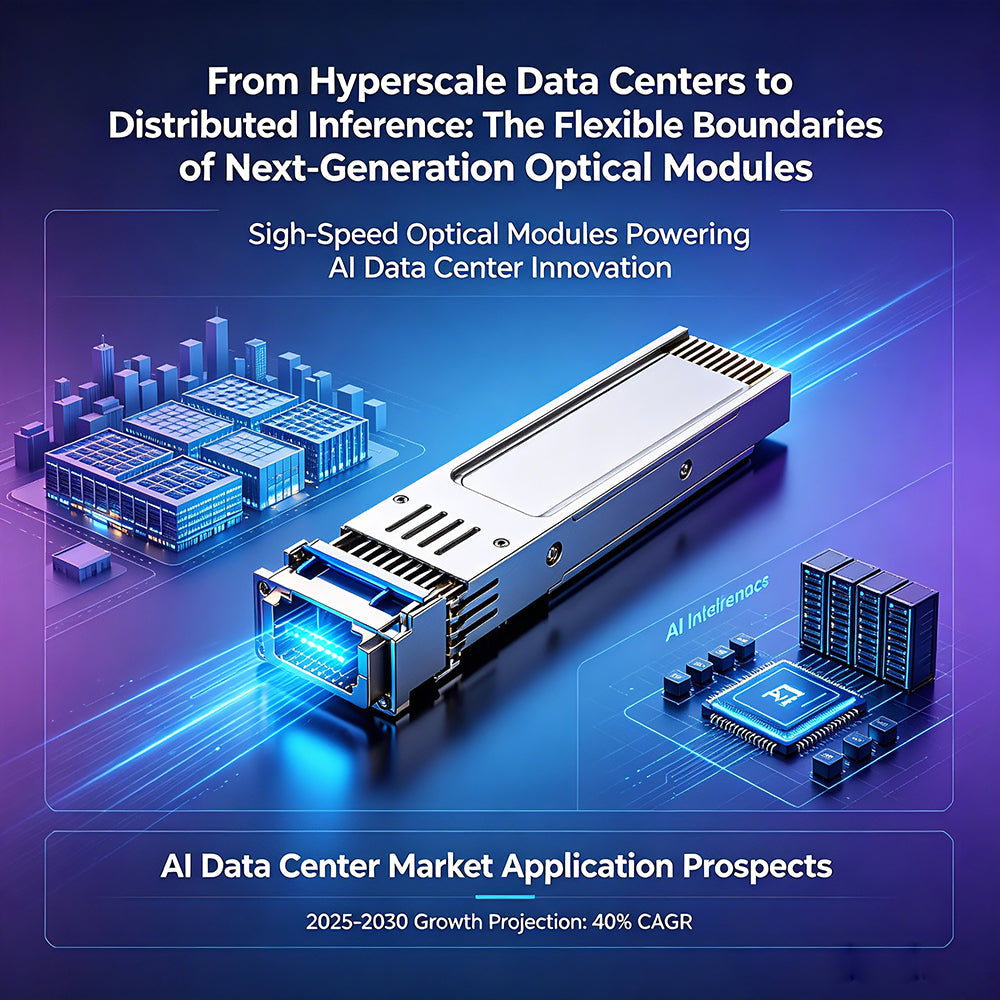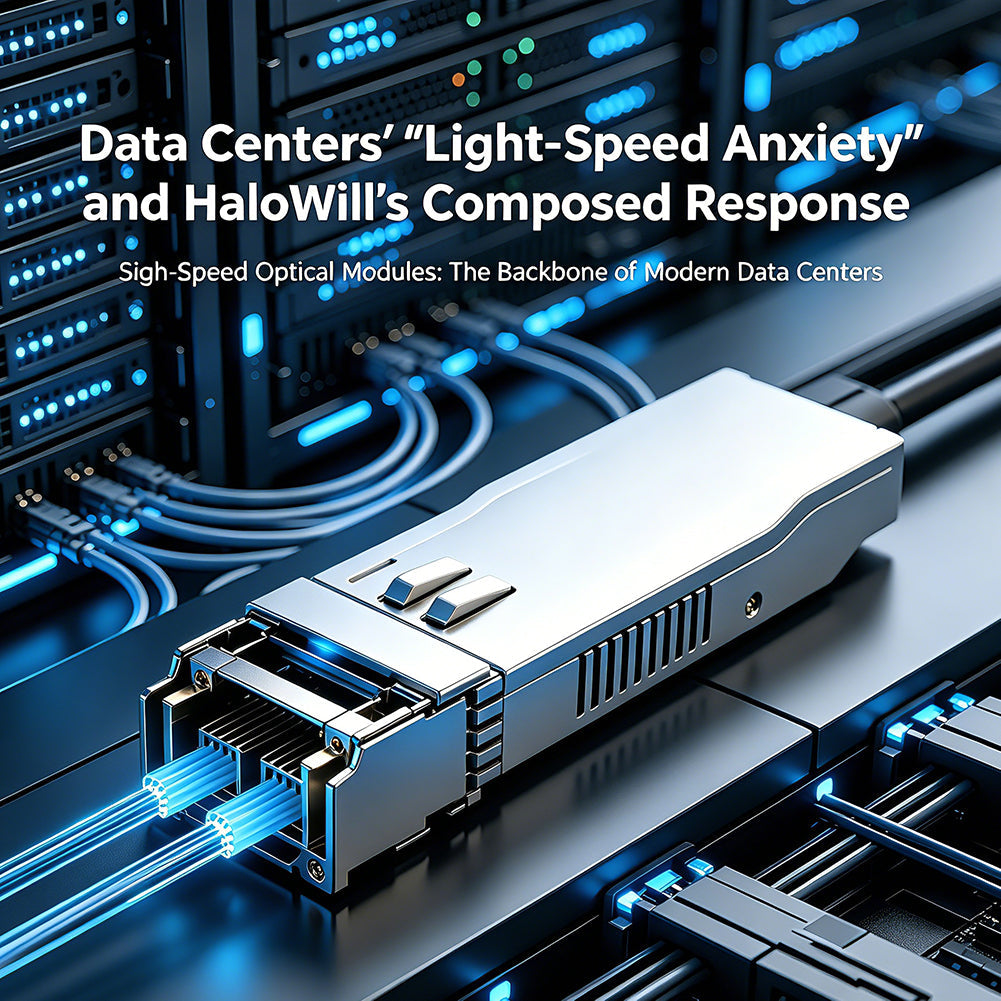

On the technology map of North America, the race for artificial intelligence has long since spread from algorithmic innovation to every contact point of the physical infrastructure. As hyperscale clusters equipped with tens of thousands of H100 or B200 accelerators rise one after another, a silent bottleneck is surfacing: nearly 40% of the time, these expensive GPUs are not computing, but waiting for data. As the neural network connecting every compute node, the speed, latency, and reliability of optical modules directly define the ceiling of effective compute power for AI clusters. HaloWill is deeply engaged in the field of high-speed optical interconnects precisely to break through this ceiling for North American customers, ensuring that every joule of energy and every dollar of capital expenditure translates into real training floating-point operations.
The requirements for optical modules in AI training are fundamentally different from those in general-purpose cloud computing. Traditional cloud traffic is predominantly north-south, with significant bursts but tolerating microsecond-level jitter. Large model training, on the other hand, involves east-west, fully interconnected synchronous communication. An instantaneous packet loss in any single optical module, or a tail latency exceeding a few microseconds, can trigger an overall stall in gradient synchronization, causing tens of millions of dollars worth of compute infrastructure to sit idle. Such harsh scenarios drive a qualitative shift in the engineering standards for optical modules. Speed is merely the entry ticket; the true deciding factors are signal integrity, bit error rate (BER) performance, and long-term thermal stability in high-density port environments. HaloWill’s 800G SR8 and DR8 series products have undergone full-link optimization from chip to package to target these pain points. Through a proprietary linear equalization algorithm and carefully selected VCSEL and EML lasers, they control the end-to-end BER to below 1E-15. This level of reliability means that during a non-stop training cycle lasting days and nights on a 10,000-accelerator cluster, task failures caused by optical links are virtually zero.
In our collaboration with several leading hyperscale customers in North America, we have observed a clear trend: the transition from traditional three-tier network architectures to AI Fabrics based on rail-optimized leaf-spine topologies is driving surging demand for 800G single-mode optical modules. Unlike the simpler deployment of short-reach multimode, single-mode connections spanning 500 meters or even two kilometers must overcome dispersion penalties and nonlinear effects. HaloWill’s 800G FR4 solution employs an advanced sandwich heat sink structure and a low-power, 7nm-process DSP chip, keeping the case temperature within commercial-grade specifications even under extreme air-cooling conditions. This means customers can instantly double port bandwidth density without modifying existing cooling infrastructure, thereby supporting more GPU nodes within the same 19-inch rack space and significantly reducing the energy consumption per bit and total cost of ownership.
In the post-pandemic era, the emphasis on supply chain resilience in the North American market has reached an unprecedented level. Simply offering low-cost product supply can no longer impress cautious buyers; what they need is a strategic partner with multi-source wafer assurance, multi-site backup assembly capabilities, and full-lifecycle reliability data. Through its self-built burn-in testing farm and fully automated coupling production line, HaloWill has achieved a digital twin record for every optical module shipped. Customers only need to scan the serial number to retrieve all historical data for that module, from the wafer batch to the final eye diagram. This transparency capability has become a highly weighted advantage in supplier qualification reviews for North American clients. Our brand value proposition is clear: we are not a price butcher, but an amplifier of reliability for our customers’ network infrastructure.
Looking ahead to the next six to twelve months, 1.6T OSFP-XD prototypes have already entered the lab validation phase at HaloWill, while linear-drive pluggable optical module solutions are also ready for release. For North American buyers planning large-scale AI clusters, choosing an optical module is not merely selecting a component, but choosing a roadmap that guarantees smooth network evolution across the next two generations. As your compute landscape continues to expand, HaloWill is ready to be the hidden champion that best understands how to guard the data path and conquer the limits of speed.