
If your data center procurement team is planning optical interconnect solutions for the next two years, there is one number worth taping to your desk: $26 billion. That is TrendForce’s latest forecast for the global AI optical transceiver module market in 2026, an increase of more than 57% from $16.5 billion in 2025. Behind that growth rate is a structural driver: North American hyperscale data center traffic is sustaining year-over-year growth of more than 30%.
More importantly, this round of market growth is not simply a spec upgrade. The growth logic of the optical module market is shifting from a single product generation cycle to three parallel tracks: market expansion, generational technology turnover, and diversified application scenarios.
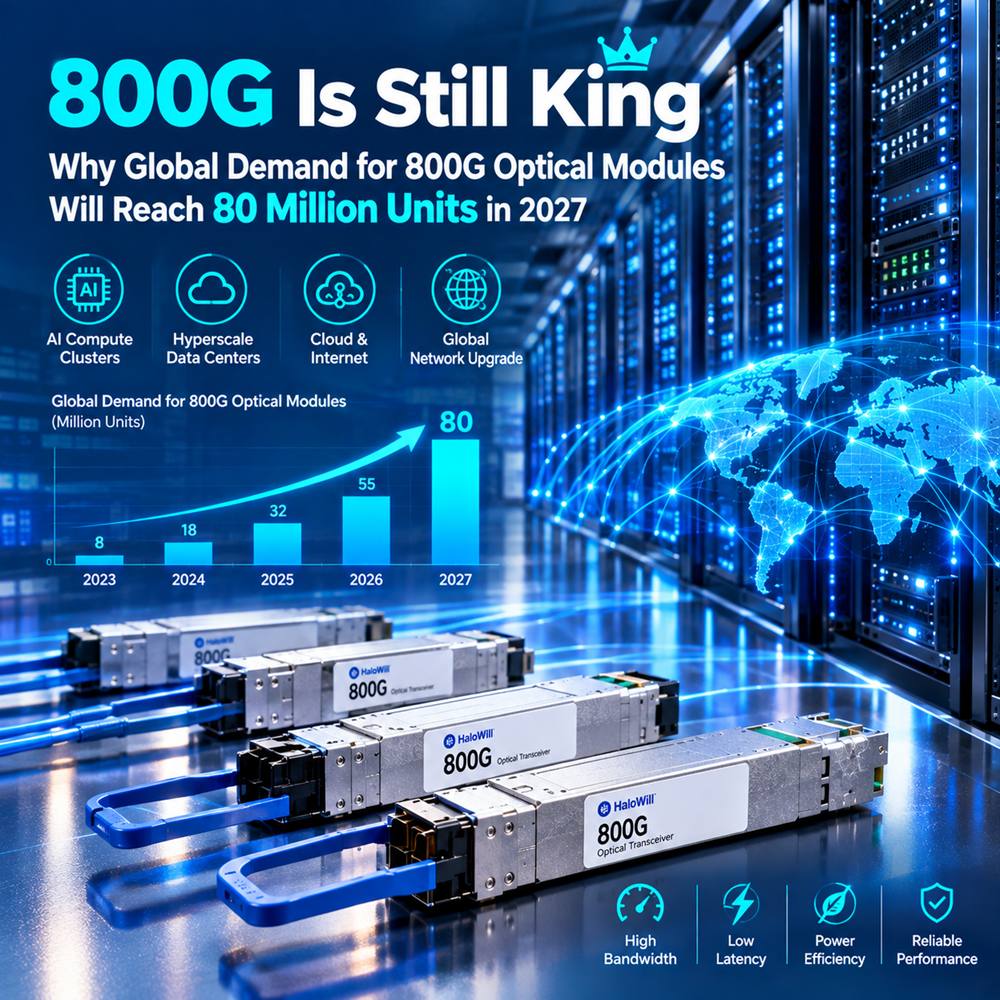
800G optical modules have already become the mainstream specification for backbone interconnect in North American AI data centers. North American cloud providers such as Meta, Google, Microsoft, and Amazon are the core buyers. Meta has the largest demand, at least 10 million units and potentially as many as 12 million; Google and Microsoft together need about 12 million units; and Amazon needs about 5.5 million units. Goldman Sachs has sharply raised its 2026 800G optical module sales forecast from 25 million units to 33.5 million units, an increase of 58%. At the same time, 1.6T products are accelerating into volume production, and overseas technology giants have raised their 2026 1.6T optical module procurement plans from 10 million units directly to 20 million units—demand doubling overnight.
But beneath this strong demand, structural constraints on the supply side are becoming more visible. Supply of core optoelectronic chips, represented by EML lasers and CW-LD, remains tight. High-precision manufacturing processes such as optical alignment limit the ability to scale capacity. Power consumption and thermal management challenges also continue to affect system design and deployment timelines. In response, upstream buyers such as Nvidia have turned to long-term agreements to lock in critical components, while technology roadmaps are accelerating toward LPO and silicon photonics integration to replace traditional high-power DSP architectures.
What does this mean for North American buyers? Supply chain resilience is becoming a procurement consideration as important as product performance. Suppliers with stable production delivery capability and readiness across multiple technology roadmaps will hold a significant advantage in this upgrade cycle. For distributors, choosing a partner that can deliver both 800G and 1.6T in parallel is key to helping end customers seize the deployment window for AI infrastructure.