
When AI inference demand surpasses training demand to become the primary workload in data centers, the design logic of network architecture is undergoing fundamental change. Omdia research data shows that in 2026, global AI inference server shipments will leap from 1.3 million units in 2025 to 2.45 million units, and by 2030, the number of inference servers will reach 4 to 5 times that of training servers. Traditional electrical switching architectures face bandwidth and power bottlenecks, while OCS, with its three advantages of low power consumption, protocol transparency, and reconfigurable topology, has become a new choice for campus-level data center expansion.
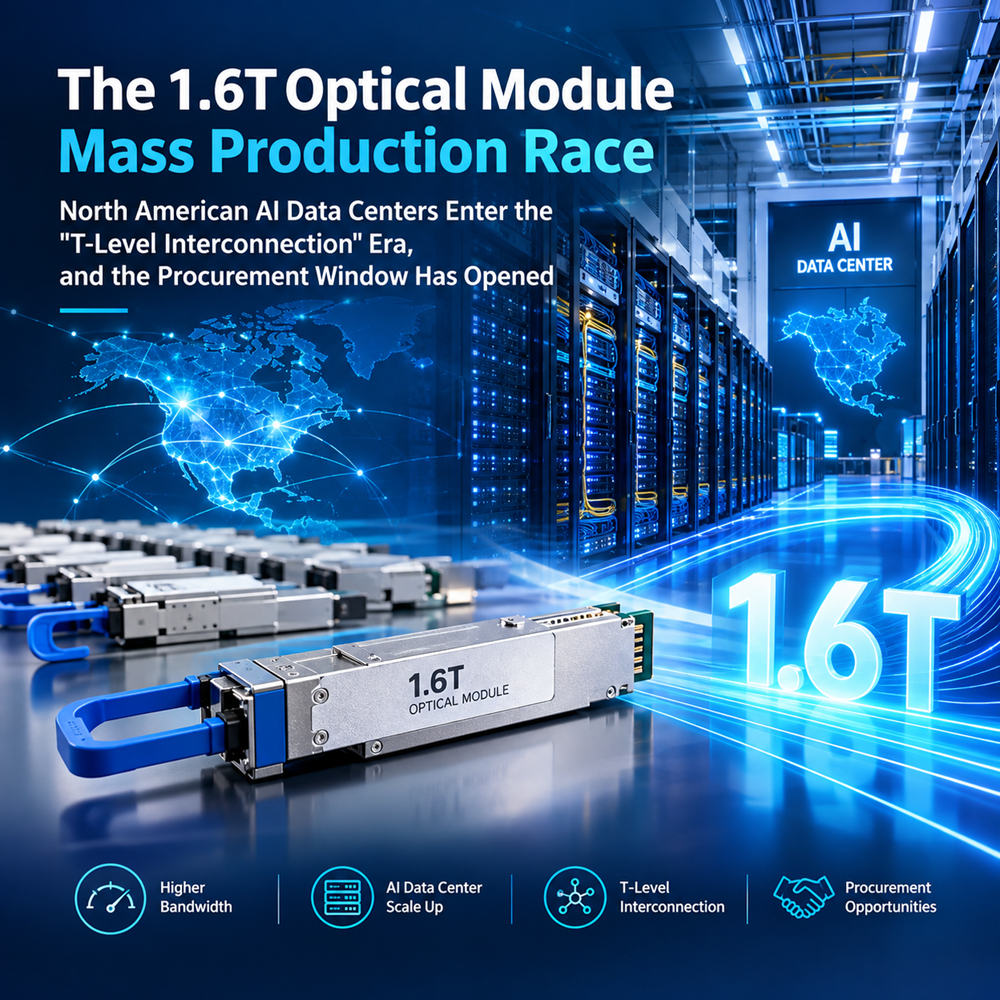
Google is the most committed practitioner of OCS technology. TrendForce points out that Google's new-generation Ironwood rack system combines 3D Torus network topology and Apollo OCS all-optical network to realize a high-speed interconnect architecture. This will push up the global shipment share of high-speed optical transceiver modules above 800G from 19.5% in 2024 to more than 60% in 2026, and they will gradually become standard equipment in AI data centers.
But OCS's path to commercialization is not easy. Lyu Mingyang, Senior Principal Analyst at Omdia, pointed out that Google began exploratory work on the prototype of optical switching from 2010 to 2013. From concept to prototype, and then to gray-scale network testing from 2015 to 2020, it took nearly ten years to truly introduce OCS into production networks. This history serves as a reminder to all potential entrants: network equipment is different from optical components; it must undergo a long verification cycle to ensure absolute safety and reliability.
In terms of market size, Cignal AI forecasts that the global OCS market may exceed $8 billion by 2030, corresponding to a CAGR of more than 30% from 2026 to 2030. In 2026, the OCS market has already exceeded $1 billion, and rapid growth is expected to continue until 2028. In addition to Google, Microsoft's "Project Sirius" is also deeply exploring OCS's potential to replace EPS, but the current goal is not complete replacement, but rather using it as a supplement to balance loss and port cardinality in non-full-mesh topologies.