
If you are responsible for optical interconnect procurement for data centers in North America, you have likely already felt an unprecedented sense of urgency. This is not a lead-time delay from one particular supplier, but a structural supply-demand mismatch that the entire industry is experiencing.
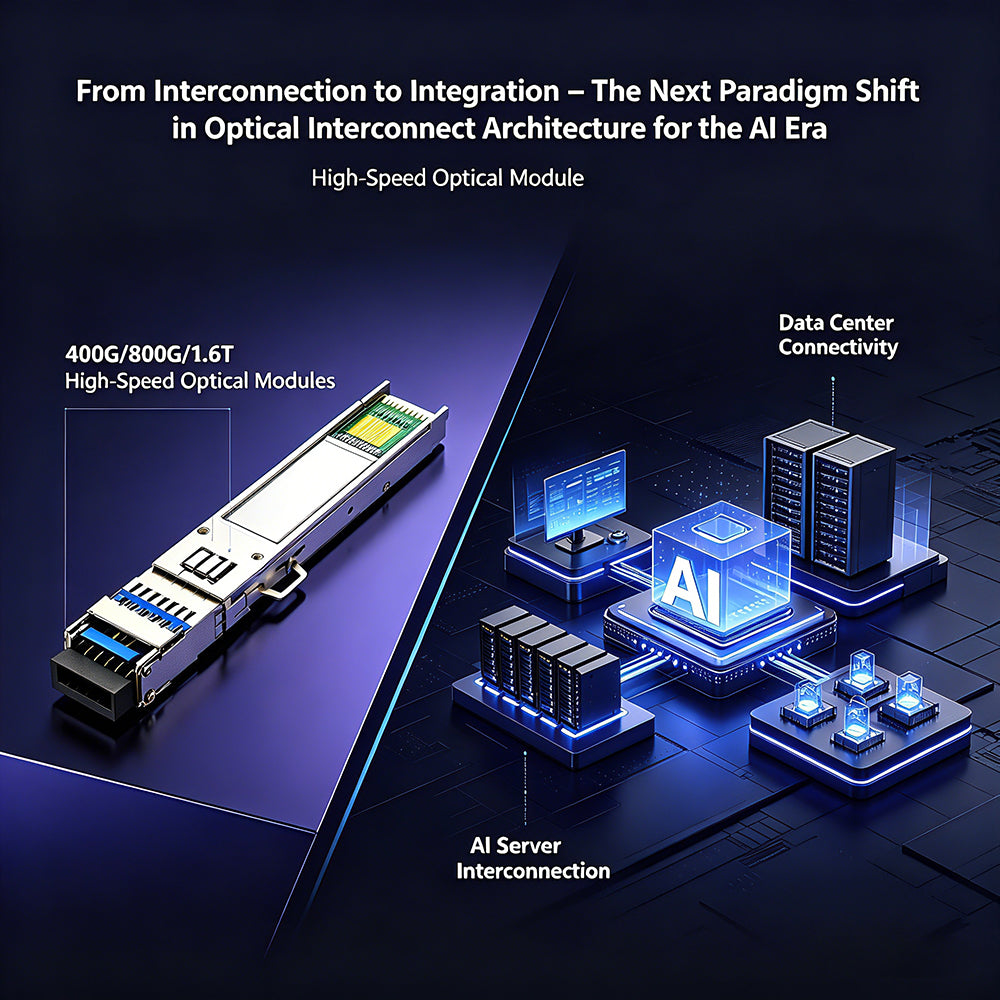
TrendForce’s latest data shows that the global AI optical transceiver module market is rapidly climbing from $16.5 billion in 2025 to $26 billion in 2026, representing year-over-year growth of more than 57%. Traffic in North American hyperscale data centers is maintaining annual growth of more than 30%. Cloud giants such as Google, Microsoft, and Meta continue to expand their GPU and AI server deployments, directly driving procurement demand for 800G and higher-speed optical modules. 800G optical modules have become the mainstream specification for backbone interconnect in AI data centers, and 1.6T products are also accelerating into mass production.
The explosive growth on the demand side is not surprising in itself. What truly deserves buyers’ attention is the structural constraint emerging on the supply side. TrendForce points out that core optical chips represented by EML (electro-absorption modulated laser) and CW-LD (continuous-wave laser diode) remain in tight supply and have become the primary bottleneck constraining capacity expansion. At the same time, manufacturing processes such as high-precision optical alignment limit the speed of scaled capacity expansion, while challenges in power consumption and thermal management continue to affect system design and deployment cadence. Order schedules for some products from Lumentum and Coherent, two North American optical communications giants, have already extended to 2028, and long-term agreements even run to the end of 2030.
What does this mean? For buyers, the classic procurement strategy of comparing multiple suppliers and slowly negotiating prices is losing effectiveness. Capacity itself is leverage. Leading upstream suppliers have already begun locking in key components through strategic long-term agreements, reducing their reliance on the spot market. If your supplier does not have sufficient capacity reserves or lacks the ability to lock in upstream core chips, lead-time risk will be transmitted directly to your data center deployment timeline.
In this environment, supplier evaluation criteria need to shift from “price first” to “capacity certainty first.” A trustworthy supplier should have several key characteristics: long-term supply agreement coverage for core optical chips, vertically integrated manufacturing capability, and a local manufacturing footprint in North America. Take leading industry practices as an example. Some manufacturers are building large-scale manufacturing bases in the United States, planning to achieve monthly capacity of more than 900,000 units of 800G and 1.6T products by the end of 2027, while expanding laser manufacturing capacity by 350%. This model of vertical integration plus localized production can not only shorten supply chain response cycles, but also provide buyers with greater buffer against tariff policies and trade uncertainty.
Another easily overlooked risk is supply fragmentation caused by technology roadmap transitions. Currently, the 800G market has two coexisting form factors: QSFP-DD and OSFP. The former typically consumes between 7W and 12W, while the latter supports a power range of 12W to 15W or even higher. When choosing a form factor, buyers must not only consider compatibility with current switch platforms, but also assess whether the supplier can smoothly evolve to next-generation 1.6T products. If a supplier adopts a transitional technical solution at the 800G stage, buyers may face additional re-certification costs and lead-time risks during the 1.6T upgrade.
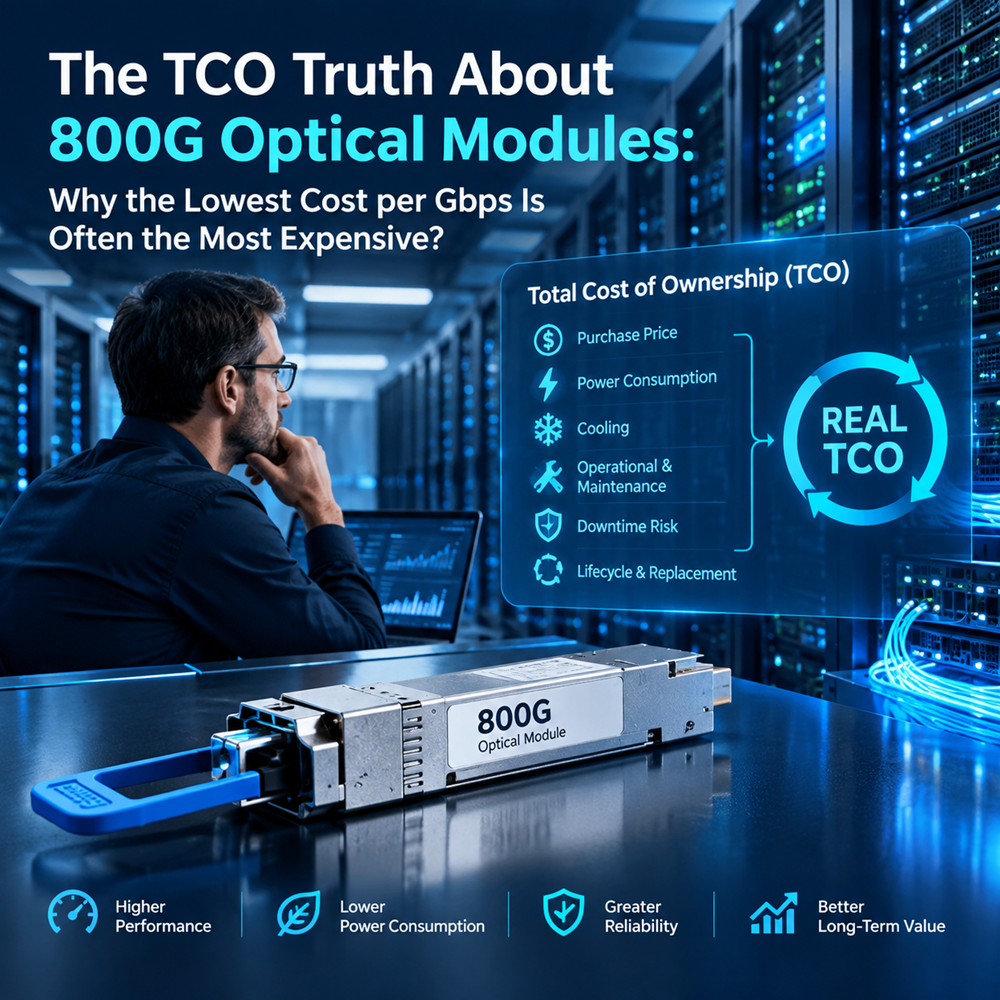
For North American procurement teams planning data center expansion in 2026–2027, the core question now is not “whether to buy,” but “from whom to buy and how to secure capacity.” It is recommended to establish strategic partnerships as early as possible with suppliers that have vertical integration capabilities and localized capacity, and to incorporate supply certainty into the core supplier evaluation metrics, rather than merely comparing cost per Gbps. In an era where capacity is king, stable supply itself is the greatest cost advantage.