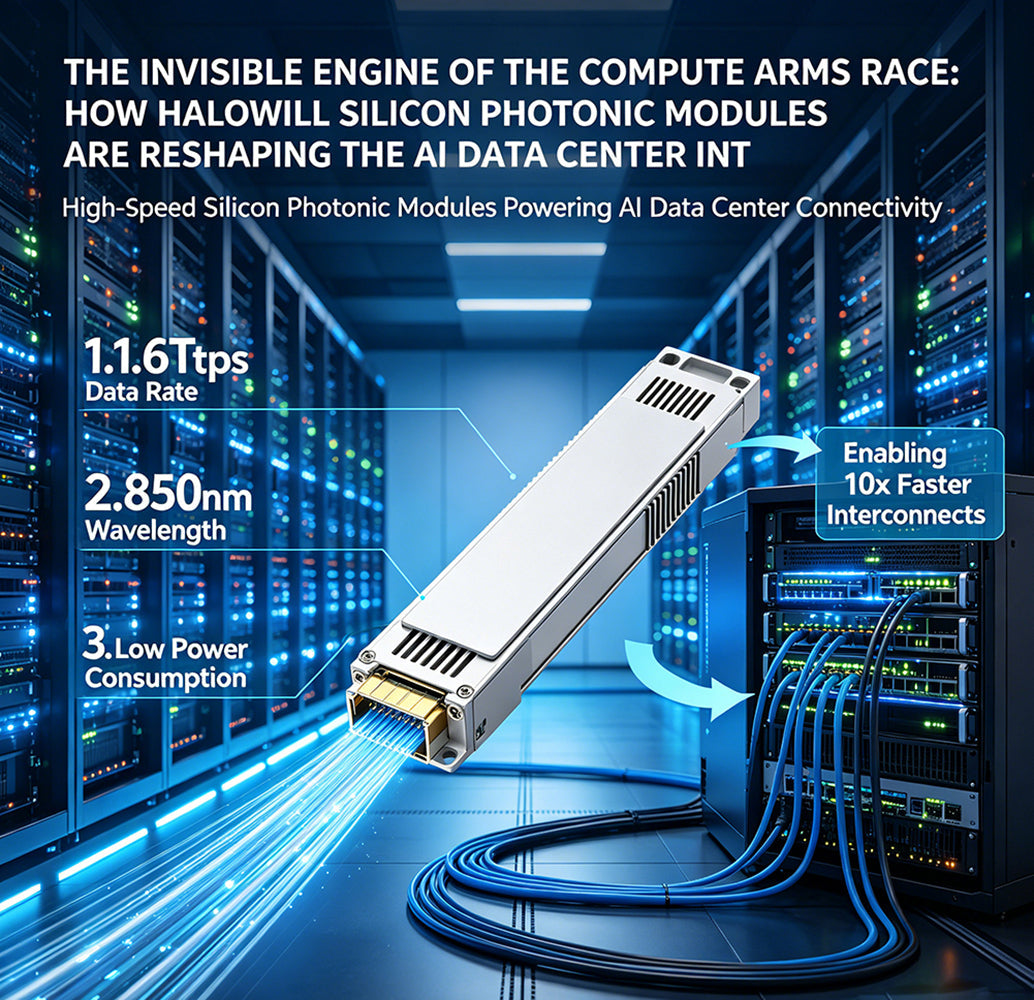

Not long ago, several North American utility companies issued successive warnings that the power supply allocation for the Virginia data center corridor is approaching its ceiling at a rate far exceeding expectations, while the single-rack power density of AI training clusters has already breached 40 kilowatts. In this wave dubbed "compute inflation," an optical module may seem like just a small pluggable component on a switch faceplate. Yet, when a hyperscale data center housing tens of thousands of ports is viewed as a whole, the cumulative power consumption of optical interconnects often reaches hundreds of kilowatts, and the electricity consumed by the supporting cooling systems is even more staggering. With carbon reduction regulations tightening and electricity costs soaring, the pressure facing North American buyers has never been more tangible—what they need is not just higher speeds, but an entirely new breed of technology that achieves superior performance with significantly lower energy consumption. The answer HaloWill provides is the linear direct-drive optical module.
The essence of linear direct-drive technology lies in resolutely discarding the digital signal processing chip traditionally used for signal recovery inside optical modules. It allows the switch's SerDes signals to directly drive the laser and modulator, as if removing an interpreter to let two giants who speak the same language converse directly. In the past, this was seen as an almost risky ideal, because signal attenuation and reflections over long links would push the bit error rate to unacceptable levels. HaloWill's breakthrough lies in the integrated co-design of precision RF material science, adaptive linear equalization, and narrow-linewidth optical chips. In a typical copper cable replacement scenario connecting to a 51.2T switch, its 800G LPO OSFP module can operate stably on multimode fiber within five meters and single-mode fiber over several hundred meters. The link budget fully satisfies the stringent requirements for cross-rack interconnects in AI clusters, and the power consumption stays under 5 watts, merely half that of traditional DSP-based solutions.
The benefits that such a green-inspired module brings to North American customers are all-encompassing. The most immediate is a sharp reduction in electricity and cooling expenditures, directly improving the data center's operating profit. A deeper value lies in the compression of latency to the sub-nanosecond level, which is critically important for the frequent All-Reduce collective communications in large language model training. In computations where thousands of GPUs work in lockstep, nanosecond-level savings in each optical transmission accumulate over tens of thousands of iterations, ultimately translating into a significant reduction in model convergence time. For buyers, this means a faster time to market and a higher resource turnover rate—a business return far beyond mere hardware price differences. HaloWill's linear modules also inherently feature fewer components and higher reliability, which, for North American financial-grade colocation environments and cloud service providers that emphasize zero downtime, offers a sense of security that penetrates deep into the marrow of operations.
The strategy HaloWill is implementing locally in North America is to willingly serve as the "pluggable pioneer." The brand knows well that hyperscale users harbor concerns about interoperability risks and deployment inertia when migrating to LPO. Therefore, in addition to fully complying with the CMIS 5.0 diagnostic standard and supporting zero-touch provisioning, HaloWill has proactively joined the Open Compute Project and co-published an LPO interoperability white paper with multiple switch ASIC vendors. HaloWill's localized application engineer team can bring test boards directly into a customer's lab and complete a link evaluation within a week or even a few days, helping users see the real-world performance of the linear architecture in their own network environment at the smallest decision-making cost. This approach of trading trust for scale aligns perfectly with the "empirical spirit" highly valued in North American business culture.
Centered around the grand narrative of green computing, HaloWill has also specifically designed the "Green Link" market enablement program for its channel partners. Distributors and integrators who join this program not only receive differentiated profit margins based on LPO products and priority supply assurance, but also obtain a corporate carbon offset contribution accounting report that can be passed on to end customers. In North America, the carbon footprint of the supply chain is gradually becoming a hard bidding threshold. HaloWill utilizes factories with an exceptionally high proportion of green electricity for everything from front-end silicon photonic chip manufacturing to back-end module assembly, and its carbon information disclosure is completely transparent. This enables channel partners, when advancing a project, to no longer merely peddle a component, but to deliver a quantifiable ESG improvement plan to the customer.
The storm of linear optical interconnect has only just begun to stir from the gentlest breeze. With the proof-of-concept for 1.6T LPO achieving a key breakthrough in HaloWill's laboratories, and major North American cloud platforms initiating the design of their next-generation AI Fabric, the linear direct-drive module is rapidly rising from a supplementary role replacing copper cables to become the mainstay of the new generation of short-reach optical interconnect. HaloWill invites all North American buyers and channel partners who believe that compute and nature can coexist to stand at the crest of this green technological wave. In the future, every single watt in a data center will be entrusted with the new mission of connecting intelligence, and HaloWill is willing to be the spark that ignites this green fuse.