
When the AI Computing Boom Meets Supply Chain Uncertainty: A Path Forward for North American Optical Transceiver Procurement
Walk into the procurement office of any hyperscale data center in North America, and you will hear the same conversation—optical transceiver lead times are stretching longer. It is not that demand is slowing; quite the opposite. According to the latest figures from industry research firm LightCounting, the Ethernet optical transceiver market grew 93% in 2024, followed by 82% in 2025, and is forecast to grow another 65% in 2026. Tech giants Microsoft, Google, Amazon, and Meta plan to collectively invest 725billionincapitalexpenditurein2026—astaggering77410 billion—to accelerate AI infrastructure buildouts. Behind these numbers lies a rarely discussed reality: optical transceivers are shifting from being "supporting components" for data centers into genuine "strategic assets."
For the past decade, optical transceivers have been treated as standardized consumables in the data center world. The procurement team’s workflow was simple and mechanical—compare specifications, compare prices, place orders, and wait for delivery. But when generative AI foundation models like ChatGPT pushed GPU clusters to scales of tens of thousands or even hundreds of thousands of GPUs, the rules of the game changed completely. Generative AI clusters require 10 to 100 times more fiber connections than traditional cloud services, and the physical limitations of copper cabling at high bandwidths make optical interconnects the only viable option. In Nvidia’s NVL72 rack, optical transceivers already account for 20% of the total rack procurement cost. Optics are no longer a peripheral accessory; they are a critical factor that determines whether an AI factory can come online on schedule.
However, as every data center operator scrambles to secure optical transceivers, the hidden bottlenecks in the supply chain are being exposed one by one. First and foremost is the shortage of electro-absorption modulated laser (EML) chips. Lumentum stated clearly in its latest earnings report that the supply-demand gap for EML lasers has exceeded 30%, and even though the company is ramping up production at an unprecedented pace, demand is growing even faster—virtually all product lines remain in a state of oversubscription. What does this mean in practical terms? If you place an order for an 800G optical transceiver from a mainstream vendor today, lead times may have already stretched from the previous 8–12 weeks to 20 weeks or even longer. For North American enterprises racing to deploy AI infrastructure, every single week of delay represents a massive opportunity cost.
Another bottleneck, frequently overlooked by procurement teams, stems from an unassuming yet indispensable component—the Faraday rotator, the core material of optical isolators. The price of this material has surged from
120to175, and the market shortage rate has reached as high as 50%. The world’s largest supplier, Coherent, controls approximately 50% of global production capacity and prioritizes internal demand. Even if your optical transceiver vendor has promised a delivery date, upstream material shortages can overturn that commitment at any moment.
It is precisely under these market conditions that procurement strategy must evolve from a "transactional mindset" to a "partnership mindset." Vendors that compete solely on price are the first to fall behind when a supply chain storm hits. A truly trustworthy partner must possess three core capabilities. The first is deep global supply chain reach. HaloWill has deeply integrated its global supply network for core chips and optical components, establishing multi-source mechanisms for critical materials to avoid over-reliance on any single supplier. This is not a simple backup plan, but a battle-tested resilient supply system—when one supply channel is disrupted, alternative pathways can be activated in the shortest possible time, minimizing the risk of delivery interruption.
The second capability is rigorous compatibility and reliability verification. Anyone with hands-on data center operations experience knows that optical transceiver compatibility issues are often the most insidious and difficult-to-troubleshoot culprits behind network failures. A scenario where an optical transceiver performs flawlessly in a lab environment but frequently triggers error rate spikes once inserted into a live production switch is far from uncommon. HaloWill regards compatibility verification as the first line of defense for product quality. All products must pass stringent interoperability testing with mainstream switch brands—including Cisco, Arista, Juniper, and Nvidia Spectrum series—before leaving the factory, ensuring a seamless plug-and-play deployment experience.
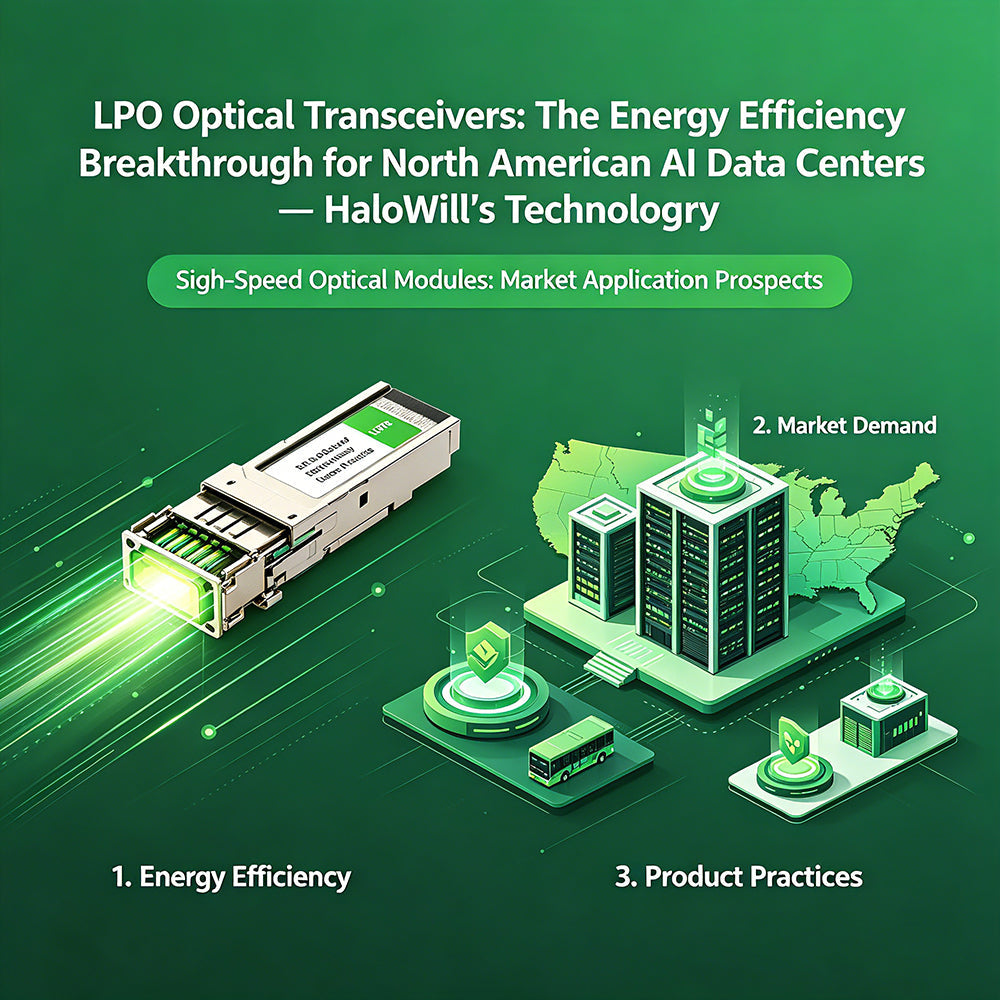
The third capability is a clear-eyed judgment on technology roadmaps. While the industry debates when co-packaged optics (CPO) will reach mass commercialization, pragmatic data center operators are more focused on reliable choices available today. Pluggable optical transceivers will remain the dominant form factor for AI data center interconnects over the next three to five years. Linear pluggable optics (LPO) technology, as an intermediate path, eliminates the DSP chip on the module side, reducing power consumption by up to 38% and end-to-end latency by approximately 200 nanoseconds. HaloWill's 800G and 1.6T product lines are actively embracing this technology direction, delivering an optimal balance of performance and energy efficiency to customers.
For North American buyers and distributors, the current market presents both challenges and opportunities. The challenge is that a tight supply chain dramatically shrinks the margin for error in procurement decisions—choosing the wrong supplier could mean an entire quarter’s deployment plan grinds to a halt. The opportunity is that vendors capable of helping customers navigate these risks are growing into genuine strategic partners. HaloWill’s brand promise is clear and pragmatic: we do not promise what we cannot deliver, but every commitment we make is honored with verifiable quality and a proven delivery track record.
While other brands are still using slide decks to showcase their technology roadmaps for the next three years, HaloWill chooses to invest its energy into every checkpoint in the global supply chain, every compatibility test, and every batch of outgoing quality inspection. In today’s optical transceiver market, certainty itself has become the scarcest commodity. And that is precisely the core value HaloWill creates for its North American partners.