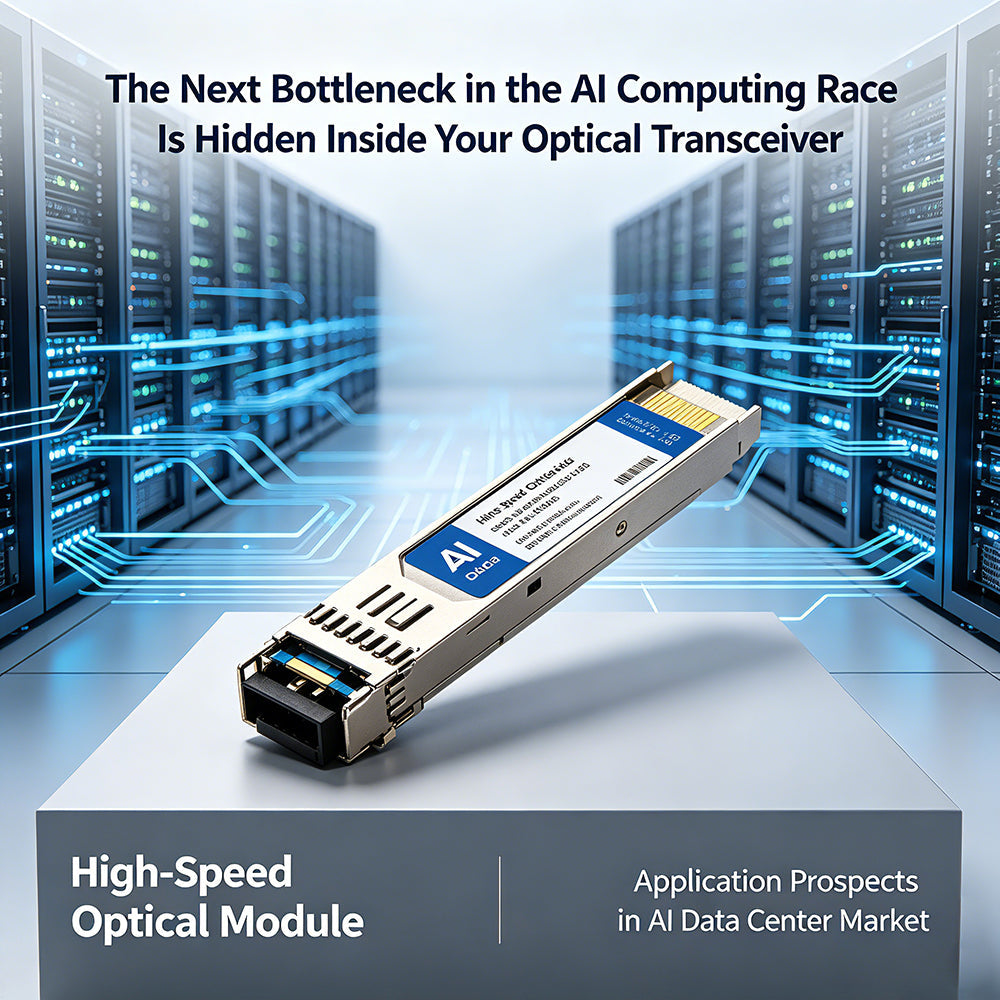

For far too long, the dominant narrative in the data center industry has centered on server chips and cooling systems. We eagerly discuss the temperature differential between the inlet and outlet of liquid cooling plates, yet we rarely cast our gaze toward the tens of thousands of small optical transceivers plugged into switch faceplates. That neglect is now being corrected by the energy bill. Consider a simple calculation: an AI compute cluster deploying 50,000 first-generation 800G DR8 optical transceivers consumes nearly 6 million kilowatt-hours annually for optical interconnects alone — equivalent to the annual electricity consumption of 3,000 North American households. And when that electricity comes primarily from natural gas peaker plants, the resulting indirect carbon emissions are sufficient to trigger an ESG inquiry from the board of any publicly traded company.
Frankly, the optical transceiver industry’s past strategy for addressing power consumption was to “wait for process node dividends” — expecting that as DSP chips migrated from 7nm to 5nm and then to 3nm, power consumption would naturally decline. But the further process nodes shrink, the harder it becomes to ignore the physical barrier of leakage current and the relentless rise in costs. A more fundamental solution emerges from a bold question: in short-reach interconnect scenarios within a single rack or between racks in the same row, do we truly require that DSP chip, which burns 4 to 5 watts and introduces considerable latency?
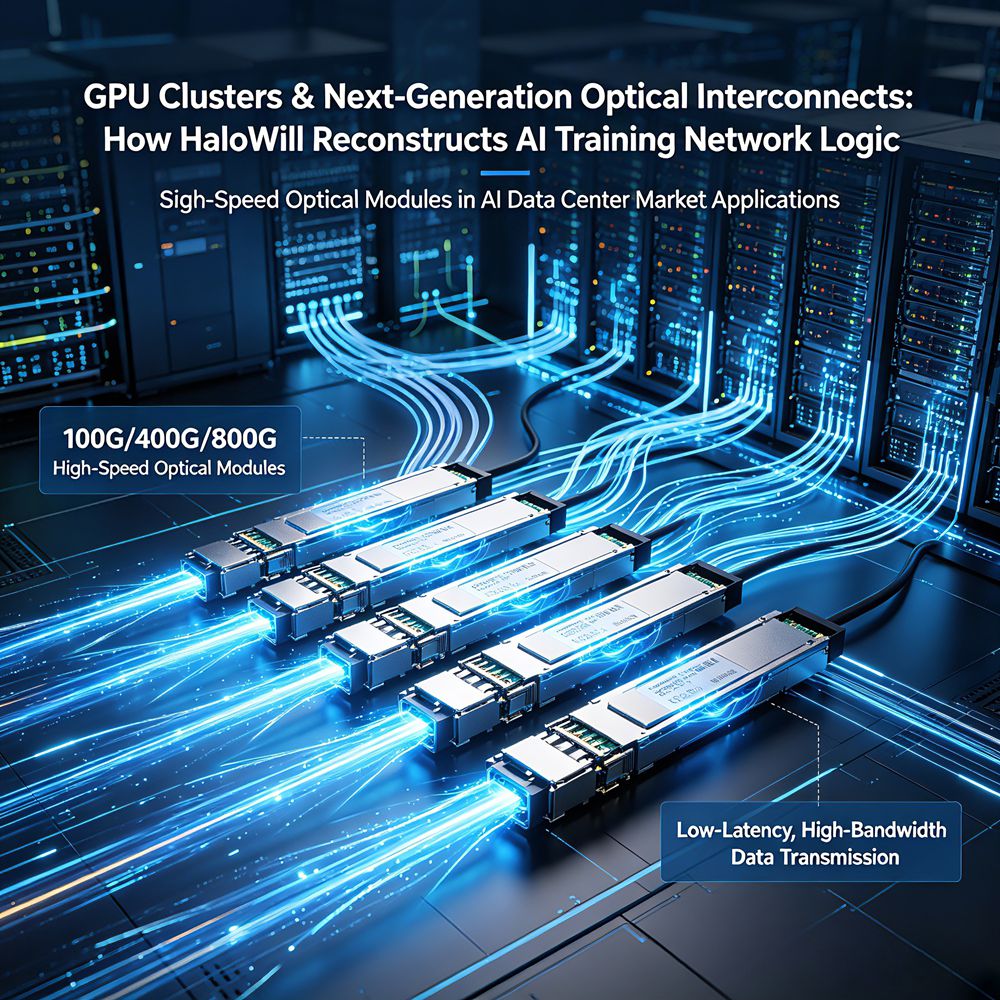
HaloWill’s LPO (Linear-drive Pluggable Optics) series of optical transceivers represent the practical answer to that very question. We conducted two years of joint signal integrity simulations with leading North American switch silicon vendors and redesigned the analog direct-drive link from the switch ASIC SerDes port to the optical engine of the transceiver. In essence, we have deftly handed the tasks of digital signal recovery and retiming — previously performed inside the optical module — back to the powerful SerDes processing capability on the switch chip itself. The optical transceiver, in turn, returns to the pure essence of light, completing the electrical-to-optical conversion in a nearly “transparent” linear fashion. The results of this shift are striking: HaloWill’s 800G LPO DR8 module consumes a typical power of merely 6.5 watts, while its latency drops by nearly 80% compared to traditional DSP-based solutions, reaching the picosecond level. For AI application scenarios such as high-frequency trading, real-time inference, and distributed reinforcement learning — where sensitivity to latency jitter borders on ruthless — such a dramatic reduction in latency means the algorithmic convergence curve can be steepened directly.
That said, LPO faced skepticism around “interoperability” during its early industry promotion. Some initial tests showed that the signal-to-noise ratio margin in linear direct-drive mode was extremely narrow, and minor variances between switch brands and fiber types could lead to link instability. To address this, HaloWill’s North American R&D team developed the AutoLink adaptive linear equalization firmware. When a module first establishes a connection with a switch, instead of brutally pushing the drive current to its limit, it rapidly scans the S-parameter characteristics of the end-to-end channel, locating the optimal balance among linearity, eye height, and power consumption within nanoseconds. In mixed-vendor interoperability tests at a third-party open network lab in North America, HaloWill LPO modules achieved a 99.97% successful interconnect rate with mainstream Tomahawk 5 platforms and multi-vendor single-mode fibers — virtually indistinguishable from their DSP-equipped counterparts. That number signifies that LPO technology has graduated from a laboratory curiosity into a mature product ready to be written into the procurement specifications of North American enterprises.
Green AI must not remain merely a slogan; it must be realized through quantifiable procurement decisions. HaloWill provides a unique digital product passport for every LPO module shipped, which records the carbon footprint of the manufacturing process, the measured factory power consumption, and the estimated lifecycle carbon emissions. When North American channel partners present this information to procurement managers, what those managers see extends far beyond a few cents per watt in direct electricity savings. They see the long-term value for their own customers in terms of CDP (Carbon Disclosure Project) ratings, pre-compliance with the EU Carbon Border Adjustment Mechanism, and attractiveness to ESG-themed fund investment. This capability for carbon data visualization penetrating through the entire supply chain has evolved from a value-added feature into a table-stakes entry requirement in the North American cloud computing market.
It is worth emphasizing that HaloWill’s LPO product line is not the result of simple technological radicalism, but rather a prudent and strategically composed portfolio. For campus-level interconnects spanning 500 meters to 2 kilometers between switches, we continue to offer traditional high-swing DSP-based modules. However, in intra-rack and same-row interconnect scenarios — which account for over 70% of total AI network connections — we firmly recommend and deliver LPO modules at scale. This architectural guidance, grounded in actual transmission distance and real-world application scenarios, ensures that every dollar of the customer’s network budget is spent precisely where it counts, rather than being wasted on paying an electricity and procurement premium for excessive link budget.
In HaloWill’s view, AI’s great leap forward at the speed of light must not come at the price of mortgaging the environment’s future. Truly sustainable compute resides not only in ever-larger wind turbines and solar farms, but also inside every optical transceiver that quietly reduces power consumption by 50%. We are actively working with multiple Tier 1 data center operators across North America to accelerate the evaluation and qualification of LPO technology in their newly constructed AI PODs. The next time your customers calculate the PUE and CUE of their AI clusters, they would do well to include optical interconnects in that declining curve — HaloWill LPO will be the core variable that drives that curve steadily downward.