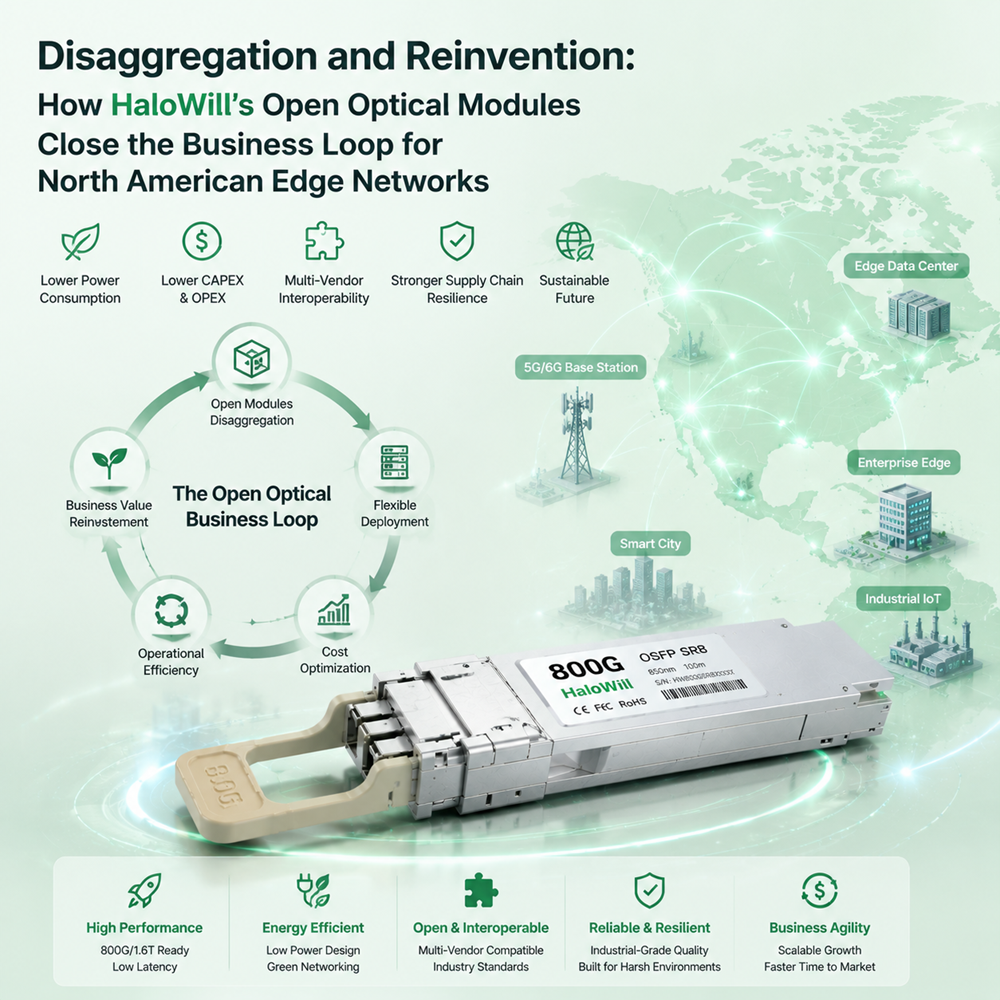

On the North American continent across the Pacific, stretching from the banks of the Columbia River in Oregon to the data center corridor in Virginia, rows of grey-white buildings are consuming astronomical amounts of electricity. What drives this energy feast is not only the ever-rising number of GPU clusters, but also an inconspicuous yet critical neural pathway — the optical interconnect network. As large-scale models like GPT synchronize gradients among millions of processors, and recommendation engines ingest hundreds of millions of feature vectors in real time, network bandwidth nearly doubles every eighteen months. Against this backdrop, 800G pluggable optical transceivers are no longer a nice-to-have enhancement; they have become an absolute necessity to keep AI infrastructure economically viable. Yet, truly packing 800G of throughput into a tiny QSFP-DD or OSFP form factor and making it operate reliably at server inlet temperatures ranging from 25°C to 55°C is far from as simple as updating a datasheet.
The core challenge can be distilled into three words: power, signal, and consistency. Inside an 800G optical transceiver, from the digital signal processor to the microring modulator, from the laser to the driver, the slightest deviation in any electronic or photonic component is magnified geometrically at high speeds. Leading North American cloud service providers have long reached a consensus: the per-bit power consumption of optical transceivers must continuously decline; otherwise, the thermal design of an entire rack will become unsustainable. This is precisely the critical area where HaloWill’s new-generation 800G product family has focused its breakthroughs. Through over two years of engineering iteration on a dual architecture combining silicon photonics integration and a 7nm DSP, we have reduced the power consumption of our 800G SR8 and DR4 modules under full load by approximately 15% compared to mainstream industry solutions. Do not underestimate that 15% — in a campus network with over 100,000 deployed transceivers, it translates into hundreds of megawatt-hours of electricity saved each year, and a meaningfully smaller investment in cooling infrastructure. For any North American data center procurement director, that is a line item on the financial statement that simply cannot be ignored.
Pure power consumption figures, however, may impress engineers but are rarely enough to persuade an entire procurement committee. In the North American market, the hidden costs of optical transceiver procurement often hide in two grey boxes labeled “compatibility” and “delivery consistency.” Any operations manager who has ever experienced a network flap will tell you that the scariest scenario is not a transceiver that fails to light up, but one that starts generating intermittent high bit error rates after two weeks of operation, causing upper-layer BGP sessions to oscillate unpredictably. HaloWill’s solution philosophy is to front-load testing resources into the scenarios that matter most to our customers. We have established two optical interconnect joint laboratories, in Silicon Valley and Dallas, equipped with the most mainstream switch platforms in the North American market — from Cisco’s Nexus 9000 series to Arista’s 7800R3 series and Juniper’s PTX series. From every production batch of HaloWill 800G modules, random samples undergo 240-hour burn-in testing and bit error rate monitoring on these real-world platforms, simulating a complete thermal cycle from cold start to maximum operating temperature. This seemingly painstaking investment is what gives our channel partners the confidence to promise end customers that HaloWill modules will work stably right out of the box — no need to cherry-pick switches, and no need to pray for a coincidental firmware version match.
If compatibility testing answers the question of “does it work,” then signal integrity optimization determines the upper limit of “how well it works.” At 800G speeds, even a few extra millimeters of impedance discontinuity along the electrical path from the switch ASIC to the transceiver’s gold fingers can cause reflections and inter-symbol interference. HaloWill’s engineering team has taken tolerance control in this process to the extreme. Through close collaboration with leading North American switch chip vendors, we have obtained actual channel parameters and inversely injected them into the joint optimization of the transceiver’s transmitter and receiver equalization algorithms. The result is that HaloWill 800G modules still deliver link margins that comfortably exceed IEEE standards in real in-rack cabling environments. Put another way, customers do not need to redesign backplanes or replace costly high-end DAC cables for extreme corner cases; stable 800G throughput can be achieved using standard copper cabling. For North American infrastructure operators already feeling supply chain pressure, this “no-hassle” smooth deployment experience is, in and of itself, an immensely compelling value proposition.
Worthy of a dedicated discussion is the east-west traffic pattern found in AI training clusters. Unlike traditional north-south internet traffic, AI training flows are highly synchronized, possess low entropy, and exhibit an intensely bursty character. When tens of thousands of GPUs complete a round of matrix operations simultaneously, they launch full-speed gradient pushes to parameter servers or peer nodes within extremely short microsecond-level time windows. This microburst traffic can instantly fill switch buffers, and if the optical transceiver’s transient response is not fast enough, it will lead to packet loss and retransmission — and every retransmission means that a portion of expensive GPU compute is wasted waiting. To address this, HaloWill has developed an “Intelligent Burst Buffer” firmware feature that introduces a tiny elastic buffer and traffic shaping inside the transceiver, working in concert with the upper-layer switch’s explicit congestion notification mechanisms to substantially reduce tail latency caused by microbursts. In a comparative field test conducted by an AI startup in Silicon Valley, deploying HaloWill 800G DR4 modules increased training throughput by 5% at an identical GPU cluster scale — precisely the kind of number that makes an AI infrastructure leader develop a strong preference for an optical transceiver brand.
Turning to market prospects, we need to shift our gaze away from technical metrics for a moment and examine the deep changes reshaping the North American optical interconnect supply chain. As geopolitics and supply chain security become hard constraints in enterprise procurement, North American distributors and channel partners are no longer chasing the lowest unit purchase price alone; they place increasing weight on supply continuity, local technical support, and long-term brand credibility. HaloWill was built precisely for this reality. We have established buffer warehousing and a customer service center in Texas for the North American market, keeping inventory of mainstream models and enabling rapid replenishment within two weeks. At the same time, our localized field application engineer team can fly to customer sites on short notice to assist with initial deployments and troubleshooting. This “global quality, local service” model transforms North American channel partners from mere component resellers into a trusted extension of their customers’ network infrastructure.
Viewed against the larger industry cycle, 800G will not be the final destination, and the pluggable optical transceiver form factor will remain mainstream for the long haul. HaloWill has already laid out advanced research on next-generation 1.6T and coherent optical transceivers, but our core philosophy has never wavered: to deliver the most mature, most stable, and most cost-effective optical interconnect products into the hands of those who are truly building the digital world. Whether you are a procurement manager at a cloud service provider planning the next hyperscale data center, or a boutique channel partner delivering holistic solutions to regional enterprise customers, HaloWill offers a solid, transparent, and long-term partnership. What stands behind this brand is not just the blinking green light on a hot-pluggable module, but a set of optical interconnect promises that can withstand the test of time: to let every strand of fiber carry the surging information flows of this intelligent era with the lowest possible energy consumption and the highest possible certainty.