
The New Map of Compute: Why Interconnect Has Become the Achilles’ Heel of AI Clusters?
In the AI large model era, measuring a computing cluster compute power is no longer just about how many GPUs it contains, but about whether those GPUs can work together as a single giant computer—the well-known “cluster efficiency” problem. As clusters scale up, interconnect bandwidth and latency become the critical variables limiting overall performance.
Current mainstream AI cluster architectures use electrical interconnects for intra-rack connections and optical interconnects for inter-rack connections. However, as rack power densities continue to rise and GPU-to-GPU data transmission rates grow exponentially, signal attenuation and crosstalk on copper electrical interconnects at distances beyond tens of centimeters have become increasingly difficult to overcome.
A new computing architecture revolution is brewing in the industry. The AI Optical Interconnect Forum at OCP Global Summit 2025 explored the latest developments in cutting-edge standards such as 448G/Lane, with AI ultra-large-scale intelligent computing cluster optical interconnects becoming a hot topic of industry discussion.
Technology Roadmap: The Evolution Logic from NPO to CPO to OIO
The evolution of next-generation optical interconnect technology can be understood along a clear “integration ladder.”
The first tier is traditional pluggable optical modules. Through years of development, pluggable solutions have reached high maturity in terms of cost and reliability, with a complete industry ecosystem and convenient maintenance. For the foreseeable future, pluggable optical modules will remain the mainstay solution for AI data centers. For ultra-large-scale AI cluster interconnect requirements, pluggable optical modules currently offer the most balanced trade-offs across bandwidth density, power efficiency, latency, cost, and reliability.
The second tier is Linear Pluggable Optics. LPO achieves significant improvements in power consumption and latency by removing DSPs or simplifying them to linear drive functions. LPO, favored for its low-power characteristics in AI data centers, is expected to capture a substantial share of the data center optical module market alongside CPO within the next five years.
The third tier is Co-packaged Optics. CPO packages optical engines and switching chips on the same substrate, dramatically shortening electrical signal transmission distances and achieving quantum leaps in power consumption and bandwidth density. CPO offers low latency, high bandwidth, and high integration, making it suitable primarily for intra-rack interconnects. However, widespread CPO adoption faces multiple challenges—packaging process complexity, interoperability ecosystem requirements, system reliability, and field maintainability all require time to resolve.
The fourth tier is Optical Input/Output. OIO aims even higher—integrating optical interconnect technology directly at the chiplet level, fully overcoming the bandwidth, power, and distance limitations of electrical interconnects for core compute domain connections.
As AI clusters continue to scale, multiple technologies will likely coexist in the medium to long term, deployed across different scenarios—CPO for intra-rack interconnects and OIO for chiplet-to-chiplet interconnects.
HaloWill Forward-Looking Positioning: A Pragmatic Innovator, Not a Radical
For North American data center operators, the evolution of optical interconnect technology is not just an engineering competition in laboratories—it is a strategic decision about infrastructure choices for the next three to five years. Given the complex landscape with multiple technology paths, how can one make choices that remain both technologically advanced and commercially pragmatic?
HaloWill approach is: provide partners with a long-term technology roadmap that ensures interconnect solutions deployed today will not rapidly depreciate due to technology iterations tomorrow.
HaloWill has deep technical expertise in silicon photonics integration, optoelectronic integrated devices, and high-speed communication modules. The company product portfolio covers optical modules ranging from 10G to 400G and beyond, laying a solid foundation for transitioning to next-generation technologies. The company focuses on the fast-growing data communications, data center, and cloud computing sectors, dedicated to independent R&D of high-speed optical communication devices and modules.
In LPO, multiple leading optical module manufacturers are actively positioning in linear pluggable optics technology, and HaloWill maintains close technology tracking and solution readiness. In silicon photonics technology, silicon photonics has become a contested domain for all optical module manufacturers. The LightCounting report projects that the adoption of LPO and CPO technologies will increase silicon photonics market share from 30% in 2025 to 60% in 2030. HaloWill will continue its R&D investment in this area.
Looking Forward: How to Make Informed Procurement Decisions?
For North American purchasers planning next-generation AI data center infrastructure, optical interconnect procurement decisions should go beyond supplier selection—they represent strategic votes for future technology paths.
HaloWill recommends a“phased evolution”strategy: in the current phase, prioritize proven pluggable optical module solutions to ensure rapid cluster deployment and stable operation; simultaneously, evaluate and validate next-generation technologies such as LPO and silicon photonics through test platforms to build technology readiness for subsequent large-scale upgrades; work with technology partners to explore the technology mix best suited to your specific business scenarios, avoiding blind investments driven by “technology for technology sake.”
Open Ecosystem: HaloWill Building the Future of Optical Interconnects with Global Partners
The evolution of optical interconnect technology is not a solo race—it is a relay requiring close collaboration across the entire industrial chain. From standardization to product development, from testing and validation to scaled deployment, true maturity of optical interconnect technology depends on tight cooperation across all links of the industry chain.
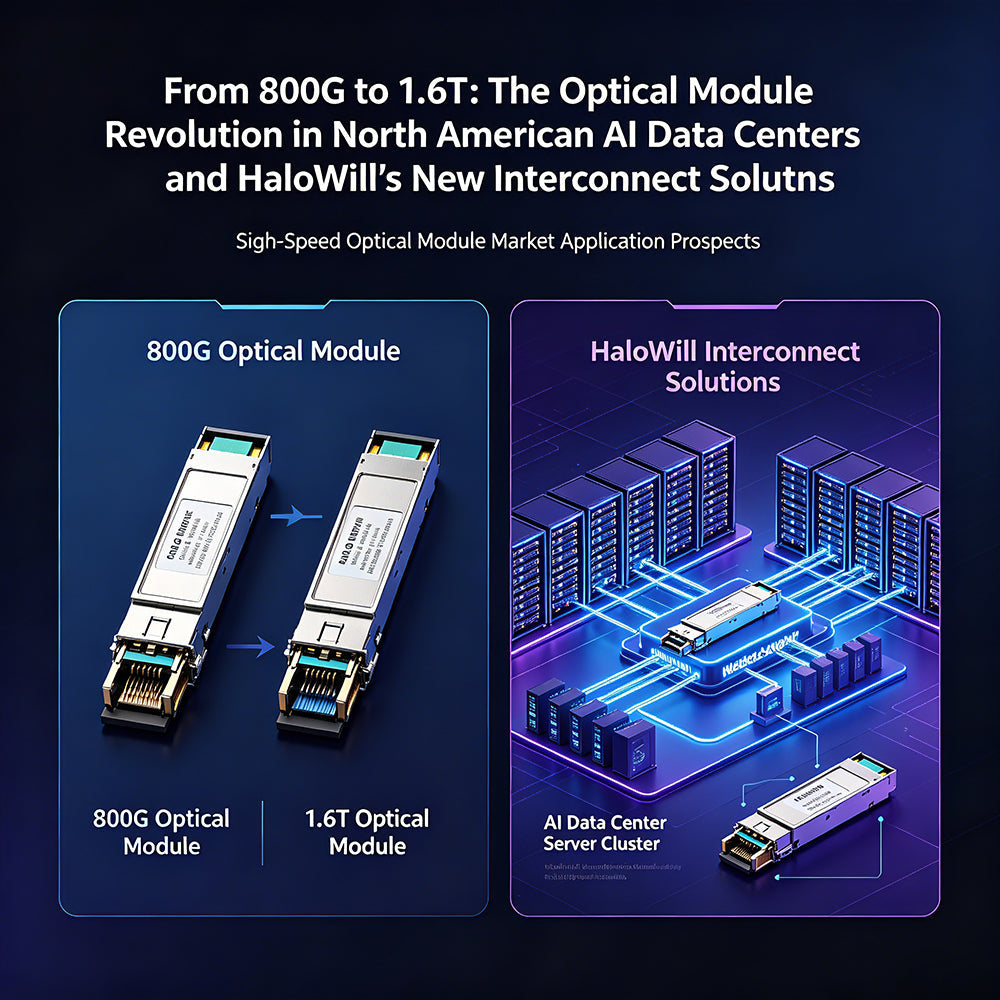
While focusing on independent R&D, HaloWill also tracks the evolution of industry standards and participates in building the global optical communications ecosystem. In 2025, the optical module industry is experiencing unprecedented compression of technology iteration cycles—the iteration cycle for 800G and 1.6T products has shortened from the traditional three to four years to less than two years. Keeping pace with customer demand is no longer sufficient; anticipating market direction a year or more in advance is essential. This is the true embodiment of HaloWill brand value—we deliver not only today products but also work with North American partners to define tomorrow optical interconnect standards.