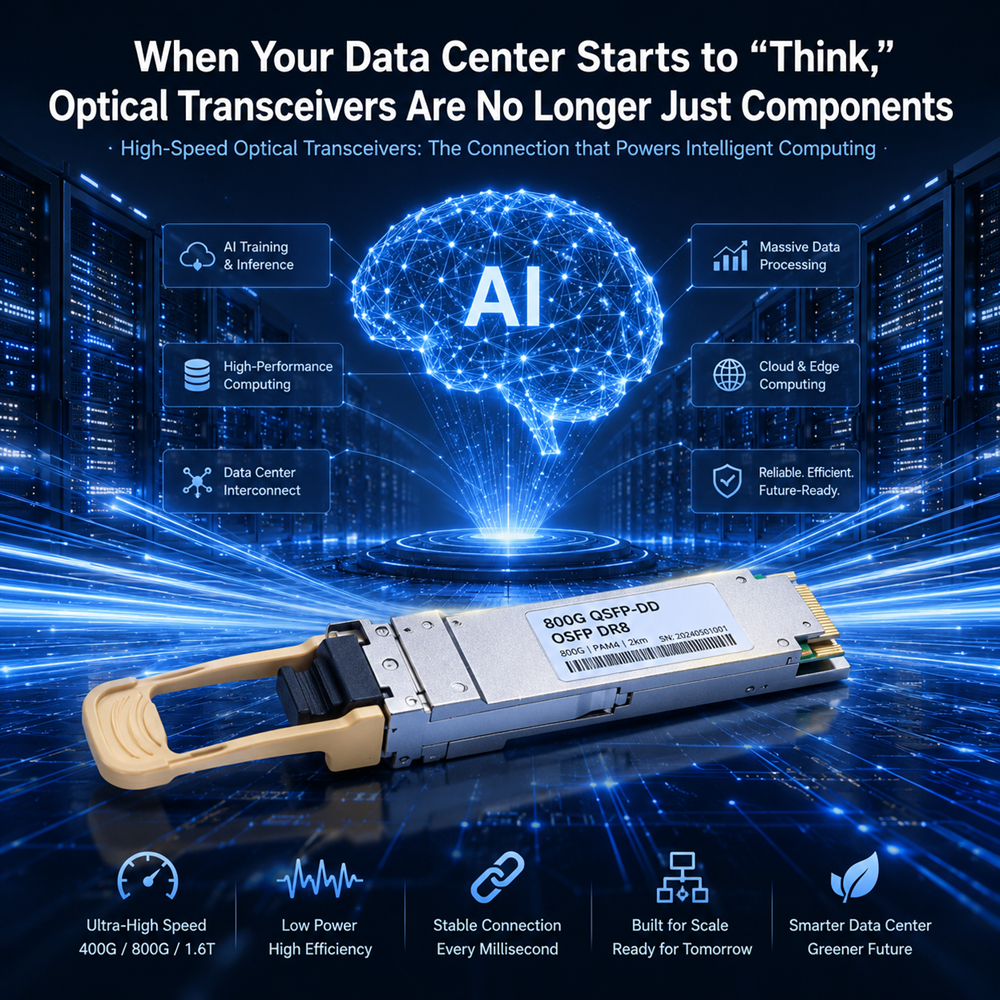

In the North American data‑center market, if you ask a procurement director what keeps them up at night, the answer might surprise you—it is not unit price, not lead time, but power consumption. This metric, once buried in the back of TCO spreadsheets, has now moved squarely to center stage in data‑center design. The reason is straightforward: a mainstream switch chip consumes roughly 500 watts, and if every port plugs into an 800G optical module that draws over 14 watts, the optics alone can easily exceed 400 watts per chassis. At that point, power delivery, cooling, and rack space are all teetering on the edge of alarm. When HaloWill’s engineering team visited Silicon Valley customers last year, they heard the same lament more than once: “We’re not buying optical modules—we’re buying heat modules.”
That sigh became the starting point for HaloWill’s eighth‑generation 800G product line. We knew that a breakthrough in power could not rely on a single gimmick; it required a systemic re‑architecture across three dimensions: topology, fabrication, and software. The result crystallized into what we call the CoolLight™ low‑power platform.
Our first lever was the driver architecture. Traditional 800G modules commonly use a DSP‑retiming architecture—the incoming signal is fully recovered and regenerated inside the module. That delivers excellent signal integrity, but at the cost of nearly 4 watts burned by the DSP itself. For the mainstream data‑center links of 500 meters to 2 kilometers, HaloWill chose to push forward with a linear direct‑drive approach. We offload part of the complex signal‑recovery responsibility back to the switch‑side SerDes, redistributing the equalization burden using the channel‑signature library we have accumulated through DSP tuning. This decision eliminated the single largest heat source from the transmit chain. The result was immediate: our linear 800G‑DR8 modules now operate at a typical power of under 9 watts—a drop of more than one‑third compared to conventional DSP‑based designs. For a data center deploying tens of thousands of modules, every saved watt directly translates into lower PUE and more headroom in the power budget.
The second lever was a revolution in the optical path itself. Rather than taking the shortcut of acquiring an outside silicon‑photonics house, HaloWill chose a more grounded, in‑house path. We collaborated with leading North American silicon‑photonic foundries to develop a new heterogeneous integration process that combines modulators, detectors, and passive waveguide devices on a single silicon substrate, with passive optical coupling directly to the fiber array. This process eliminates the redundant losses from multiple coupling and bonding steps in traditional discrete optical assemblies, cutting the intrinsic insertion loss of the optical path by nearly 2 decibels. In optical communications, lower insertion loss directly means lower laser drive current, which in turn reduces both power and heat dissipation. When our first samples passed traffic at a customer’s lab, their engineer looked at the thermal camera—showing a cool blue region—and muttered, “Now that’s what I call proper.”
The third lever is less visible on paper but delivers a non‑negligible energy‑saving contribution in actual network operation: intelligent sleep. This is not a crude “turn off the laser when there is no traffic,” because idle links are rare inside a data center. HaloWill’s approach is “link‑aware dynamic bias”: the module continuously monitors the actual error‑margin, and when link quality is excellent, it automatically adjusts the laser bias point and drive swing to a more economical setting, shaving off another half‑watt to a watt. The moment degradation is detected, it snaps back to full‑performance mode in nanoseconds. This subtle, “silent” energy saving is completely transparent to traffic, yet it makes the annual electricity bill noticeably gentler across the entire fleet.
For North American procurement professionals, the dividends of low power ultimately must be translated into business terms. Saving 4 watts per module, for 100,000 modules, saves over 3.5 gigawatt‑hours of electricity per year. In regions like California or Virginia, where electricity rates are high and carbon regulations are strict, that translates into a substantial carbon‑credit ledger and more headroom for government energy‑efficiency compliance. HaloWill has proactively included detailed power‑curve and energy‑model data in product documentation, rather than offering just a single typical value. We want customers to be able to calculate a true 3‑ to 5‑year total energy cost, not just compare a cold purchase‑price list.
As the entire industry races toward 800G, HaloWill has chosen a different dimension: applying the brakes firmly at the precipice of power. That does not mean we are slowing down—quite the opposite. We are shedding the weight from data centers, enabling them to use the same power budget to light up more compute. This is HaloWill’s commitment to the North American market: what we deliver is not a hot module, but a cool, composed optical pathway.