
2026: A Critical Inflection Point for the AI Optical Module Market
If you are responsible for optical module procurement for North American data centers, you’ve undoubtedly felt the heat of the market. According to the latest research from TrendForce, the global AI optical transceiver market is projected to surge from
16.5billionin2025to26 billion in 2026, representing an annual growth rate exceeding 57%. This is not merely a numerical increase—it signifies a profound reshaping of the entire industry chain, from demand structure to supply landscape.
The relentless expansion of North American hyperscale data centers is the primary driving force behind this transformation. Cloud giants such as Google, Microsoft, and Meta are experiencing data center traffic growth exceeding 30% annually, compelling them to continuously scale up GPU and AI server deployments, which in turn fuels procurement demand for high-speed optical interconnect products. 800G optical modules have become the mainstream standard for AI data center backbone interconnects, while 1.6T products are rapidly moving into volume production—the next upgrade cycle has already begun.
This growth is not a simple linear extension. The explosion of AI training and inference demands has dramatically compressed data center network upgrade cycles, shortening the bandwidth doubling cadence from a previous 3–4 years to approximately every 2 years, creating structural upgrade momentum. For buyers and distributors, this translates into faster product iteration rhythms, more pressing delivery windows, and higher requirements for supply chain flexibility.
Deep Supply Chain Challenges: Core Pain Points for Buyers
Yet behind the market’s rapid growth lie risks that cannot be ignored. The persistent shortage of core optoelectronic chips has become the primary bottleneck constraining capacity expansion. Tight supply of key components such as EML lasers and CW-LD continues, affecting not only delivery lead times but also intensifying price volatility.
Another often-overlooked bottleneck lies further upstream in the materials segment—market shortage rates for Faraday rotator garnet (the core material for optical isolators) have reached as high as 50%, severely constraining optical isolator shipments and, in turn, holding back final optical module deliveries. At the same time, production capacity for 200G EML chips in 2026 is projected to fall short of 50 million units, forcing the industry to accelerate migration toward silicon photonics solutions. It is expected that in the 1.6T era, silicon photonics will account for 60% of the market.
These supply chain challenges add a new dimension to procurement decision-making. Choosing a supplier is no longer just about price and performance; it is increasingly about the supplier’s comprehensive capabilities in upstream resource integration, capacity planning, and technology roadmap positioning. A partner that can maintain delivery stability amid chip supply fluctuations offers value that far exceeds the quoted price itself.
HaloWill's Value Proposition: Building a Reliable Supply Chain Bridge
In this market landscape, HaloWill offers North American customers a procurement option that combines professionalism with flexibility.
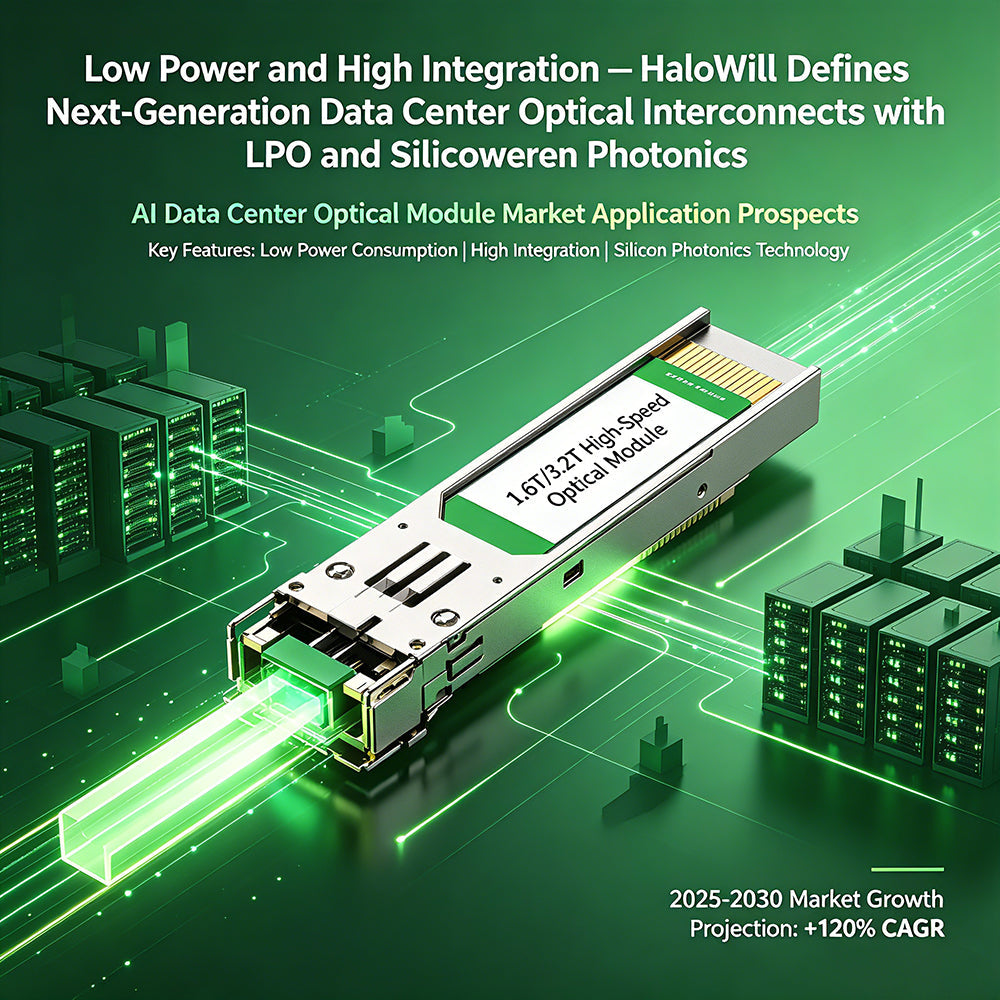
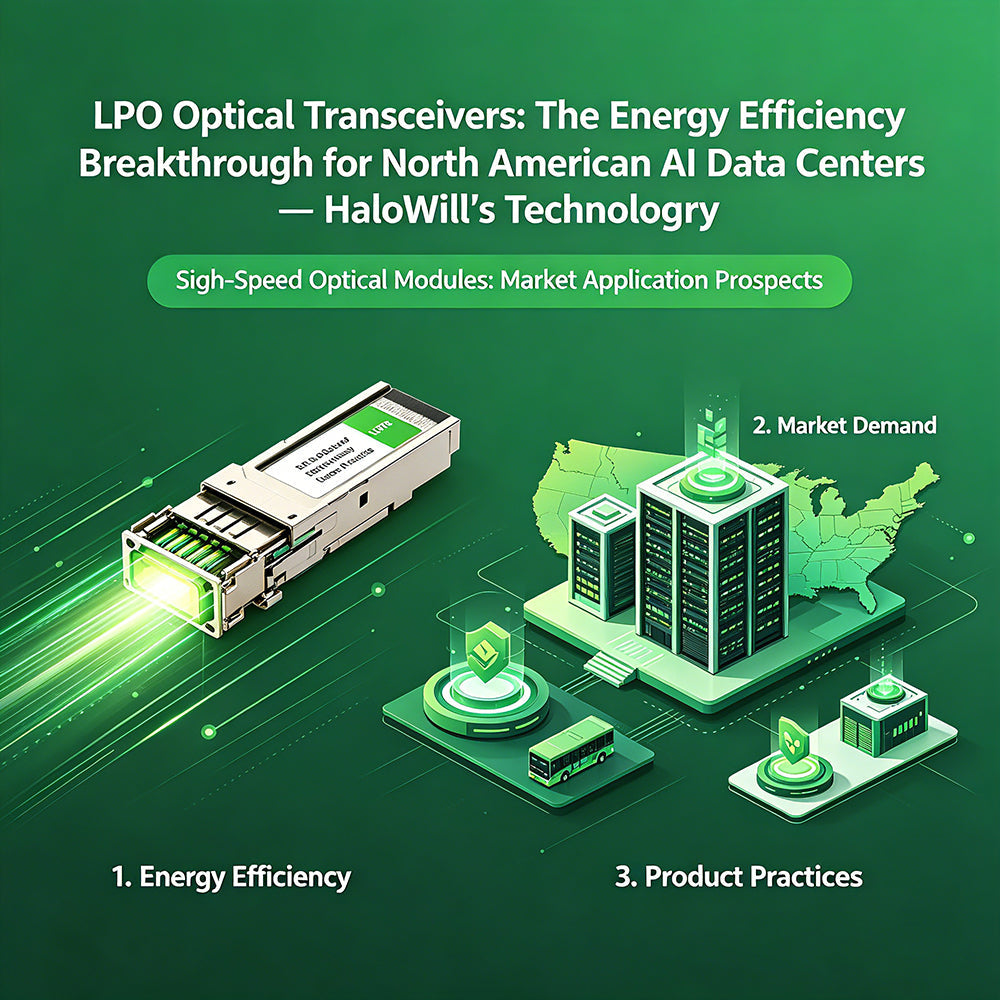
HaloWill focuses on 800G OSFP/QSFP-DD and 1.6T DR8/LPO optical module product lines, covering transmission distances from 50 meters to 500 meters. The products feature ultra-low-power designs and are engineered specifically for high-density AI cluster environments, significantly reducing operational overhead in large-scale GPU deployment scenarios. HaloWill deeply understands that in an AI data center, every watt of power saved translates into a substantial cost advantage when scaled across clusters of thousands of servers.
More critically, HaloWill’s technology roadmap fully aligns with the industry’s evolution toward silicon photonics integration. As traditional EML-based solutions face rising prices and supply shortages, silicon photonics has become an irreversible direction. HaloWill’s silicon photonics product portfolio is built upon a mature CW laser ecosystem, enabling a more favorable cost structure and greater supply resilience to meet North American customers’ demands for 1.6T and future higher-speed products.
For North American distributors and buyers, HaloWill's value extends beyond the products themselves to its unique positioning as a global supply chain node. HaloWill integrates Asia’s leading manufacturing capabilities with North American market quality standards, enabling responsive customer service with flexible MOQs and agile delivery lead times. This “global resources, local service” model provides customers with a rare and valuable degree of certainty in today’s volatile supply chain environment.
The Road Ahead: Seizing the Golden Window of North American AI Infrastructure
2026 is a pivotal transitional year for the optical module industry. The dual trends of 800G volume ramp and 1.6T accelerated commercialization present a clear window for procurement decisions—this is the moment to lock in quality capacity and establish strategic supplier relationships. Over the next 12 to 18 months, the ability to ensure stable, large-scale delivery will be the dividing line between market winners and followers.
HaloWill is fully prepared, with a complete product matrix, a reliable quality system, and a competitive cost structure, to wholeheartedly support North American customers in seizing the historic opportunity of AI infrastructure build-out.