
The AI Data Center: A New Growth Engine
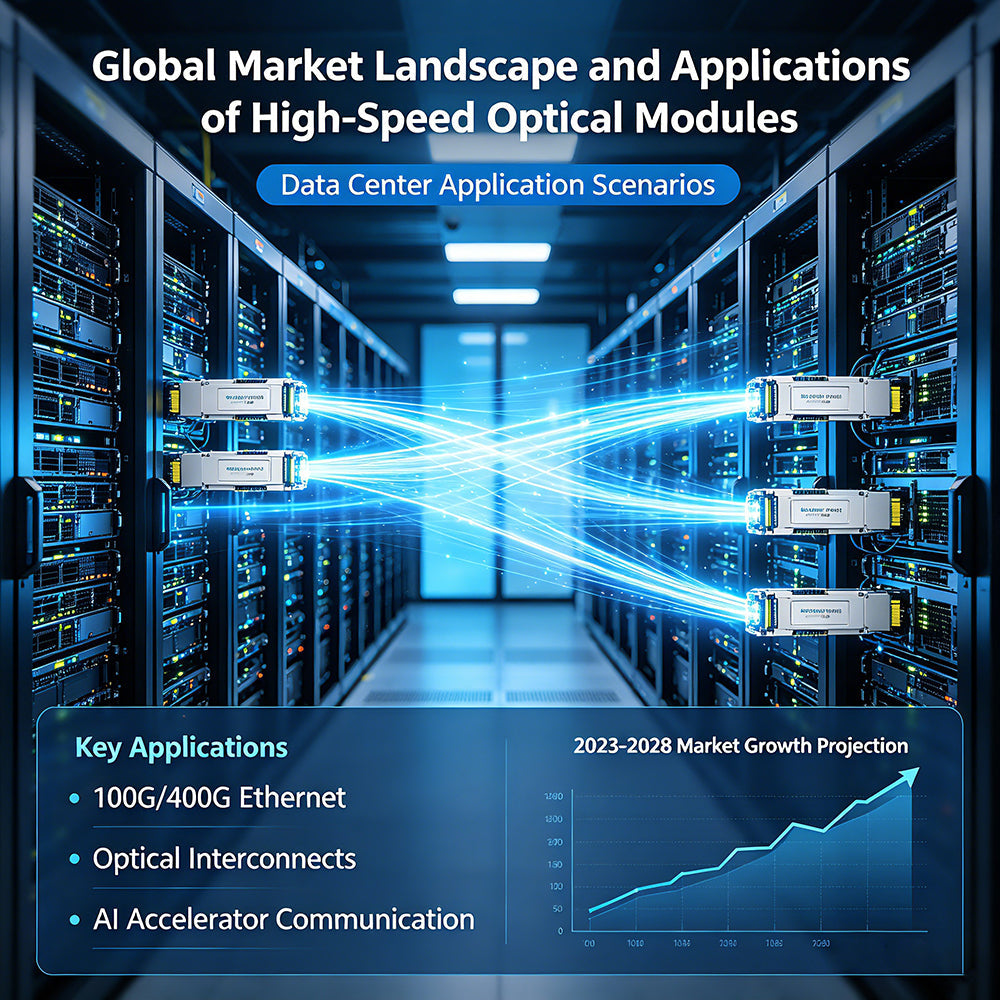
The single most powerful catalyst driving optical transceiver demand today is the rapid build-out of AI-optimized data centers. According to TrendForce, the global market for AI-specific optical transceivers is projected to grow from USD 16.5 billion in 2025 to USD 26 billion in 2026 — a year-over-year increase exceeding 57%. This extraordinary growth trajectory reflects not merely a cyclical upswing but a structural shift in how data centers are architected.
AI training and inference workloads place unprecedented demands on data center networking. Large language model (LLM) training clusters comprising thousands of GPUs require high-bandwidth, low-latency optical interconnects to function as a unified computing fabric. As Cignal AI Chief Analyst Dr. Scott Wilkinson noted, in 2024 alone, deployments of 400G and higher-speed optical modules grew by over 250% year-over-year, with 2025 projected to see an additional 50%+ growth.
From an architectural perspective, AI data centers are transitioning from single-node designs to hierarchical collaborative interconnection models encompassing three dimensions: Scale-Up (intra-rack), Scale-Out (cross-rack), and Scale-Across (cross-data center). Each dimension imposes distinct requirements on optical transceiver performance, reach, and power efficiency, creating a multi-layered demand landscape that rewards suppliers with broad product portfolios.
800G: Today‘s Mainstream, Tomorrow’s Baseline
In 2025, 800G optical transceivers have firmly established themselves as the backbone of AI data center interconnects. North American hyperscale data centers — operated by Google, Microsoft, Meta, and others — are experiencing annual traffic growth exceeding 30%, driving sustained procurement of 800G modules.
The numbers are compelling. Industry forecasts indicate that global 800G optical transceiver shipments will reach approximately 18–19.9 million units in 2025, effectively doubling year-over-year. LightCounting reports confirm that 800G Ethernet transceiver sales are the primary driver of market recovery in Q2 2025 and beyond, with overall optical transceiver sales expected to rise approximately 10% quarter-over-quarter.
Several factors underpin this volume growth:
- GPU clustering requirements: A single AI training cluster may require thousands of 800G optical links to interconnect GPUs across server racks, creating a direct multiplier effect between GPU deployments and transceiver demand.
- Network topology evolution: The shift from traditional three-tier architectures to spine-and-leaf and rail-optimized designs increases the number of optical ports per compute node.
- Bandwidth scaling: As GPU compute capability doubles roughly every two years, network bandwidth must scale commensurately to prevent interconnect bottlenecks.
Price dynamics are also evolving favorably for deployers. Industry contracts typically require price reductions twice per year, with per-Gbps costs projected to approach approximately USD 0.5 by 2027, improving the total cost of ownership (TCO) for large-scale deployments.
1.6T: The Next Frontier Enters Commercialization
While 800G dominates current deployments, the 1.6T transition has already begun. 2025 marks the commercial introduction year for 1.6T optical transceivers, with global demand estimated at 2.5–3.5 million units. By 2026, shipments are projected to accelerate to 10–12 million units, representing approximately 15–20% of the total optical transceiver market.
The transition to 1.6T is driven by several converging factors:
- Next-generation switch silicon: 51.2T and 102.4T switching ASICs require 1.6T optical ports to maintain radix and density, creating a direct technology pull.
- AI cluster scaling: As AI models grow from hundreds of billions to trillions of parameters, the interconnect bandwidth per GPU must increase proportionally.
- 224 Gbps electrical lane migration: The industry-wide transition from 112 Gbps to 224 Gbps PAM4 electrical lanes enables native 1.6T optical module designs.
Cisco‘s Optical Systems and Optics group projects that AI optics will be the primary growth contributor to the data center optics market over the next five years, with the total addressable market (TAM) exceeding USD 20 billion annually by 2030, supporting speeds from 400G through 3.2T.
Supply-Side Constraints and Strategic Implications
The demand boom has exposed significant supply-side constraints. Core optoelectronic chips — particularly electro-absorption modulated lasers (EMLs) and continuous-wave laser diodes (CW-LDs) — remain in tight supply, representing the primary bottleneck to production capacity expansion.
This constraint has triggered several strategic responses across the industry:
- Long-term agreements (LTAs): NVIDIA and other major purchasers have shifted toward LTAs to lock in critical component supply, mirroring practices in the broader semiconductor industry.
- Technology diversification: The industry is accelerating development of alternative architectures, including linear-drive pluggable optics (LPO) and silicon photonics integration, to reduce reliance on traditional DSP-heavy designs.
- Manufacturing regionalization: Leading suppliers are expanding production capacity in Southeast Asia, though the availability of skilled technical personnel remains a constraint, with qualified engineer training periods typically requiring 12–18 months.
For procurement professionals, these supply dynamics underscore the importance of diversifying supplier relationships and maintaining strategic inventory buffers, particularly for 800G and emerging 1.6T module categories.
Looking Ahead: 3.2T and Beyond
While 1.6T commercialization is just beginning, the industry is already laying groundwork for 3.2T optical transceivers, with initial deployments projected around 2029. This trajectory reflects the broader reality of AI-driven networking: bandwidth demand is not merely growing — it is accelerating.
Bank of America Securities analysts have characterized the current period as a “super cycle” for optical communications, driven by the architectural shift toward Scale-Across data center designs. This suggests that the optical transceiver market‘s growth may outpace even current projections as AI workloads become more distributed and data center interconnect (DCI) requirements intensify.
The optical transceiver market is at an inflection point. AI data center build-outs are driving unprecedented demand for 800G modules today, while the 1.6T transition accelerates and 3.2T appears on the horizon. For organizations deploying or procuring optical networking infrastructure, the key imperatives are clear: plan for multi-generational speed transitions, secure supply chain relationships proactively, and evaluate total cost of ownership across the full product lifecycle.