
In technical discussions across the optical communications industry, CPO (co‑packaged optics) is undoubtedly one of the hottest topics. Analyst reports, industry conference agendas, and even stock price movements have all revolved around this concept. Yet for North American procurement decision‑makers who are actively planning data‑center network upgrades, a far more practical question presents itself: which technology path should we invest in today?
The answer may be clearer than many assume. Research from multiple institutions indicates that for the foreseeable future, pluggable optical modules and CPO will develop in parallel and coexist over the long term. Within scale‑out networks—the largest segment of market demand—pluggable optical modules will continue to hold an absolute dominant position for years to come. In other words, CPO is a direction worth watching, but pluggable solutions are the most pragmatic choice for today.
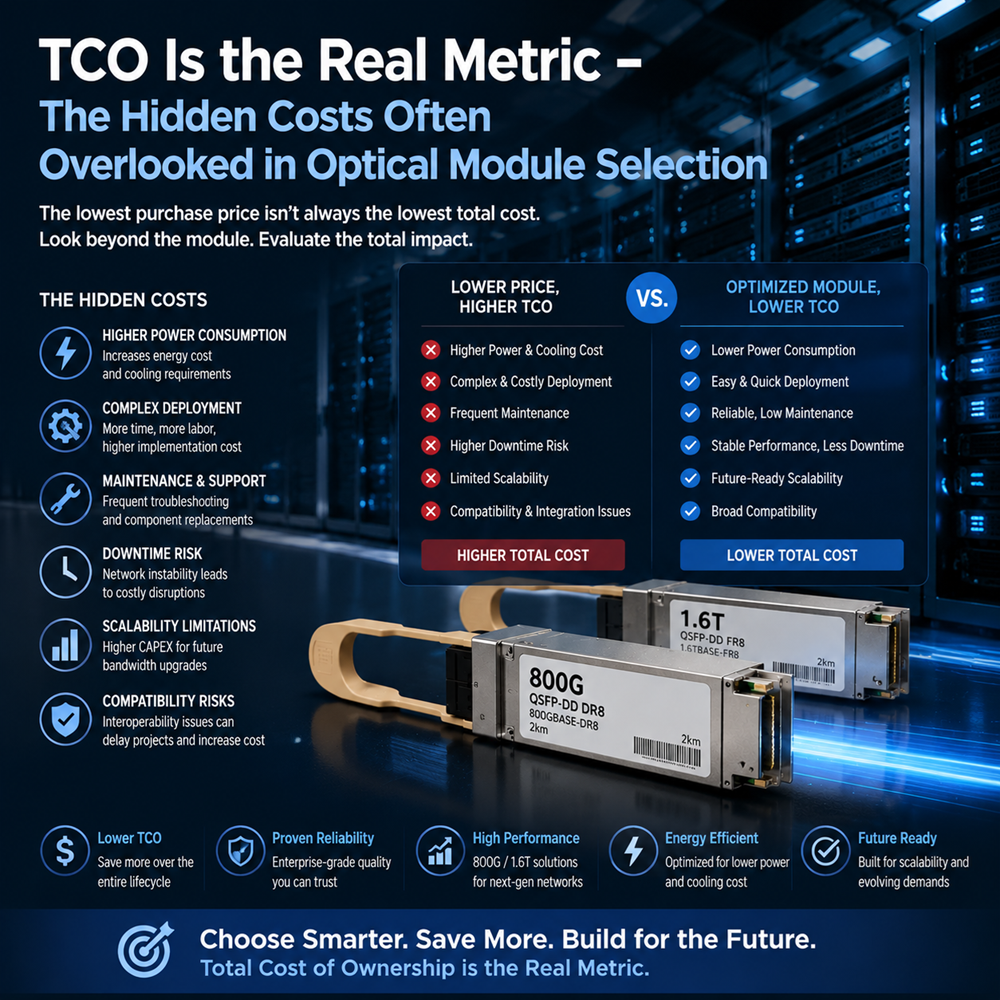
Why do pluggable optical modules remain irreplaceable as the mainstream? First is deployment flexibility. Pluggable modules support hot‑swapping, so a failed module can be replaced individually, whereas with CPO, a failure often requires replacing the entire packaged module, incurring extremely high maintenance costs. Second is the gap in technological maturity—CPO faces a series of engineering challenges including fiber‑to‑photonic‑IC alignment precision, thermal management, and reliability design, with mass‑scale adoption not expected until after 2027. Third is supply‑chain reality—currently only Broadcom can supply CPO switches, and that availability is very limited. Fourth is cost considerations—CPO modules carry a 30%–40% price premium over traditional solutions, with a 1.6T CPO module potentially exceeding $5,000.
Against this technology landscape, HaloWill’s pluggable optical module portfolio offers North American data centers a choice that is both forward‑looking and pragmatic. The company’s product lineup comprehensively covers 100G, 400G, 800G, and 1.6T interconnect speeds, supporting industry‑standard form factors such as QSFP‑DD and OSFP. This means that North American buyers can achieve a smooth upgrade from 400G to 800G and onward to 1.6T without altering their existing network architecture.
Of particular note is HaloWill’s breakthrough in LPO (linear direct‑drive pluggable optics) technology. The company’s 1.6T LPO optical module has achieved power consumption as low as 10 watts, representing an approximately 60% reduction compared to traditional DSP‑based optical modules. This technological advance directly addresses the biggest pain point for AI data centers—energy consumption. In hyperscale data centers, the power difference across tens of thousands of optical modules translates directly into millions of dollars in electricity bills and corresponding carbon footprints.
Another often‑underestimated value is HaloWill’s deep accumulation in silicon‑photonics technology. The company has developed and mass‑produced 400G and 800G silicon‑photonic modules. Silicon photonics, with its “low power, low cost” advantages, is rapidly becoming the mainstream technology direction for high‑speed optical modules. LightCounting notes that in 2026, silicon‑photonics‑based optical module sales will exceed 50% of the total market for the first time. HaloWill’s early positioning in the silicon‑photonics space enables it to find a better balance among cost, power, and performance.
For North American procurement decision‑makers, the choice of technology path has never been an either‑or proposition. Pluggable optical modules and CPO will each serve their respective roles in different scenarios. But at this point in time, choosing HaloWill’s mature, reliable, and low‑TCO pluggable solutions is undoubtedly the most rational decision to ensure the smooth progress of your data‑center expansion plans.