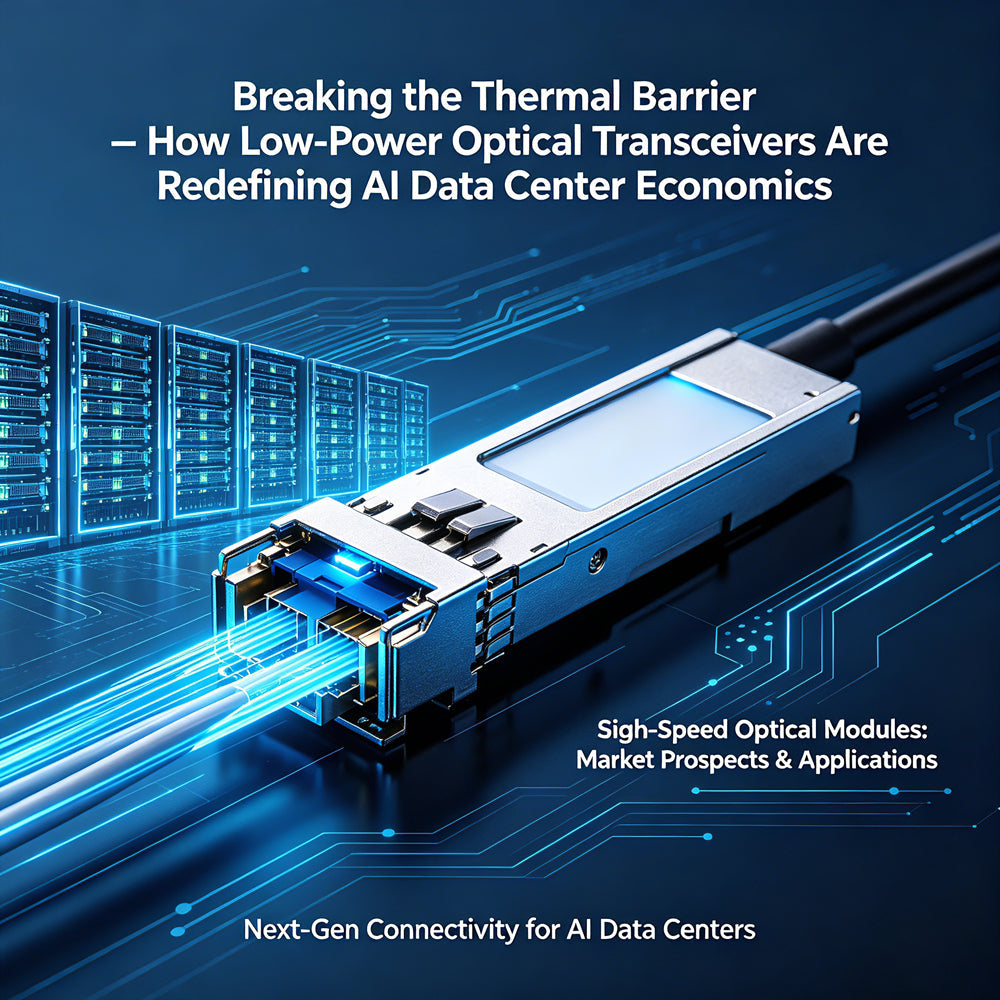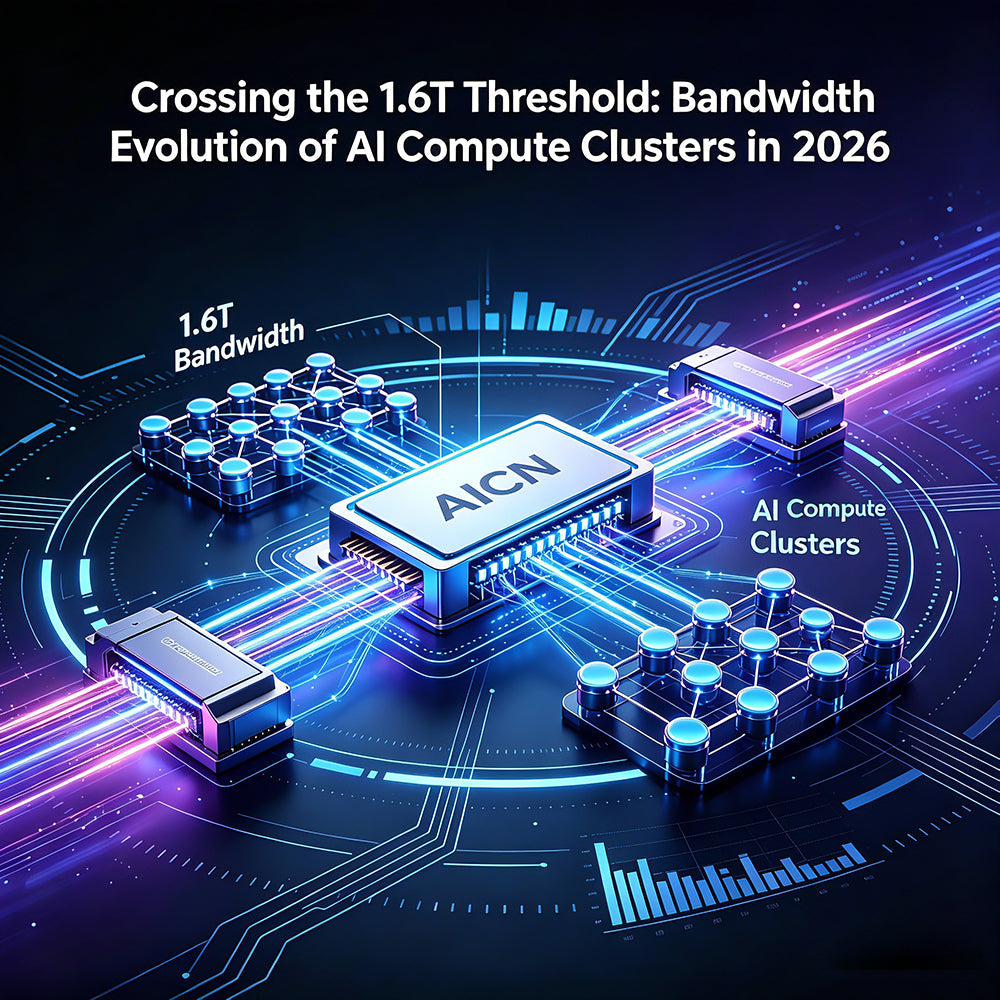
- In the AI computing battlefield of 2026, the definition of efficiency is quietly shifting. If 1.6T represents the "speed" of the network, then LPO (Linear-drive Pluggable Optics) represents its "depth." As single-GPU power consumption breaks through the 1000W barrier in 2026, data center power and cooling budgets have approached their critical limits. Against this backdrop, optical transceivers—once regarded as mere "peripheral accessories"—now account for over 40% of a switch's total power consumption, becoming the core battleground for energy efficiency optimization.
- Traditional optical modules are "heavyweight" processors, integrating complex Digital Signal Processing (DSP) chips. While DSPs provide powerful signal regeneration, the cost is high: the DSP inside a single 800G module typically consumes 6W to 8W of power and introduces approximately 10 nanoseconds of inherent latency. In small-scale networks, this may be negligible; however, in AI training fabrics with tens of thousands of nodes requiring extreme synchronization, these accumulated power draws and latencies lead to a pronounced "tail effect," dragging down overall training speeds.
- The emergence of HaloWill's 800G LPO modules marks a victory for "decentralized" thinking in optical communications. The core of LPO technology is the removal of the DSP chip from the module, instead relying on the powerful SerDes equalization capabilities of host-side switches (such as Broadcom Tomahawk 5 or NVIDIA Spectrum-4) to compensate for signal loss. Through this radical simplification, HaloWill has successfully reduced the power consumption of a single 800G module from 16W to below 8W—a 50% reduction. For a large North American data center with 32,000 interconnect ports, adopting the HaloWill LPO solution means saving over 2 million kWh of electricity annually, directly translating into significant OPEX savings and PUE optimization.
- Beyond energy efficiency, the feature of LPO most favored by North American AI research institutions such as OpenAI and Anthropic is its near-physical-limit ultra-low latency. AI training tasks are essentially highly synchronous parallel computing processes; at the end of every step, all GPUs must exchange gradients. LPO technology eliminates the signal encoding and decoding process of the DSP, compressing electro-optical conversion latency to the sub-microsecond level. This "deterministic latency" is crucial for Ethernet fabrics running the RoCE v2 protocol, significantly reducing the frequency of Congestion Control (ECN) triggers and maintaining network stability under peak loads.
- HaloWill has concentrated its LPO R&D efforts on overcoming the industry challenge of "link robustness." Without the signal regeneration provided by a DSP, LPO modules are extremely sensitive to environmental noise and connector contamination. HaloWill employs industry-leading high-linearity TIA (Trans-impedance Amplifier) and Driver chips, combined with self-developed analog equalization technology, to achieve a link budget margin 3dB higher than the standard specification over 500-meter OM4 multimode fiber transmissions. This means that even in harsh data center construction environments, HaloWill LPO modules can maintain extremely low retransmission rates, ensuring uninterrupted AI training tasks.
- In the North American market, rising electricity prices and increasingly stringent ESG compliance requirements have made green computing a hard asset. Neocloud service providers such as Vultr are leveraging global nodes to offer cost-effective GPU compute. Through collaborations with such platforms, HaloWill has validated the reliability of LPO technology in large-scale, cross-regional clusters. For North American customers purchasing through our Shopify store, HaloWill provides not only hardware but also a comprehensive "ASIC-Transceiver Compatibility Matrix," helping engineers quickly select the most suitable LPO configuration based on their existing Mellanox or Arista switches.
- The future of Green AI should not come at the expense of performance. HaloWill's 800G LPO transceivers, with their extreme energy efficiency and near-zero latency, offer a sustainable evolutionary path for the computing infrastructure of 2026.