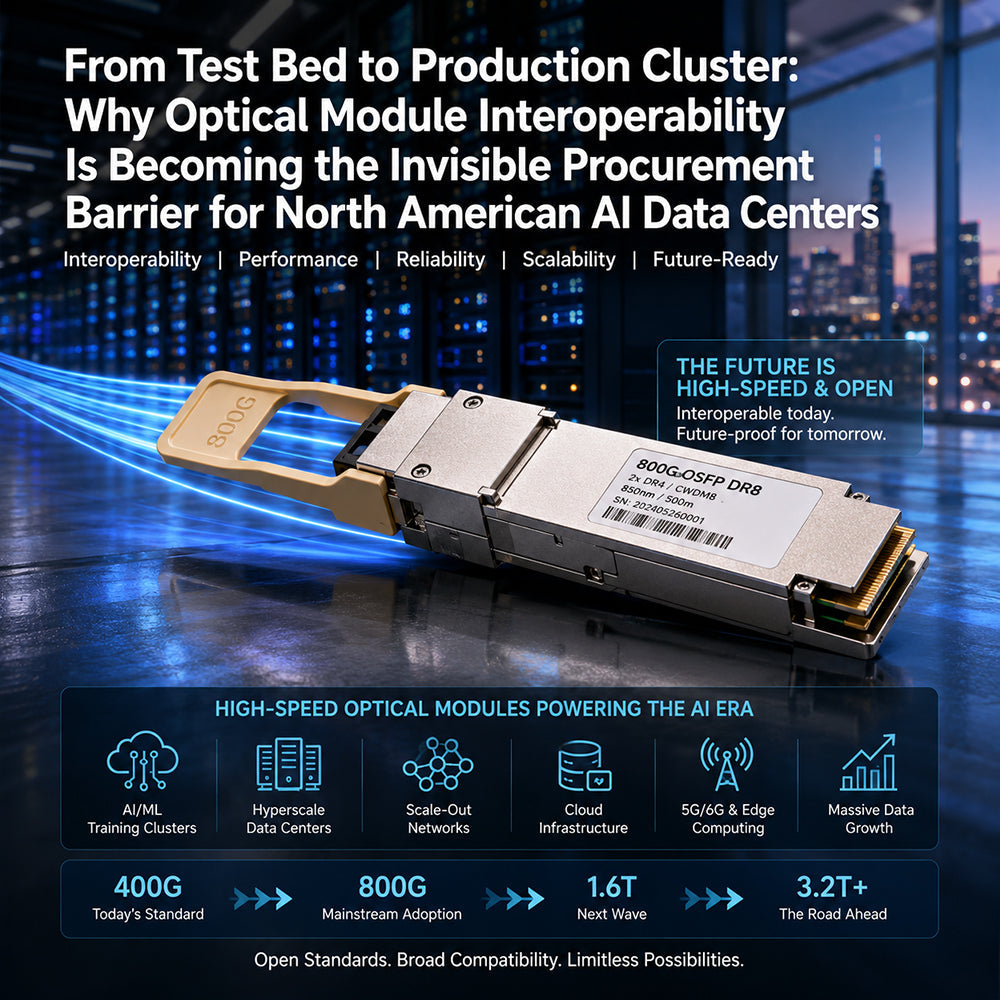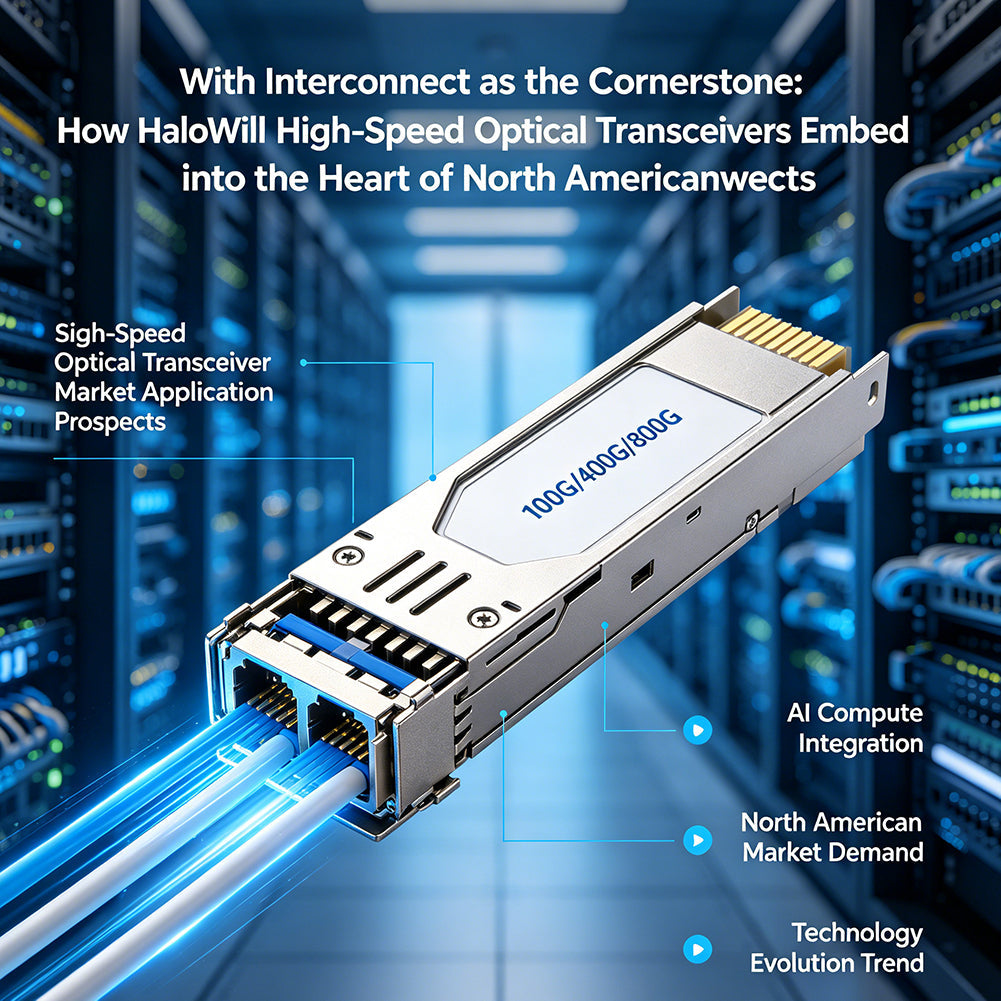

In the data center corridors of Northern Virginia, utility companies are beginning to cautiously allocate power capacity for new AI halls, because the electricity demand of a single AI cluster now rivals that of a small town. As data center operators treat performance-per-watt as the new hard currency, optical interconnect modules—a seemingly modest component—have suddenly become a critical line item on the power ledger: within a cluster fully loaded with 51.2T switches, optical transceivers can account for over 15% of total network power consumption. It is within this extreme thirst for energy efficiency that Linear-drive Pluggable Optics (LPO) has rapidly transitioned from an industry seminar topic to a concrete deployment plan for North American hyperscale users. HaloWill has keenly captured this structural shift and is among the first to launch a rigorously interoperability-validated 800G LPO product family, helping customers "unshackle" kilowatts of energy from their power budgets so that AI growth is no longer constrained by power allocation caps.
The core philosophy of LPO is that simplicity equals efficiency. Traditional pluggable optical transceivers must integrate a high-power Digital Signal Processor (DSP) to recover signals and compensate for link impairments, whereas LPO directly drives the optical transmitter with linear signals from the switch ASIC's SerDes, relying on the system-side chip's DSP capabilities to handle equalization. This architectural subtraction brings disruptive benefits: the power consumption of HaloWill 800G LPO transceivers under typical operating conditions plummets to around 8 watts—roughly half that of a DSP-based module at the same speed—while end-to-end latency drops to the nanosecond level. For 10,000-GPU AI clusters that require strict synchronization of gradient updates, this translates into cumulatively significant physical time saved during every training iteration. For North American buyers, this power reduction means lighter cooling infrastructure, lower immediate electricity costs, and the ability to deploy compute more densely. In campuses where power supply is constrained, every saved watt can be converted into additional GPU deployment capacity.
However, the North American market does not pay for a "new technology label" alone; reliability and interoperability are the decisive thresholds determining whether linear-drive optical transceivers can move from the lab to large-scale deployment. HaloWill's approach is not to avoid the issue, but to dispel doubts with engineering evidence. We fully understand that removing the DSP tightens the link budget, so we have specially optimized the linear driver circuitry within the optical engine and adopted algorithms for adaptive pre-emphasis tailored to link length and connector loss. Meanwhile, the HaloWill 800G LPO module retains a complete digital diagnostic monitoring function internally, reporting real-time optical power, temperature, voltage, and link status, and using enhanced bit error statistics to help network administrators precisely locate degraded links. This design makes it virtually indistinguishable from standard DSP modules on an operator's dashboard. In multiple rounds of joint testing with Broadcom Tomahawk 5 and mainstream switch platforms, HaloWill LPO modules have achieved over 2,000 hours of stable, zero-packet-loss operation at full load, breaking through the market fog of skepticism regarding LPO reliability.
HaloWill's brand appeal lies in always placing the commercial success of our North American partners front and center. We recognize that when promoting a new technology, channel partners need sufficient knowledge empowerment and trust endorsement. Therefore, HaloWill not only offers an extended five-year warranty on the LPO product line but has also launched the "LPO Hands-On Certification Workshop"for North American resellers, providing comprehensive empowerment covering link design rules, switch firmware compatibility, and on-site troubleshooting. Even more reassuring for partners is that HaloWill enforces a strict channel protection policy, offering rigorous price protection and opportunity lock-in for projects introduced through certified channel partners, ensuring they have the full motivation to introduce this high-value product to the data center clients they serve over the long term. This strategy of "product leadership, channel mutual success" is attracting a growing number of regional infrastructure VARs and national integrators across North America to join the HaloWill partner network.
From a broader industry perspective, linear-drive optical transceivers are driving data center architectures toward fully linear, low-power "green backend networks." The Open Compute Project (OCP) has initiated LPO standardization work, and the IEEE P802.3dj standard is also paying close attention to linear optical interfaces. This signifies that LPO is no longer a niche experiment but will become a core player in future mainstream interconnect specifications. HaloWill has proactively aligned with standardized interfaces, ensuring that the firmware of its 800G LPO modules can smoothly upgrade as specifications evolve, protecting customer investments from lock-in risk. For procurement decision-makers at publicly listed North American companies who must address ESG reporting disclosures and energy efficiency regulations, choosing HaloWill LPO is not merely a technology purchase; it is a quantifiable carbon emission reduction commitment—replacing traditional modules with every 10,000 HaloWill LPO units deployed reduces annual carbon emissions equivalent to the carbon sequestration capacity of 70 acres of forest. This arms procurement departments with highly persuasive material in the corporate sustainability narrative.
We welcome more North American channel partners and OEM partners to request the HaloWill LPO evaluation board and test it under your most stringent thermal chambers and traffic models. When the power consumption curve is redrawn and latency is compressed to its limit, what the HaloWill linear-drive optical transceiver carries is the confidence to help the entire AI data center industry cross the energy-efficiency inflection point. Unplug the DSP and plug in HaloWill LPO—this is not just a physical action, but a wise vote for a sustainable computing future.