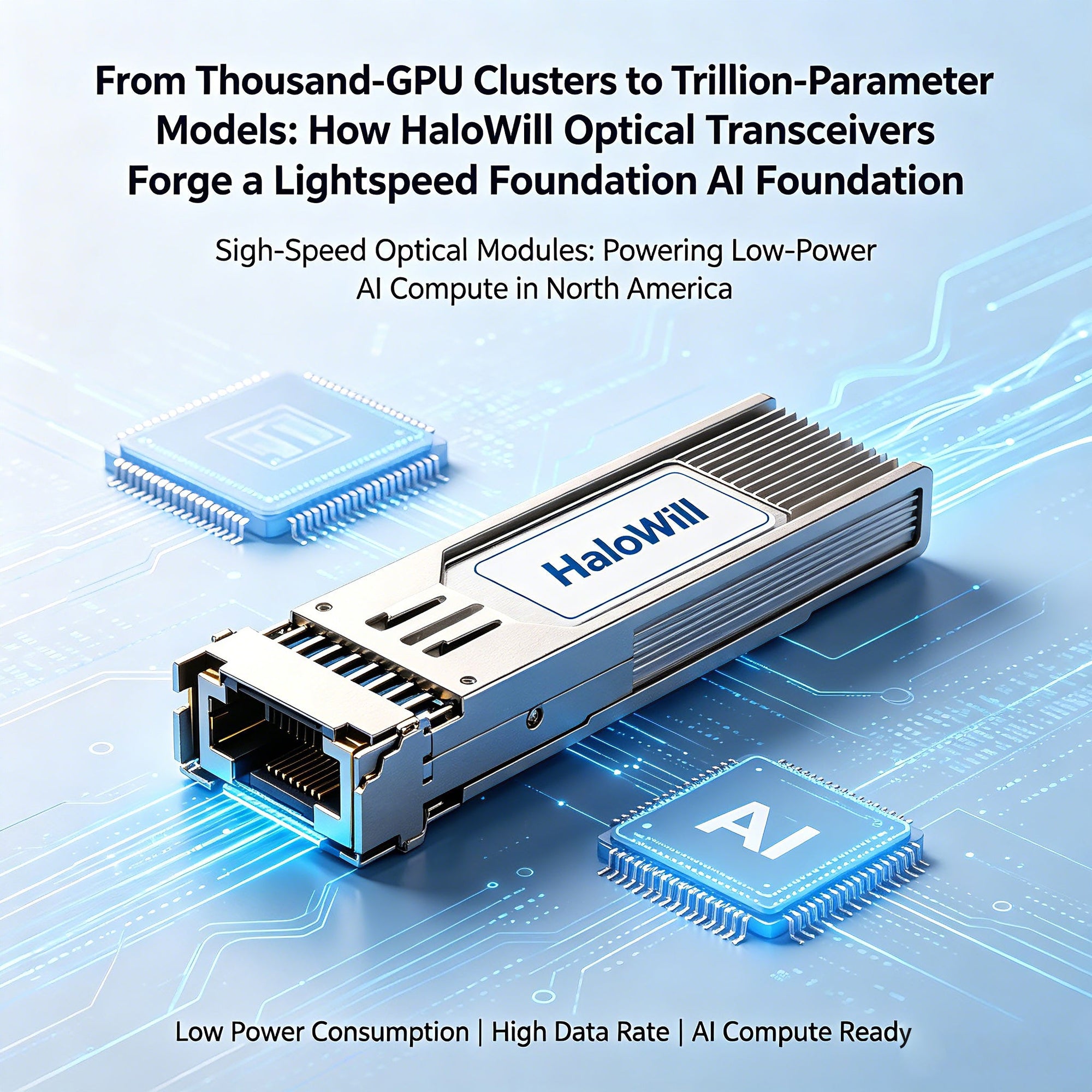

We can start with a simple number: in an AI training cluster deploying one hundred thousand GPUs, the total power consumption of the optical interconnect modules alone could exceed three megawatts. What does three megawatts represent? It is roughly equivalent to the instantaneous peak power demand of three thousand American households running their air conditioners simultaneously on a scorching summer day. Meanwhile, the computing power actually dedicated to matrix multiplication operations in this cluster must also shoulder the added burden of dissipating those three megawatts of heat. With several North American states already tying data center energy efficiency directly to tax incentives, this figure is shifting from an internal engineering metric to a cost driver that demands the CFO's direct attention.
Over the past few years, when the North American data center industry discussed optical modules, the conversation revolved almost entirely around speed — from 400G to 800G and on to 1.6T, a curve so steep it was exhilarating. But behind the doubling of speed lies a drastic deterioration in signal integrity and an exponential increase in the need for digital signal processing. Traditional pluggable optical modules rely on an internal DSP chip to handle complex signal compensation algorithms; this fingernail-sized chip at high speeds often consumes more than half of the module's total power. When AI clusters grow to a certain scale, these "heating wires on a silicon chip" become a significant and unavoidable piece of the operational cost.
HaloWill's engineering team anticipated this trend three years ago and chose a technology path that was considered "radical" at the time: LPO (Linear-drive Pluggable Optics). The core idea behind LPO is elegantly simple — since signal equalization can also be handled by the switch chip, why embed a high-power DSP inside the optical module? By reassigning signal processing duties to the existing SerDes capabilities of next-generation switch ASICs, LPO optical modules shed the bulk of power consumption, achieving a near 50% reduction compared to traditional solutions. Moreover, eliminating the DSP not only saves electricity but also removes several nanoseconds to tens of nanoseconds of signal processing latency. In AI training scenarios where GPUs must frequently synchronize gradients, every nanosecond of latency optimization tangibly improves the cluster's effective computing throughput.
For North American buyers, the benefits brought by LPO are multi-layered. First is the direct reduction in electricity and cooling costs, which is particularly significant in key hubs on the West and East Coasts where power prices continue to rise. Second is the training efficiency gain from reduced latency — more subtle than electricity cost savings, but often carrying greater business value. While competitors are racking their brains to shave time off a single training iteration, HaloWill's LPO optical modules are quietly reclaiming hundreds of microseconds of cumulative latency at the physical layer. Furthermore, for publicly listed North American enterprises actively embracing ESG ratings and carbon neutrality commitments, procuring energy-optimized infrastructure components is itself a powerful sustainability narrative. This is increasingly becoming a veto-worthy consideration in major procurement decisions.
If LPO is HaloWill's trump card on the energy efficiency track, then silicon photonics integration is the next card waiting in the deck. Silicon photonics technology shortens the electro-optical conversion path at the physical level by integrating optical components such as lasers, modulators, and waveguides onto a silicon substrate, further reducing the energy consumed per bit. HaloWill's work in silicon photonics has already reached the engineering sample stage, with the goal of continuously driving down per-port power consumption in next-generation 1.6T and 3.2T optical modules. For North American distributors seeking long-term supplier stability, this means HaloWill's technology reserves are sufficient to support the evolution of customer needs over the next three to five years, avoiding product gaps during generational transitions.
Distributors will also notice an often-overlooked commercial advantage: low-power optical modules generally have lower return rates. This is not difficult to understand — the lower the module power consumption, the lower its internal operating temperature, and naturally the longer the lifespan of all electronic and optical components. Within HaloWill's quality system, the long-term stability data demonstrated by LPO and silicon photonics modules in accelerated aging tests have repeatedly validated this physical principle. Lower failure rates directly translate into fewer after-sales replacements, fewer customer complaints, and more stable channel partnerships. In the distribution industry, nothing builds distributor confidence in a brand quite like the phrase "this batch barely needs any after-sales support."
Looking at the bigger picture, the rules of the game for the North American data center industry are being reshaped by energy efficiency concerns. Pressure on power infrastructure continues to mount in Northern Virginia, Dallas, and around Silicon Valley, with some regions already implementing stricter reviews of power supply applications for new data centers. While reducing optical module power consumption cannot solve all problems, at the scale of a hundred-thousand-chip cluster, the electricity headroom it frees up could be precisely the critical margin that determines whether an AI enterprise's next round of expansion can proceed. What HaloWill strives for is to enable customers, under the same megawatt of power capacity, to pack in more compute units that actually do the computing, rather than having that precious power budget consumed by the "pipes" connecting them.
Ultimately, the value of technology must be validated on the commercial level. When the power consumption of a single optical module drops from 16 watts to 8 watts, it may sound unremarkable. But when the procurement volume is in the tens of thousands, that 8-watt difference translates into millions of kilowatt-hours saved per year, millions of dollars in reduced operational costs, and a verifiable carbon reduction curve. HaloWill's brand promise remains unchanged: to ensure that every technical specification can be translated into tangible returns that customers can see and that finance departments can approve within North American data centers.