
In less than three years, the role of optical transceivers has completed a leap from "auxiliary accessory" to "strategic asset." There was a time when data center operators drafting network architectures regarded optical modules as nothing more than a cost item at the end of the equipment list. Today, they have become a core variable determining GPU cluster utilization, training job completion time, and even overall return on investment. For buyers and distributors in the North American market, understanding this paradigm shift is the prerequisite for capturing the growth dividends of the next five years.
The global AI optical transceiver market is entering a phase of rapid expansion. According to research from TrendForce, the market size is projected to grow from USD 16.5 billion in 2025 to USD 26 billion in 2026, representing a year-over-year increase of over 57%. Traffic within North American hyperscale data centers has sustained an annual growth rate exceeding 30%, prompting cloud computing giants such as Google, Microsoft, and Meta to continually expand their deployments of GPUs and AI servers, further driving procurement demand for high-speed optical interconnect products. Even more noteworthy is that J.P. Morgan analysts indicate the data center optical communication market is expected to expand from USD 19 billion in 2025 to USD 47 billion by 2028 at a compound annual growth rate approaching 35%, with 1.6T-speed products serving as the absolute growth engine at a CAGR of approximately 200%.
Why is the demand curve for optical transceivers so steep? The answer lies hidden within the internal architecture of every AI server. Taking the NVIDIA GB200 server as an example, a single unit requires 162 1.6T optical transceivers to ensure data transmission efficiency. As AI training clusters scale from thousands of GPUs to tens of thousands or even hundreds of thousands of GPUs, the volume of data exchange between GPU nodes grows exponentially. Traditional copper interconnect reaches its physical limits at speeds of 800G and above, making optical interconnect the only viable path forward. It is precisely for this reason that overseas technology giants have directly revised their 2026 procurement plans for 1.6T optical transceivers upward from 10 million units to 20 million units.
However, surging demand has also exposed the fragility of the supply chain. The supply of core optoelectronic chips, represented by EML lasers and CW-LDs, remains persistently tight, becoming the foremost bottleneck constraining capacity expansion. In this window of supply shortage, the focus of North American buyers has shifted — they are no longer merely comparing the unit price per gigabit of bandwidth, but are paying greater attention to suppliers' technology roadmaps, delivery capabilities, and the reliability of long-term partnerships.
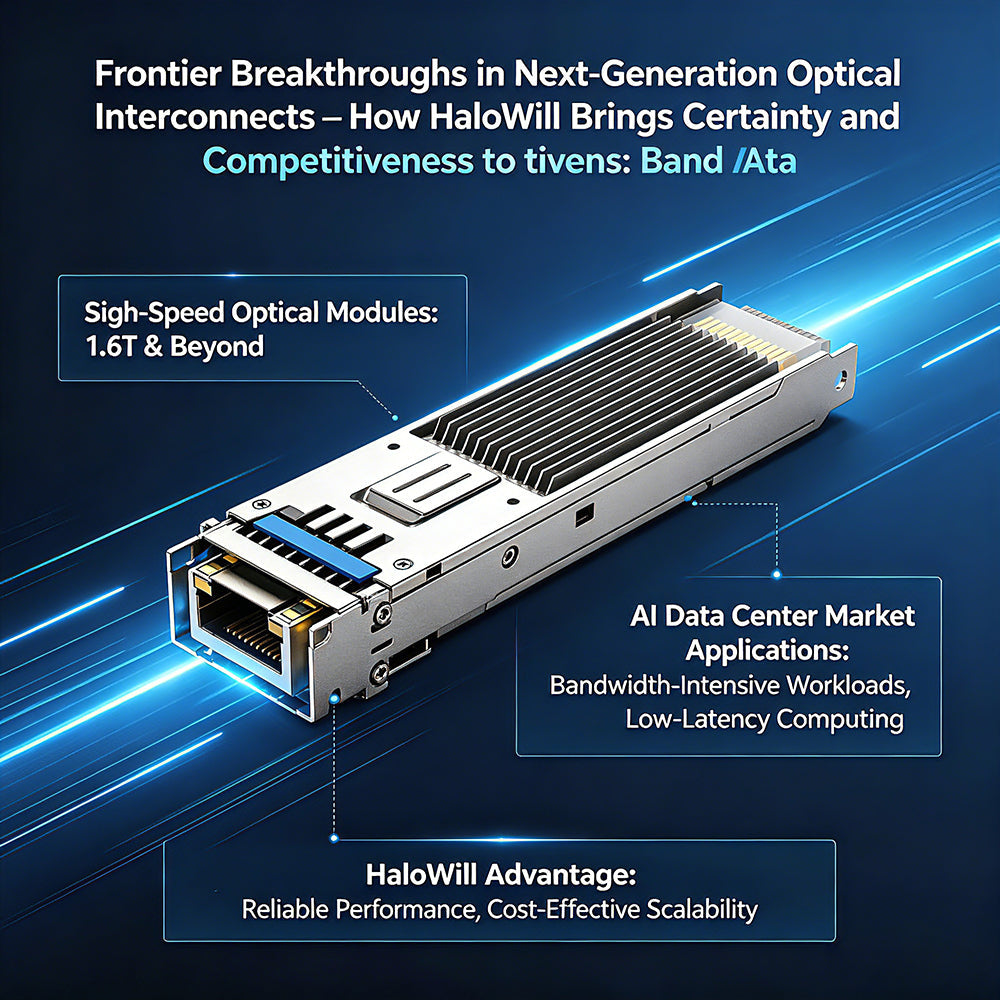
This is precisely the area where HaloWill is committed to creating value for North American customers. As a rapidly rising professional brand in the global optical transceiver market, HaloWill's product portfolio precisely covers the most critical demand range of today's AI data centers. From the currently large-scale deployed 800G SR8, DR8, and FR4 series to the 1.6T silicon photonics modules about to enter commercial breakout, HaloWill offers rigorously validated, standardized products that are fully interoperable with mainstream switch platforms. Our 800G optical transceivers feature optimized thermal design and advanced manufacturing processes, achieving competitive power consumption performance while ensuring high performance, seamlessly meeting the stringent energy efficiency requirements of North American hyperscale data centers.
HaloWill's value proposition extends beyond the products themselves. We deeply understand that for North American distributors and system integrators, supply chain predictability often carries greater decision-making weight than the specifications of any single product. Consequently, HaloWill has established a vertically integrated system spanning from chip procurement to final assembly, ensuring stable delivery cycles by locking in long-term supply agreements for key components. When the industry faces core chip shortages, this risk resilience translates into tangible competitive advantages for our partners.
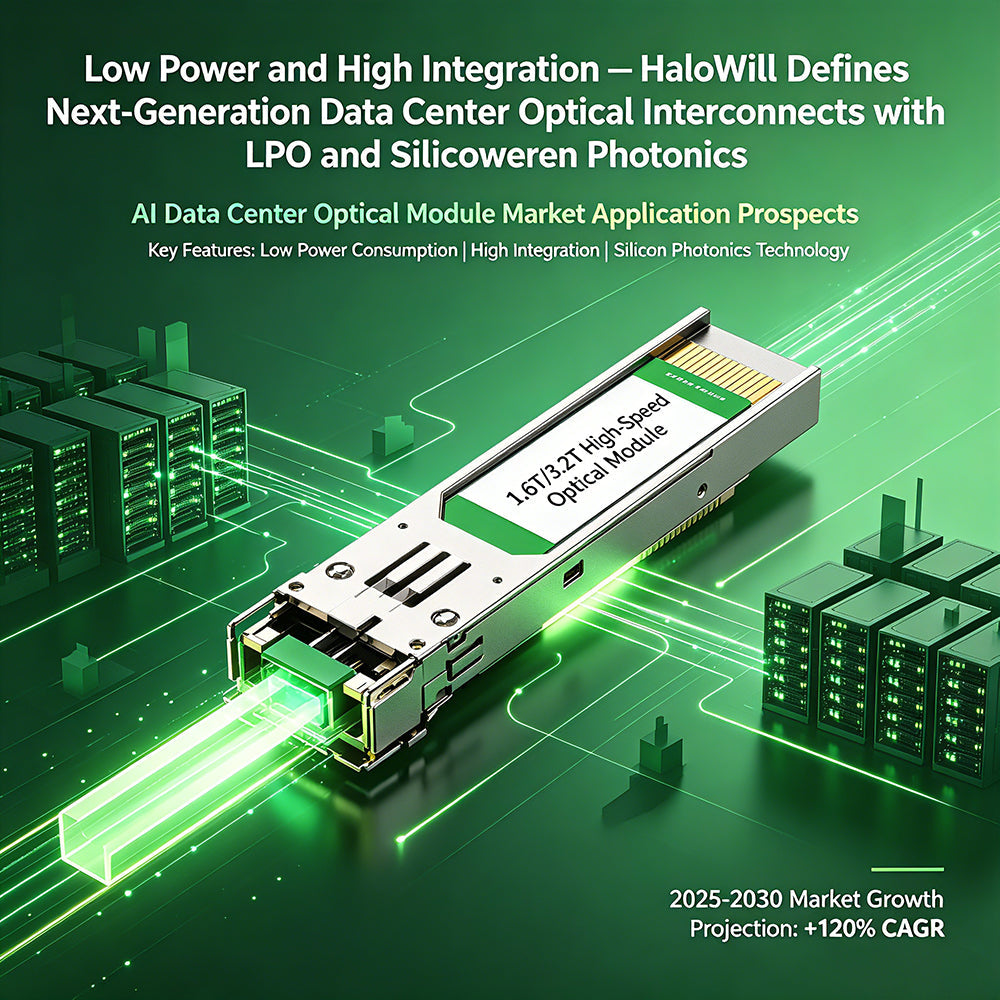
Another dimension increasingly valued by North American buyers is the capability for technology roadmap iteration. The optical transceiver industry is currently undergoing a technology transition from traditional DSP architectures to LPO and silicon photonics integration. HaloWill continues to invest heavily in research and development in the silicon photonics domain, and our 1.6T products adopt advanced silicon photonics integration solutions that significantly reduce unit costs while ensuring high yield rates. This means that customers who choose HaloWill do not have to compromise between "current needs" and "future upgrades" — we provide competitive solutions in both directions.
From a broader perspective, North American data center construction is entering a clear acceleration phase. Goldman Sachs research reports indicate that even accounting for project delays and execution risks, total installed data center capacity in the United States will still double to approximately 95 GW by the end of 2027, with corresponding electricity demand surging from 31 GW to 66 GW. Every watt of power consumption correlates to demand for optical interconnect bandwidth, and this deterministic trend provides a solid long-term growth foundation for the optical transceiver market.
For North American buyers and distributors currently evaluating optical transceiver suppliers, the present market environment presents both opportunity and challenge. On one hand, the pace of technology iteration means that choosing the wrong technology path could incur high switching costs. On the other hand, the tense supply chain situation makes establishing reliable supplier relationships an urgent priority. HaloWill invites you to engage in in-depth discussions with our solutions team. Whether you are a data center architect planning the next generation of AI clusters or a channel partner seeking a differentiated product portfolio, we will leverage our professional technical capabilities and flexible business solutions to become your trusted partner in the wave of AI computing infrastructure.