
Today, if you ask what the most expensive resource in AI infrastructure is, the answer may well no longer be the GPUs themselves, but rather the interconnect bandwidth that allows these GPUs to work together as a single giant computer. A brutal reality is surfacing: compute power can scale linearly by stacking chips, but communication bandwidth is constrained by the laws of physics, with each doubling coming at a disproportionately steep cost. When an AI training cluster expands from a thousand cards to a hundred thousand, the power consumption, latency, and signal attenuation introduced by network interconnects turn conventional optical transceivers into the most vulnerable plank in the entire system.
The industry calls this dilemma the "bandwidth wall." What makes it so terrifying is that it is not as obvious as a shortage of compute. Instead, it hides behind the dense maze of fibers and ports at the back of every rack, lying in wait until training efficiency bottlenecks become insurmountable. For North American cloud giants and AI infrastructure operators, breaking through this wall is no longer a simple matter of purchasing higher-speed optical transceivers. It demands a fundamental re-examination of the architectural philosophy of optical interconnects at the system level.
The first trend to recognize is this: East-West traffic within AI compute networks is expanding exponentially. Training paradigms such as tensor parallelism, pipeline parallelism, and data parallelism for large models require massive data exchange between GPUs with extremely low latency. Large embedding table models, commonly found in recommendation systems and natural language processing, can even generate all-to-all communication patterns, saturating network bandwidth in an instant. In such scenarios, 400G optical transceivers are merely an entry ticket. 800G has already become the absolute mainstay for newly built clusters in 2025, and the deployment speed of 1.6T pluggable optical transceivers has far exceeded expectations. This is because 1.6T can double switch capacity without increasing port density, thereby protecting the data center's existing investments in space and cooling.
However, moving from 800G to 1.6T is not simply a matter of doubling the speed. As single-wavelength rates push toward 200Gbps, signals suffer severe attenuation across PCB traces and fiber. The power consumption of traditional DSPs (Digital Signal Processors) skyrockets. Unchecked, the power consumption of a single 1.6T optical transceiver can approach 40 watts. In a hyperscale data center packed with tens of thousands of modules, this translates to the annual electricity consumption of a small town. It is for this precise reason that the top criterion for North America's leading cloud service providers when selecting suppliers has quietly shifted from "meeting the speed spec" to "the long-term total cost of per-bit power consumption."
This is exactly where the core competitive barrier of HaloWill optical transceivers lies. Three years ago, we foresaw the extreme efficiency demands of AI compute networks and decisively poured R&D resources into the silicon photonics integration technology path. Compared to traditional discrete device approaches, HaloWill's silicon photonic 800G and 1.6T transceivers integrate modulators, detectors, wavelength-division multiplexing components, and passive optical paths onto a single silicon chip. This not only drastically reduces interconnection losses within the package but also physically shortens the RF trace lengths, significantly lowering the driving power consumption at the transmitter end. What excites North American customers even more is our proprietary lightweight nonlinear compensation algorithm. This IP is directly embedded into the module's DSP firmware, capable of suppressing the bit error rate of PAM4 signals to below 1E-15 without any additional power overhead. Even under the harsh conditions of high temperature and long-reach transmission, it maintains an exceptionally low FEC (Forward Error Correction) overhead.
What does this mean? For buyers and agents, it is a highly compelling total cost of ownership narrative. Take a 100,000-card AI training cluster as an example. Compared to legacy solutions, deploying HaloWill 800G silicon photonic modules across the board can save millions of dollars annually on electricity bills from the network layer alone—not to mention the additional dividend of downsized cooling system requirements resulting from lower power dissipation. Furthermore, when upgrading to 1.6T, HaloWill's solution features naturally backward-compatible physical port designs. Customers can achieve this generational speed leap on the same switch platform without redesigning thermals and cabling. In today's breakneck AI race, this smooth evolution capability is even more valuable than a simple advantage in unit purchase price.
One might ask, can this technological sophistication ultimately be delivered with stability? This is the deepest bedrock of confidence for HaloWill as a brand deeply rooted in the North American market. Our fully automated coupling and testing production lines are built upon a massive data-driven quality system. Before leaving the factory, every single optical transceiver undergoes full-temperature-range eye diagram stress testing covering -40°C to 85°C, and is simulated against the bursty high-density traffic models commonly found in AI clusters to ensure that absolutely no "soft failures" occur in real-world operational scenarios. A soft failure—a sub-health state where temperature drift occasionally and silently elevates the bit error rate without triggering a link down event—has a catastrophic impact on the checkpoint restart efficiency of large model training. To combat this, HaloWill has independently developed a link health monitoring platform called "HaloEye." By reading the rich diagnostic register data built into the module and leveraging a cloud-based large model for predictive maintenance, it can warn of potential performance degradation weeks in advance. This value leap from "selling products" to "guaranteeing operations" is redefining the relationship between optical transceiver suppliers and hyperscale data center users.
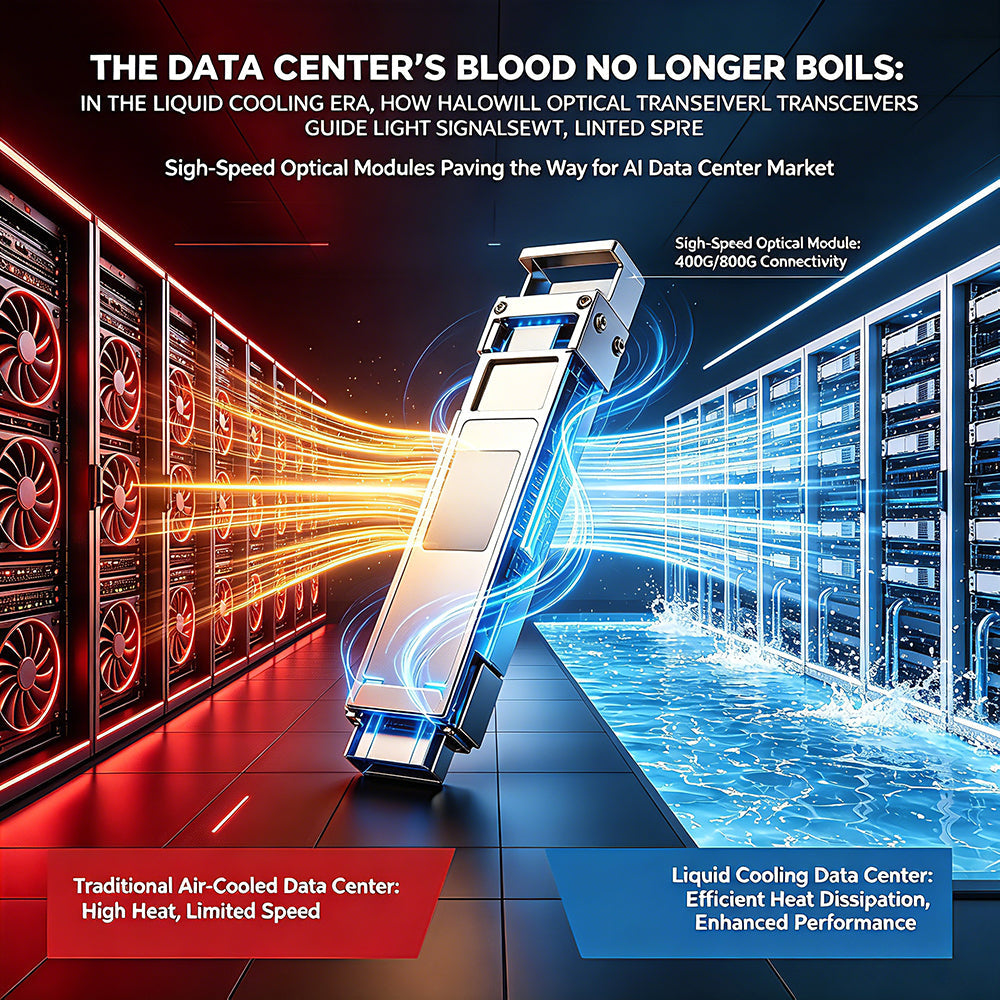
For optical transceiver distributors and buyers targeting the North American market, HaloWill delivers far more than just a single optical module. We bring an open, customizable, full-lifecycle-managed AI interconnect solution package. For example, in response to increasingly stringent regulations on data center PUE in certain North American states, HaloWill can provide firmware with an optimized low-power mode. During the tidal troughs of AI inference workloads, the module can automatically hibernate into a sub-milliwatt standby state, with a wake-up time of less than one microsecond, completely transparent to services. As another example, for scenarios requiring liquid-cooled cabinets, our modules have passed long-duration immersion and cold-plate liquid cooling compatibility tests. The anti-condensation design on the optical interface end-face meets automotive-grade hermetic sealing standards, thoroughly eliminating the hidden risk of optical performance degradation in high-humidity differential environments.
At this moment, global AI compute infrastructure is at a critical watershed. Optical interconnects have leaped from being insignificant connectors to a strategic component that determines the overall computational efficiency of a system. As an invisible bandwidth wall stands in front of every explorer striving to scale the heights of AGI, only the supplier that can tear down this wall with the lowest cost per bit, the highest signal integrity, and the strongest evolutionary vitality can become the trusted partner of the brightest minds on the planet. HaloWill is practicing this very principle in the North American market: we do not bet on a single technology route. Instead, we combine multi-platform technologies including silicon photonics and thin-film lithium niobate with deep system understanding to weave the most efficient neural network for every AI super-brain.
If you are a North American buyer or distributor searching for an optical interconnect solution worthy of a long-term commitment for your next-generation AI cluster or data center, we sincerely invite you to engage in a deep technical dialogue with HaloWill. This is not a simple product selection process, but rather a joint effort to define the passport to the boundless sea of AI computing that lies beyond that wall. Let every photon transition become a solid step pushing model parameters closer to the essence of intelligence. This is the value of HaloWill's existence in this industry, and it is the greatest common denominator we share with our North American partners for the future.