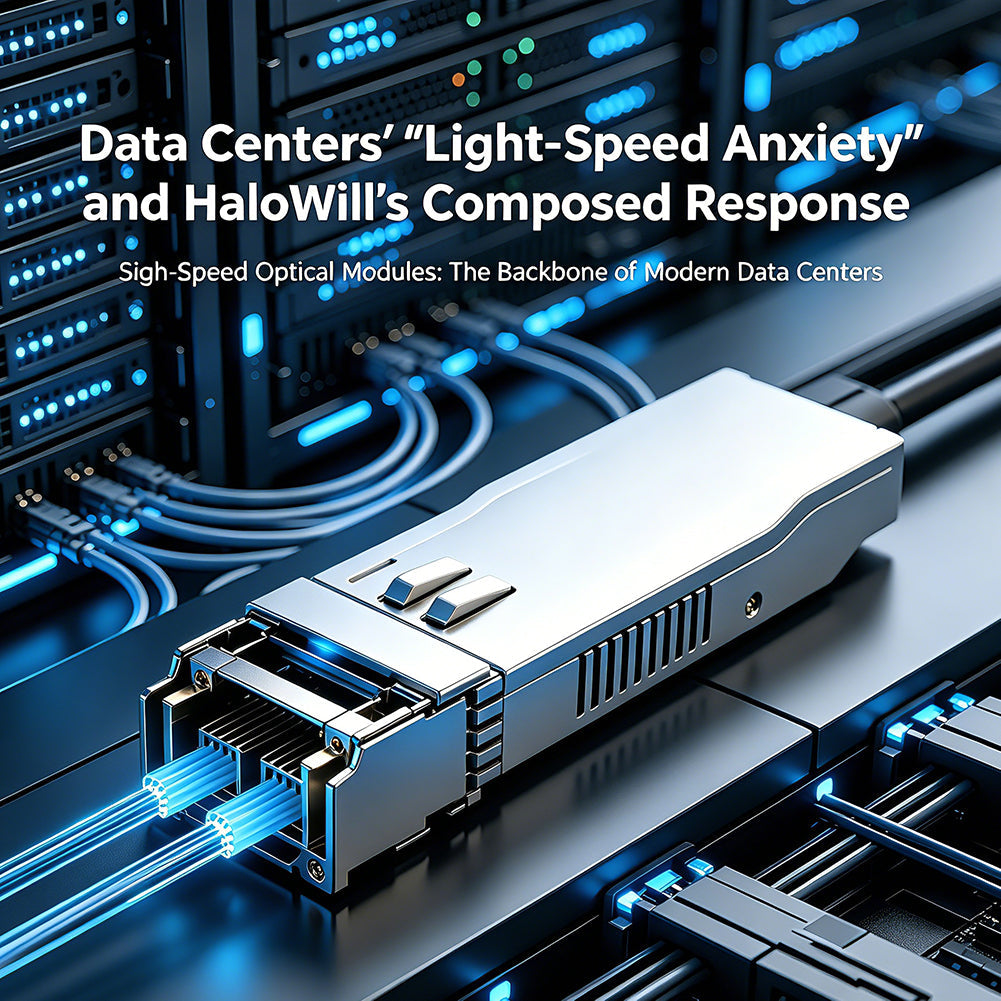

In the corridors of a typical hyperscale data center, hundreds of thousands of optical fibers are silently transporting the most expensive resource of our era—data. If GPUs serve as the brain of AI, then optical modules are the densest capillary vessels within this neural system. Without sufficiently robust optical interconnects, even the most powerful computing resources can only spin idly within their cabinets.
Over the past two years, a notable shift has occurred: the bandwidth growth curve of optical modules has become directly linked to AI training efficiency. When training a multi-modal model with trillions of parameters, thousands of accelerators must synchronize gradient information. Any delay jitter during an all-reduce operation can leave expensive computing power idle. This has elevated the importance of high-speed optical modules on the procurement lists of top-tier North American cloud providers and AI laboratories to unprecedented heights.
What truly keeps procurement decision-makers up at night is no longer simply the speed figures. What concerns them is this: during the transition window from 400G to 800G and even 1.6T, who can guarantee that the bit error rate will not deteriorate as the data rate doubles? Who can keep power consumption under control within a smaller form factor? And who can maintain model consistency and firmware stability across deployment cycles spanning several years?
This is precisely where HaloWill, as a brand deeply rooted in the optical interconnect field, demonstrates the significance of its sustained investment. We do not view ourselves merely as a manufacturer of modules; rather, we position ourselves as a risk manager of physical layer connectivity in the AI era.
On a technical level, HaloWill's 800G series products adopt advanced 7nm DSP solutions and deeply optimized silicon photonics integration designs. While maintaining PAM4 signal integrity, we have controlled the power consumption of single-mode modules at a level that pleasantly surprises North American customers. Our engineering team spent nearly two years iteratively refining RF routing, lens coupling processes, and FEC algorithm adaptation strategies, achieving a bit error margin in real switch environments that surpasses the industry average by nearly an order of magnitude. For AI clusters with tens of thousands of links, this margin translates into a significant reduction in network retransmission probability, which in turn materializes as a genuine improvement in training throughput.
At the same time, HaloWill is keenly aware of the North American market's desire for supply chain diversification. We have established a fully closed-loop production line covering everything from chip incoming inspection, COB packaging, and automated testing to burn-in. Every module undergoes a full 48 hours of environmental stress screening before leaving the factory, and the test data for every batch is fully traceable and open to customers. This almost obsessive commitment to quality transparency has earned us high praise in the qualification certifications of several Tier-2 data center operators in North America.
We also wish to emphasize a dimension often overlooked by the market—the lifecycle management of optical modules. The iteration speed of AI clusters is far faster than that of traditional cloud computing infrastructure. A 400G cluster deployed last year may face migration to 800G as early as this year. HaloWill has designed a forward-compatible firmware architecture for this purpose, allowing the same hardware platform to adapt to the interface characteristics of next-generation switching ASICs through secure firmware upgrades. This extends the value return period of customers' fixed asset investments. Against the backdrop of generally constrained capital expenditure, this design philosophy is becoming a key metric by which North American buyers assess a supplier's strategic value.
Looking further ahead, Linear-drive Pluggable Optics and Co-packaged Optics are moving from the laboratory toward engineering validation. HaloWill has already built solid prototype technology reserves in both directions, but we will not rush forward merely for the sake of technological showmanship. Our principle has always been this: the products delivered to customers must reach a level of mass production consistency, field maintainability, and cost predictability that requires no additional explanation. Because we deeply understand that for AI infrastructure, optical modules are like blood vessels for the brain—stability is far more important than a momentary burst of vigor.
Over the next three years, the race for AI computing power will continue, and the width of optical interconnects will ultimately define the height of intelligence. HaloWill is willing to play the role of silently paving the road at the physical layer, allowing every beam of light to serve intelligence without reservation.