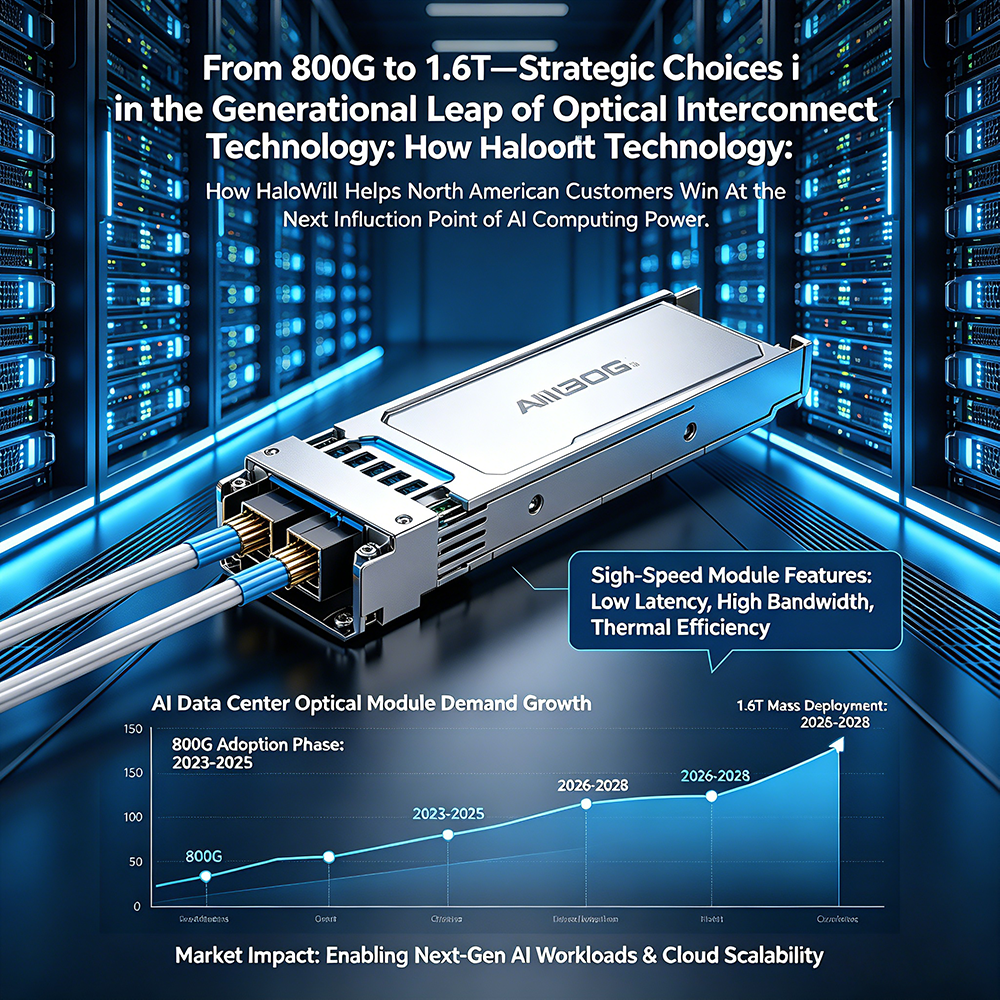

If the AI industry in 2025 was still gearing up for the expansion of computing power, by 2026 we are already acutely feeling a harsh reality: there simply aren't enough optical modules. It's not that demand is insufficient—it's that supply cannot keep pace.
According to data from multiple authoritative research institutions, the global market for AI-specific optical transceiver modules is experiencing an unprecedented growth storm. Market research figures indicate that the market size is expected to leap from USD 16.5 billion in 2025 to USD 26 billion in 2026, with an annual growth rate surpassing 57%. Traffic within North American hyperscale data centers has maintained long-term annual growth of over 30%. Cloud computing giants such as Google, Microsoft, and Meta are continuously expanding their deployment of GPUs and AI servers, relentlessly driving up procurement demand for high-speed optical interconnect products.
However, behind this demand surge lies enormous structural pressure on the supply chain. Currently, core optoelectronic chips represented by EML lasers and CW-LD continuous wave lasers are caught in severe supply tightness. Bottlenecks in capacity allocation, manufacturing process scaling challenges such as high-precision optical alignment, and technical hurdles in power consumption and thermal management together constitute multiple constraints limiting the expansion of optical module production. Industry research indicates that the supply-demand gap for 1.6T optical modules in 2026 could reach as high as 10 million units.
This is the last scenario that North American purchasers and distributors want to face. When the deployment cycles of AI clusters are constantly compressed and project delivery milestones are already set in stone, any component supply delay translates into steep opportunity costs. According to foreign media reports, the order book of leading US optical communications company Lumentum is already full through 2028, with capacity expansion speeds far lagging behind demand growth. Goldman Sachs' latest report went so far as to define optical networking as "the next big trend in AI infrastructure," forecasting a ninefold expansion of the optical networking market, reaching a size of USD 154 billion.
In such a "seller-dominated" market landscape, procurement strategy priorities have quietly shifted. In the past, performance parameters and unit cost might have been the primary criteria for selecting a supplier. Today, however, supply stability, the forward-looking nature of technology roadmaps, and a partner's responsiveness are the keys to success. And this is precisely the core of HaloWill's differentiated competitive advantage in the North American market.
HaloWill deeply understands the challenges the current supply chain environment poses for North American customers. We have adopted a fundamentally different response strategy from the mainstream industry approach. Faced with the predicament of limited EML chip capacity, HaloWill has significantly increased its investment in the silicon photonics technology route. Research predicts that in 2026, silicon photonics solutions will account for over 50% of 800G optical modules, with this proportion soaring to 70% to 80% for 1.6T products. By deeply integrating silicon photonics supply chain resources, HaloWill effectively reduces customers' dependency risk on a single chip route, ensuring stable delivery even when core component supply is tight.
Simultaneously, HaloWill has built a complete product matrix covering multiple technology forms, including traditional pluggable optical modules, LPO, and LRO, with capacity layout already completed from mainstream 800G deployment to large-scale 1.6T commercialization. Our 800G series products have entered the stage of high-volume stable delivery, while the 1.6T product line completed mass production validation in Q2 2026 and is actively undergoing sampling and design-in with leading North American customers.
For North American data center operators and channel partners, choosing HaloWill means the superposition of three layers of value. First is certainty—by locking in upstream critical materials and pursuing diversified technology routes in parallel, we ensure that delivery commitments are never broken. Second is technological leadership—whether in silicon photonics integration or low-power pluggable solutions, HaloWill keeps in lockstep with the technology evolution pace of North American hyperscale customers. Third is flexibility—we support full-process customized services from sample verification to mass production delivery, capable of providing tailored solutions for different customers' network architectures and deployment scenarios.
In an era where the computing power arms race continues to accelerate, optical modules have long since evolved from a "commodity component" to a strategic resource for AI infrastructure. Selecting a partner with robust supply chain resilience and technological foresight will directly determine whether your data center can seize the first-mover advantage in this race. HaloWill looks forward to joining hands with North American purchasers and distributors to collaboratively build a robust, efficient, and future-ready optical interconnect foundation.