
At three in the morning, a GPU cluster training a large model with hundreds of billions of parameters suddenly exhibited a bizarre phenomenon: every few hundred iteration steps, one compute card would invariably fall into a prolonged wait. The gradient synchronization timeout caused the effective utilization of the entire cluster to plummet from 92% to 78%. After weeks of packet capture and log analysis, the team finally traced the culprit to a seemingly normal fiber link. The optical module was producing intermittent burst errors within a specific temperature window. Although the forward error correction code masked most of the errors, the microsecond-level tail latency caused by retransmissions accumulated into minutes-long training stalls. This is becoming a gradually recognized fact within North American AI infrastructure circles: standard compliance does not equal AI readiness, and traditional bit error rate metrics are simply too "coarse" for synchronization-sensitive distributed training.
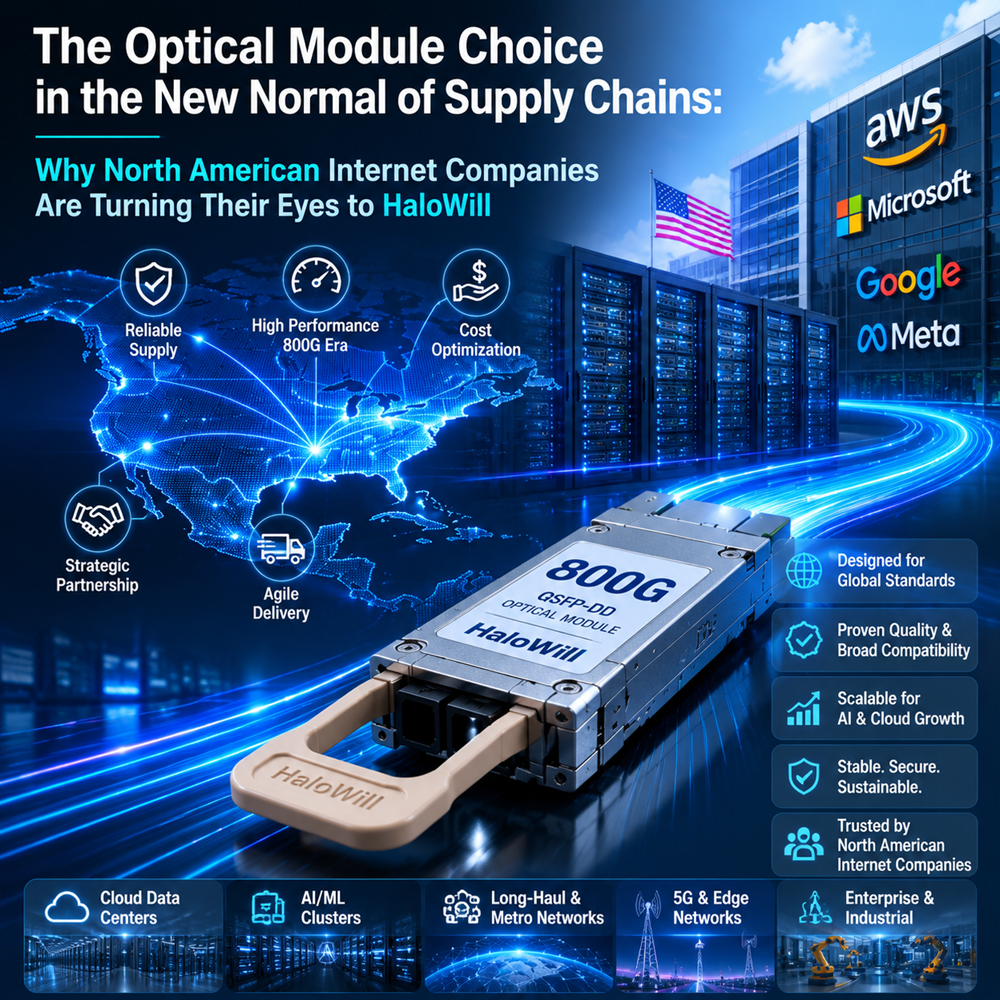
HaloWill conducted an in-depth study of the traffic characteristics of AI training clusters and discovered that large-scale All-Reduce operations are exquisitely sensitive to any packet loss or latency spike. This prompted us to define a specialized screening standard for AI workloads. Beyond conventional BERT bit error testing, HaloWill subjects each module to extended stress testing using a simulated GPU Direct RDMA traffic model, monitoring bit error rate floors as low as ten to the power of negative fifteen and nanosecond-scale jitter. Only modules that cross these thresholds receive the "AI-Ready" designation. We call this the Zero-BER Screening Project, and it ensures that every module delivered to North American AI customers far exceeds standard data center criteria. An autonomous driving model training company in Ohio reported that after replacing its existing 400G DR4 modules with HaloWill's AI-Ready version, the suspension frequency of hour-long training tasks dropped to nearly zero, and GPU cluster availability improved by close to five percentage points—equivalent to gaining eighteen extra days of training time per year.
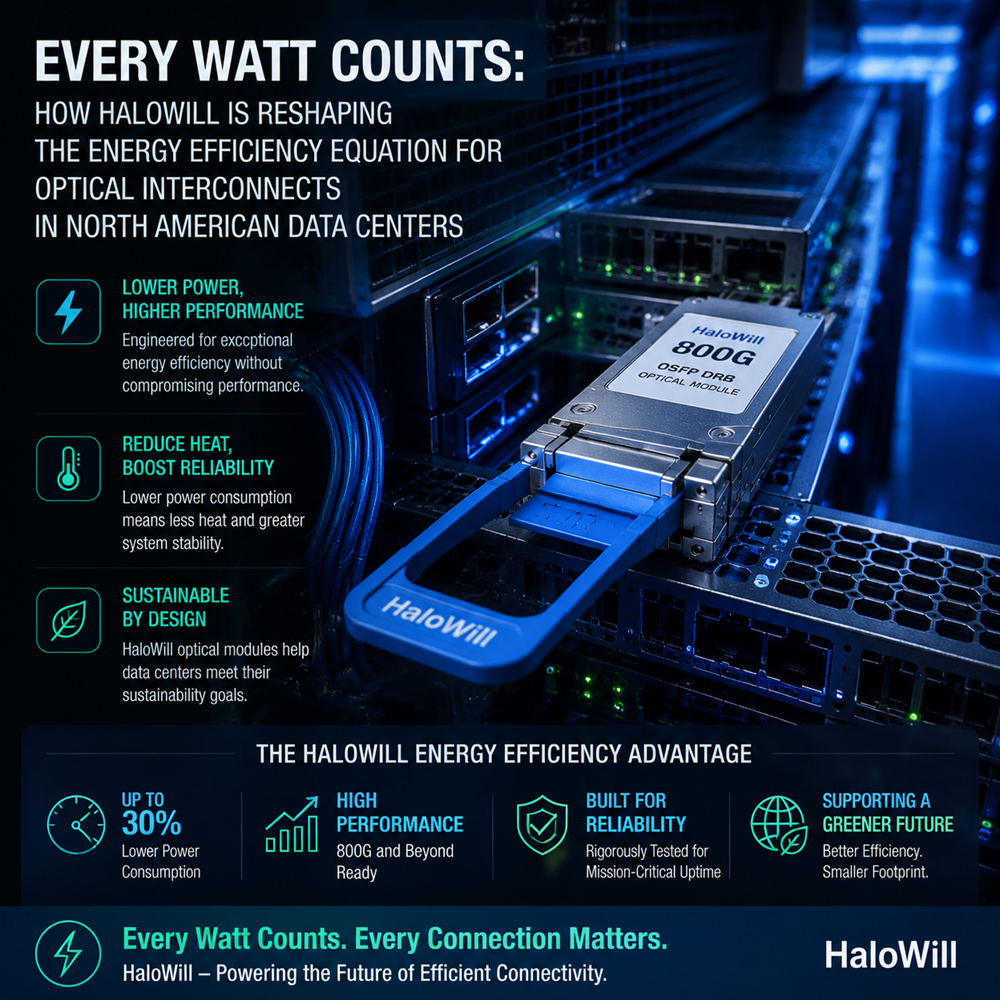
Underpinning this performance is HaloWill's proprietary Halo-Temp temperature compensation algorithm. AI clusters have extremely high power density, with significant temperature gradients at the rear of cabinets. An optical module can experience a rapid temperature swing of ten degrees Celsius within five minutes. The bias current and clock recovery loops of ordinary modules are prone to transient errors during sudden temperature changes. Our engineers embedded a real-time temperature slope prediction model into the module firmware. When a rapid temperature rise is detected, the module proactively applies feedforward compensation to the laser driver and TIA gain, thereby drastically reducing the probability of burst errors. While the technical details are complex, for the user it manifests as one simple fact: even in high-density cabinets with constrained airflow, HaloWill optical modules maintain a smooth and stable eye diagram, never becoming the component that "causes trouble in the middle of the night."
The tunability of the optical link is another differentiating value HaloWill creates for AI customers. SerDes equalization characteristics vary across different switch chips, and long PCB traces introduce additional uncertainties. HaloWill's North American field application engineers can bring specialized equipment to the customer's site and use link eye-margin tuning tools to fine-tune the equalization parameters of installed modules, maximizing the link budget. This level of service is almost unimaginable in traditional optical module procurement, but considering that the opportunity cost of a single interruption to an AI training cluster can reach tens or even hundreds of thousands of dollars, such deep support delivers an exceptionally high return on investment. One of our reseller partners successfully secured a full-year optical module supply contract with a renowned AI research laboratory precisely by leveraging this value-added service. The lab's principal network architect admitted candidly that what they were buying was not merely hardware, but the assurance of eliminating all performance uncertainties.
On the journey toward ten-thousand-GPU and hundred-thousand-GPU scale AI clusters, every tiny link imperfection can be magnified by a model with trillions of parameters. HaloWill firmly believes that optical modules should no longer be viewed as simple connecting cables, but as critical enablers that safeguard the emergence of intelligence. If you are procuring optical interconnect products for your next batch of GPU servers, we earnestly urge you to include extreme bit error rate and tail latency comparisons in your test plan, and allow HaloWill to demonstrate how link-level optimization can push the training wall even further. Let us prove together that in the world of AI, superior optical modules never settle for "good enough."