
There is a lesson repeatedly validated in the field of supply chain management: when the concentration of procurement for a critical component reaches an extreme level, any minor disturbance can push a data center expansion plan to the edge of a cliff. Between 2021 and 2023, several North American cloud service providers were forced to postpone rack deployments—and in some cases even caused cloud resource shortages in certain regions—due to capacity allocation issues at a single optical module supplier and international logistics disruptions. These events prompted procurement decision-makers to re-evaluate the hidden cost of "putting all their eggs in one basket." It was amid this wave of reflection that HaloWill gradually entered the field of vision of North American internet companies and Tier-2 operators, earning valuable long-term trust through its unique supply elasticity and technical transparency.
HaloWill's ability to endow customers with supply chain resilience is rooted in a fundamental restructuring of the optical module production model. Unlike many label-stickering vendors that rely on external TOSA and ROSA components, HaloWill holds its own laser chip packaging line and automated optical coupling equipment. This enables us not only to guarantee stable output of popular modules such as FR4 and DR series, but also to rapidly reallocate resources when urgent orders arrive, compressing standard lead times to four weeks or even shorter. For North American resellers, this means that the go-live commitments they make to their end customers have a solid foundation, and they no longer have to lose sleep over the uncertainties of factory production scheduling. We maintain a certain volume of 400G QSFP-DD DR4 and FR4 inventory at our warehouse in San Antonio, ready to respond to customers' sudden expansion needs at any time. This localized inventory strategy significantly shortens the psychological distance for North American customers from order placement to receipt.
Of course, delivery speed alone is not enough to convince North American network engineers, who regard reliability as an article of faith. What they fear most is the "coding gate" of third-party modules—where a module cannot be correctly recognized after insertion into a switch, or frequently triggers alarms. HaloWill's approach is to elevate compatibility testing to the level of an "OEM partner." Our engineering team conducts in-depth analysis of the mechanisms related to optical module I2C communication and EEPROM mapping in mainstream switch operating systems, and develops specialized coding images for each switch model and OS version. Every HaloWill module must undergo a compatibility self-check process before leaving the factory, simulating the switch's full protocol interactions such as querying serial numbers, temperature thresholds, and channel monitoring. We can even customize OID information according to the requirements of a customer's specific network management system, ensuring seamless integration into the existing operations environment. This depth of compatibility assurance has already enabled HaloWill's 400G FR4 to be successfully deployed in a large content delivery network using Arista platforms. In comparative testing, that customer reported that our modules showed absolutely no difference in port error counts compared to OEM original parts, while delivering more significant cost optimization and more flexible volume-price tiering.
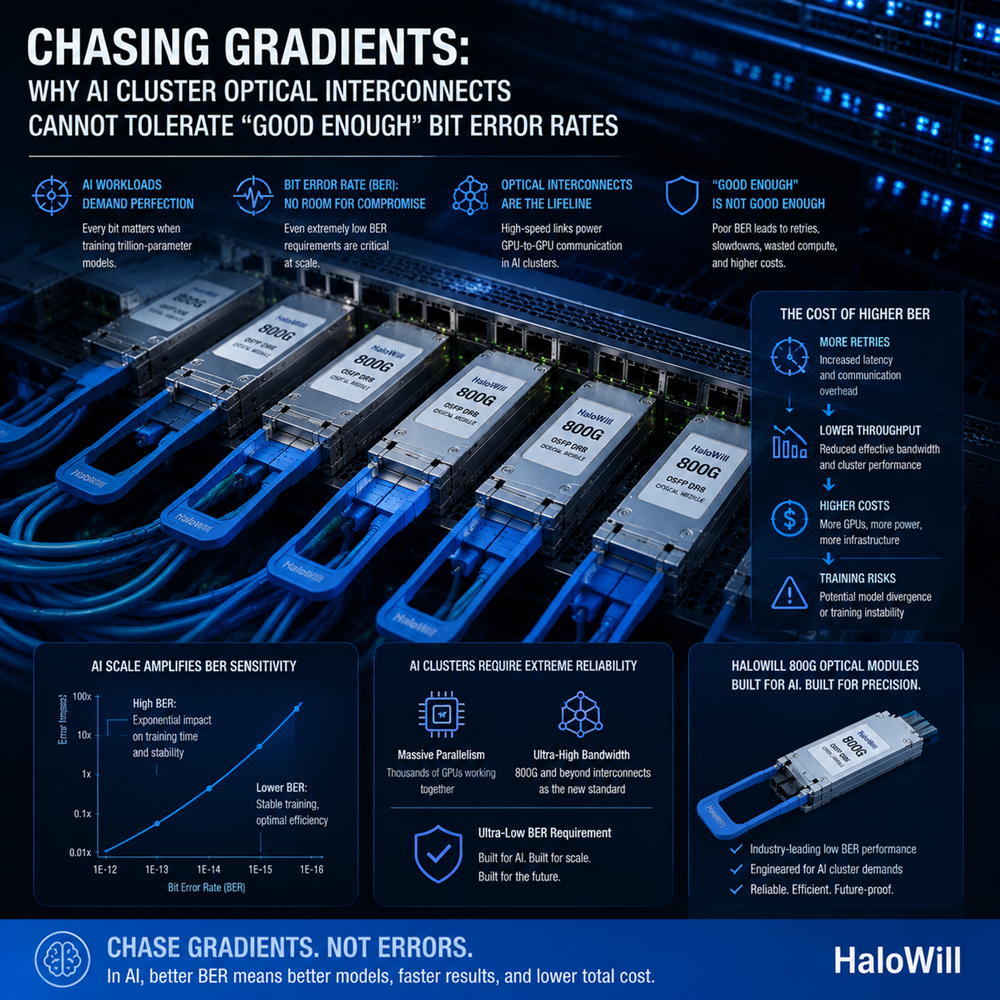
Another dimension of supply chain diversification is the parallel reservation of technology paths. North American buyers are increasingly inclined to evaluate traditional DSP-based solutions and emerging LPO linear-drive solutions simultaneously, in order to strike the optimal balance between power consumption and performance. HaloWill's product matrix happens to cover both paths. Customers can obtain 800G DR8 modules based on 7nm DSPs for long-reach DCI connections from us, or choose 800G LPO modules based on analog direct-drive for short-reach AI clusters, thereby avoiding being locked into a single technology path. One of our reseller partners, when pitching to an AI customer in Silicon Valley, won trust precisely by virtue of this multi-path technology reserve. The customer commented, "HaloWill demonstrates the engineering flexibility that an optical module vendor ought to have." At the same time, all our products come with a commitment of at least a five-year warranty, and in the event of an extremely low-probability failure, we provide an advance replacement before repair service, adding an extra safety cushion for the customer's asset management, especially in times of supply chain turbulence.
In the process of building resilience, HaloWill has never positioned itself as a cheap "replacement," but strives to become an interconnect partner that grows alongside North American customers. We candidly open our production line audits to every potential buyer, demonstrating full transparency and confidence whether through virtual factory tours or on-site visits. As the North American data center industry strides into the era of 800G and AI clusters, choosing a supplier that can withstand uncertainty and continuously inject innovative vitality into the network is more critical than ever before. If your team is drafting the next optical module RFQ, consider adding HaloWill to the evaluation list and see how the resilience of this emerging force can add a solid layer of insurance to your digital infrastructure.