
An Underestimated Procurement Risk: Generational Lock-In
We observe that procurement teams at North American data centers are facing an increasingly prominent contradiction: they must satisfy the immediate 800G deployment needs while leaving ample room for future 1.6T and even 3.2T architectures. This means the crystal-ball effect of optical module purchasing decisions is being magnified — the module solution you choose today will directly affect your network architecture flexibility and total cost of ownership for the next three to five years.
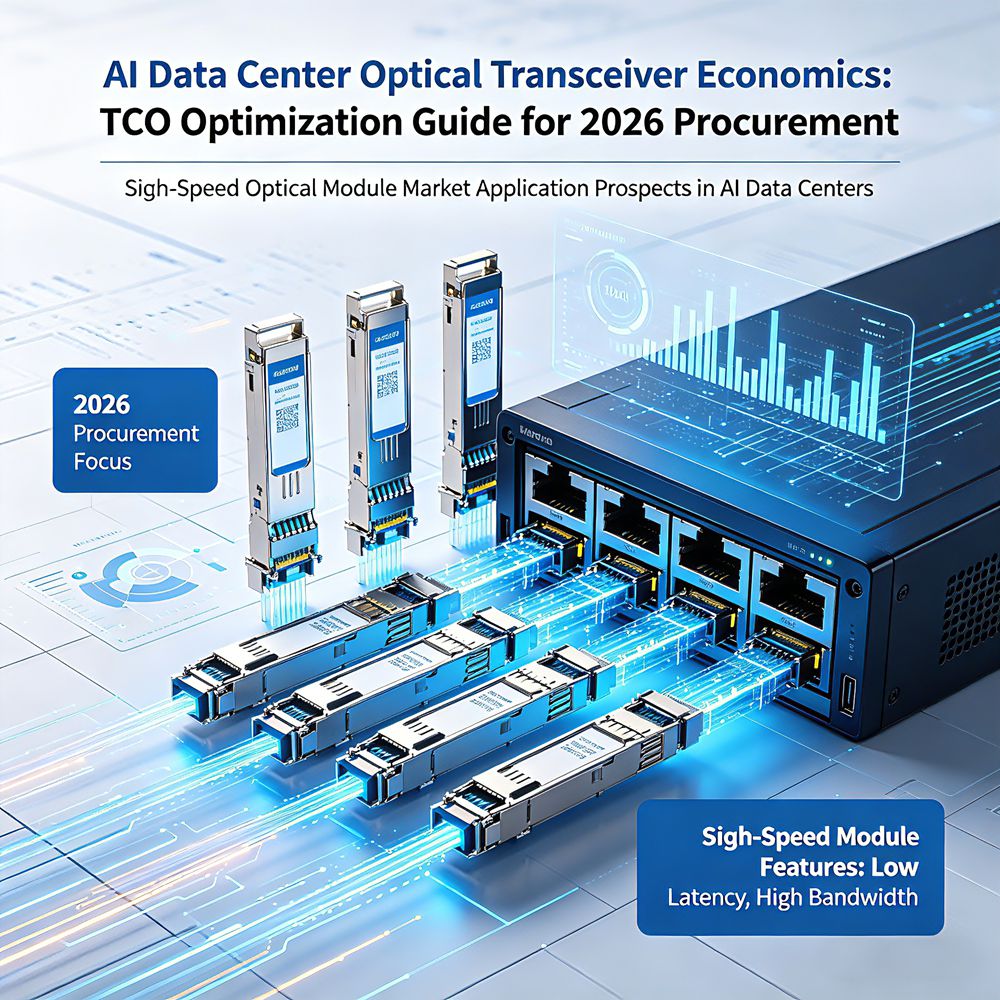
800G optical modules are undeniably the mainstay of current deployments. TrendForce indicates that traffic in North American hyperscale data centers is growing at over 30% annually, driving cloud giants such as Google, Microsoft, and Meta to continuously expand their GPU and AI server deployments and further spurring procurement demand for high-speed optical interconnect products. 800G modules have now become the mainstream specification for AI data center backbone interconnects, while 1.6T products are already accelerating into volume production — the next upgrade cycle has begun ahead of schedule.
So the question arises: Is your network architecture ready for a seamless transition from 800G to 1.6T?
Understanding the Key Technical Points of the Generational Leap
Moving from 800G to 1.6T is not a simple doubling of data rate; it is a systemic engineering challenge. The technical choices made at this stage will directly influence the cost and path of subsequent upgrades.
One core dimension to consider is the modulation format. 800G modules primarily rely on 8x100G PAM4 lanes, while 1.6T can follow multiple lane configuration paths such as 8x200G, 16x100G, or 4x400G. These different lane configuration schemes imply entirely different requirements for optical fiber infrastructure, port density planning, and power management strategies. The procurement team needs to establish a clear generational evolution roadmap when making 800G deployment decisions — otherwise, two or three years down the line, you may find that every penny saved today is forcing a far more expensive architectural rebuild.
It is around this exact customer pain point that HaloWill builds its product portfolio. Our design philosophy is not simply to launch modules with higher data rates, but to ensure maximum compatibility and smooth migration capability between different generations, form factors, and modulation schemes.
HaloWill's Cross-Generation Compatibility Design Philosophy
HaloWill offers full support for both mainstream form factors, QSFP-DD and OSFP, across its 800G product line, while also embracing silicon photonics integration. This ensures that customers deploying 800G networks can reuse the infrastructure and optical connectivity systems required for subsequent 1.6T upgrades. In practice, the switch port housing your HaloWill 800G QSFP-DD module today can be smoothly replaced with our 1.6T OSFP module when it is time to upgrade, maximizing the protection of existing investments in rack space, fiber cabling, cooling systems, and operational processes.
Particularly worthy of emphasis is HaloWill’s strategic investment in low-power directions. As AI data centers expand from clusters of tens of thousands of accelerators to clusters of hundreds of thousands, power management has shifted from a nice-to-have to a survival issue. Traditional DSP-based pluggable modules, while offering advantages in interoperability and transmission distance margin, are costly, power-hungry, and increasingly dependent on advanced-node semiconductors. The LPO (Linear Pluggable Optics) approach removes the DSP inside the module to reduce power consumption and cost, making it extremely attractive for short-reach, controlled intra-rack or scale-up links. HaloWill is advancing both DSP-based and LPO technology routes in parallel, allowing customers the flexibility to choose the optimal solution based on their specific rack architecture and distance requirements.
The essence of this dual-path strategy is this: we do not lock customers into any single technology route. Whether you choose the traditional DSP path to enjoy the advantages of interoperability and transmission margin, or opt for the LPO path to achieve extreme low-power performance, HaloWill delivers the same level of product quality and delivery assurance.
From "Buying Modules" to "Buying Evolution Capability" for the Data Center
North American data center customers are currently undergoing a shift in procurement philosophy: from "buying specifications" to "buying compatibility," and from "buying data rate" to "buying an evolution path." Behind this shift is a deep reflection on risk management — the capital expenditure scale of AI clusters has reached unprecedented heights, and the impact of any architectural choice is being drastically amplified.
LightCounting predicts that the global datacom optical module market will reach 22.8billionin2026andisexpectedtogrowto22.8billionin2026andisexpectedtogrowto41.4 billion by 2030, representing a compound annual growth rate of 20%. This means data center operators will undergo multiple densely-spaced rounds of network upgrades over the next few years. Each round of upgrade is superimposed on the infrastructure of the previous round. If there is a lack of compatibility design between the first and second rounds, the accumulated losses will be exponential.
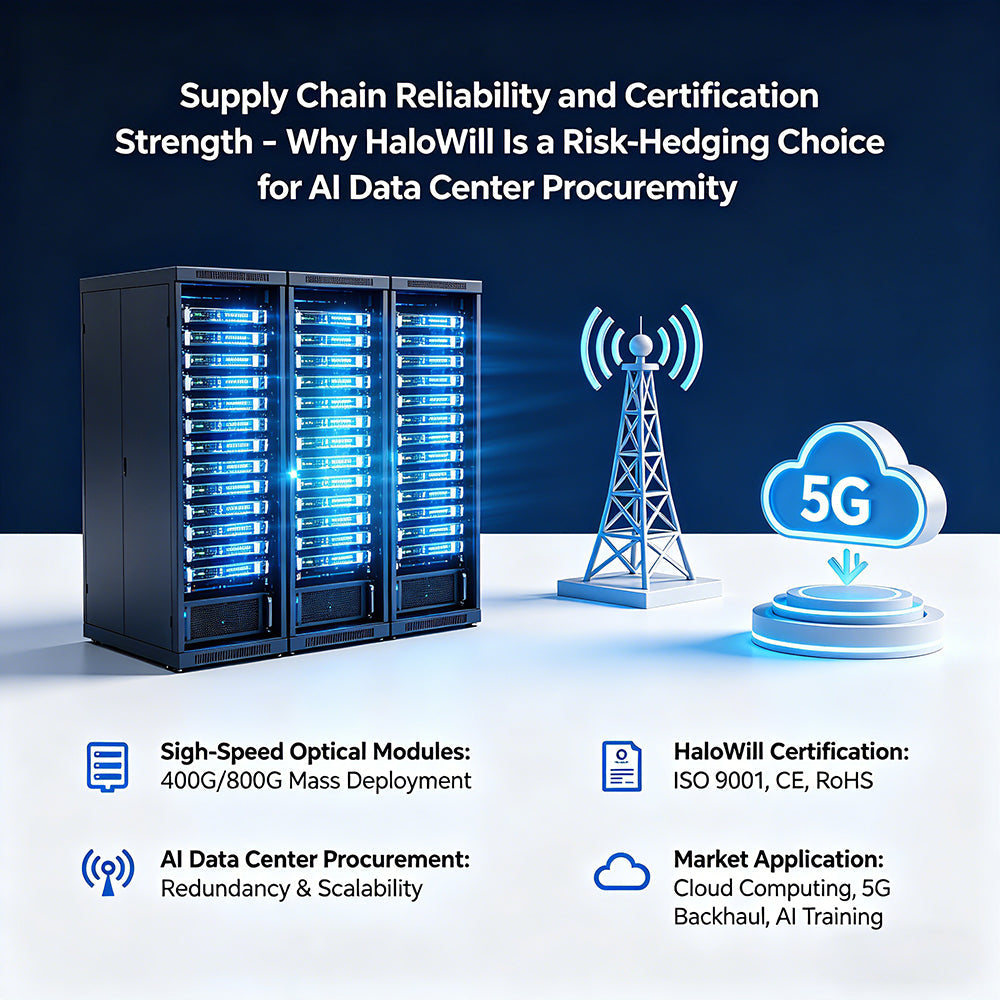
HaloWill's product philosophy is built on this assessment: our modules are not merely high-speed optoelectronic conversion devices; they are keys that unlock the door to future architectural upgrades. By completing interoperability certifications with major switch silicon vendors and equipment manufacturers, we ensure seamless deployment of HaloWill modules in the multi-vendor heterogeneous environments typical of North American data centers. For North American buyers, choosing HaloWill means your network architecture enjoys greater design freedom — you do not need to pre-lock yourself into a single vendor or a single technology form factor for future upgrades.
In the optical module industry, speed has never been the sole measure of value. The true value lies in whether the network foundation you build today can make tomorrow's upgrades faster, more economical, and safer. HaloWill's cross-generation product portfolio is precisely what creates this certainty for North American data center customers — and certainty is the scarcest asset in AI infrastructure investment.