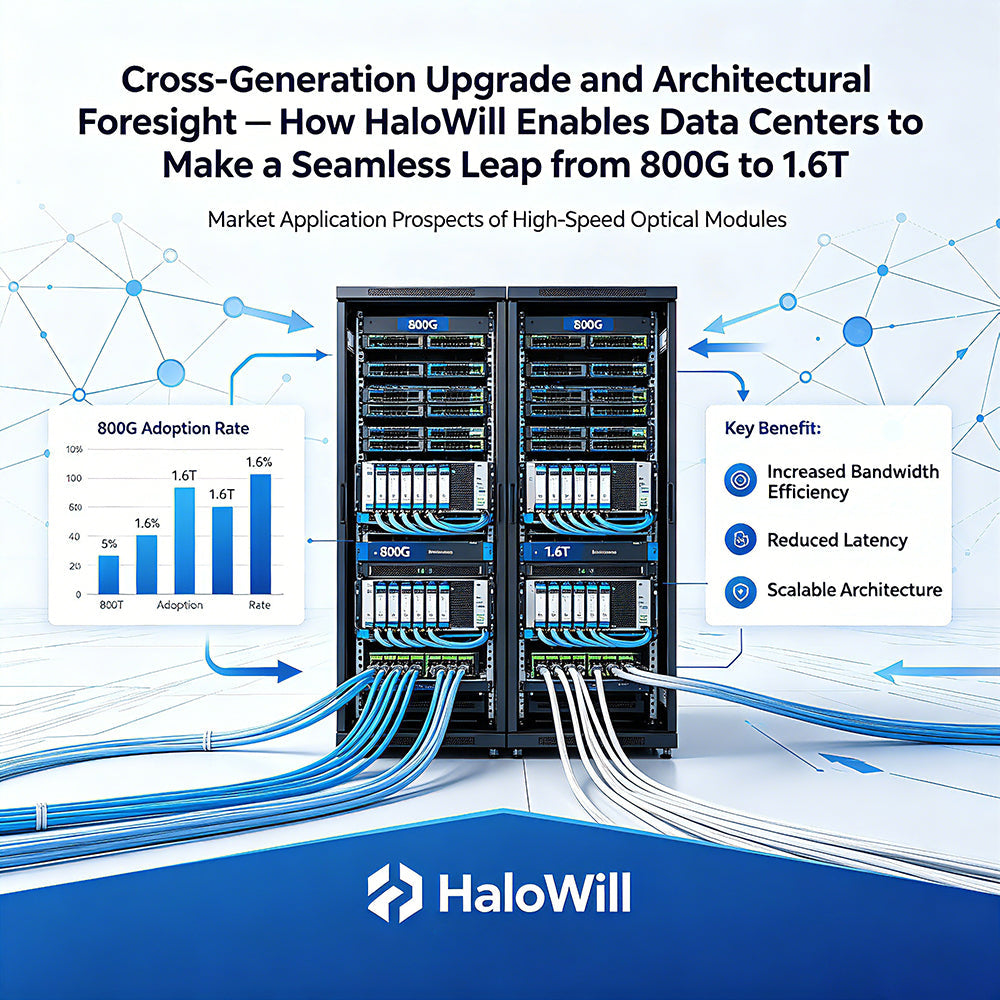

When Optical Transceivers Shift from “Accessories” to “Bottlenecks”
Any hyperscale data center operator in North America knows one thing: entering 2026, optical transceivers are no longer just peripheral accessories that you can “buy, plug in, and forget.” They are becoming one of the key limiting factors that determine the scaling speed of AI infrastructure. The latest report from Yole Group indicates that in 2025, global revenue for datacom optical components exceeded 18billion,upmorethan7018billion,upmorethan70120 to $175, directly throttling the shipment cadence of optical transceivers.
For data center procurement decision-makers in North America, this means a crucial question: Does your chosen optical transceiver supplier have the ability to deliver consistently and reliably amid supply chain storms? This question is far more important than “can you make an 800G module?”
Supply Chain Resilience Is Not a Slogan; It’s an Organizational Capability
In the optical transceiver industry, having product design capability is merely an entry ticket. What truly sets players apart is the ability to control the entire process—from wafer-level component qualification to system-level integration. The transceiver module that is ultimately delivered is only the visible tip of a deep supply chain: lasers, modulators, DSPs, TIAs, laser drivers, photodiodes, optical engines, connectors, fiber arrays, WDM filters, couplers, isolators, circulators, attenuators, as well as precision assembly and testing—a break in any single link can cause delivery collapse.
It is at this level that HaloWill’s brand advantage comes to the fore. Rather than blindly chasing short-term capacity races, HaloWill has taken a more solid path: building a diversified upstream supply network and a rigorous supplier qualification system. This means our supply chain does not rely on single sources; we can flexibly switch when core materials are in tight supply, ensuring our customers’ delivery schedules are not impacted by any single bottleneck.
More importantly, HaloWill has established a full-chain reliability qualification process that spans from chip level to system level. Across the industry, for the certified, high-yield, high-reliability optoelectronic device capacity required for 200G-per-lane optical links, the real bottleneck is not the availability of raw InP wafers, but the combined capability in epitaxy, laser processing, hermetic packaging, burn-in testing, and long-term reliability screening. There is a vast gap between a laser that barely works and one that is hyperscale-certified. HaloWill’s product qualification system is designed precisely to bridge that gap, ensuring every module delivered to customers has undergone rigorous reliability validation at hyperscale data center standards.
Silicon Photonics Roadmap: From Supply Chain Gambit to Strategic Reserve
Supply chain challenges are accelerating the industry’s migration toward silicon photonics (SiPh) technology. Against the backdrop of persistently tight EML supply, the value of silicon photonics is no longer just a topic of technical discussion—it has turned into a tangible commercial hedge against risk.
With EML chip supply currently in shortage, global shipments of 800G-and-above optical transceivers are projected to reach approximately 150 million units in 2026, and a handful of qualified InP laser suppliers simply cannot meet this demand. Silicon photonics, by shifting part of the value to wafer-level modulators and external CW-DFB lasers, theoretically broadens the manufacturing base and improves integration. According to industry forecasts, silicon photonics will account for more than 50% of 800G optical modules in 2026, and a significantly higher 70%–80% in 1.6T modules.
HaloWill’s Brand Promise: Reliability Lies in the Details
Behind every test curve is thousands of yield-sensitive optical and electronic components; the failure of any single component in high-volume manufacturing can trigger a system-level failure. In the AI era, the bottleneck is not how to assemble a module, but how to qualify and manage every component in mass production.
This is where HaloWill’s brand value lies: we not only provide MSA-compliant products, but also deliver full-lifecycle reliability assurance around product delivery. Whether it is an 800G QSFP-DD module for AI cluster backbone interconnects, or a 1.6T OSFP core component for next-generation data center architectures, the consistent attributes customers find in HaloWill products are: rigorously certified supply chain traceability, performance consistency across the full temperature range, and long-term reliability data backing.
This is precisely the capability that hyperscale data center procurement decision-makers in North America value most today. When an industry shifts from a “technology race” to a “delivery race,” HaloWill’s competitive moat is not marketing rhetoric, but a quality commitment and delivery discipline embedded in the DNA of our products.
In the AI optical module market of 2026, competition has shifted from “who can make it” to “who can make it reliably.” TrendForce’s latest research predicts that the global market for AI-specific optical transceiver modules will leap from 16.5billionin2025to16.5billionin2025to26 billion in 2026, growing over 57% year-on-year. In the face of such enormous demand, HaloWill chooses to let its supply chain resilience and qualification strength speak—a strategy that is not just a commercial approach, but a responsible, long-term.