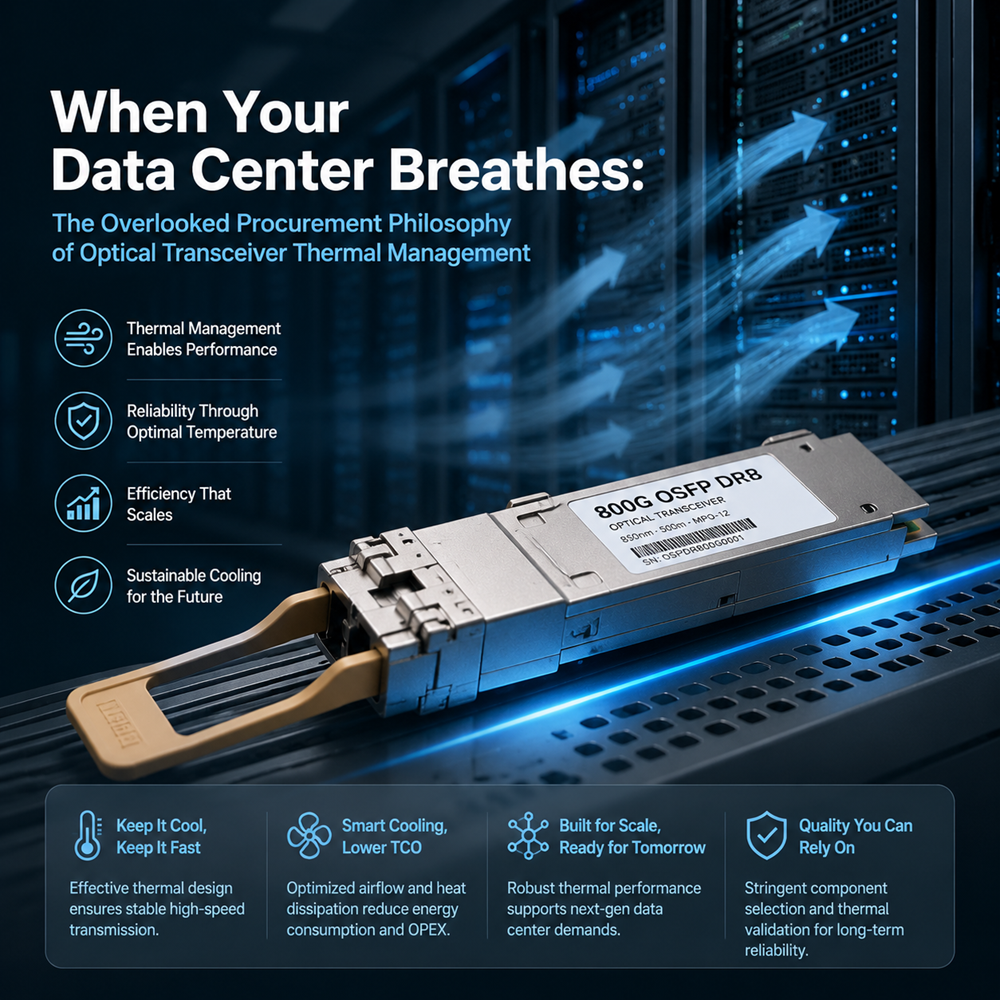

On the evolutionary trajectory of high-speed optical transceivers in North America, we are approaching a decisive technological fork. At one end lies the DSP-based retiming architecture that has been refined over decades and has continuously reinforced its dominance over the past ten years. At the other end is a disruptive path regarded as a kind of “return to fundamentals” — Linear-drive Pluggable Optics, or LPO. As industry discussions around 1.6T intensify, a ghostly question keeps echoing through high-level procurement meetings: if the linear-drive approach matures ahead of schedule, could the hundreds of thousands of 800G DR8 modules we are ordering right now become obsolete in terms of power consumption and latency within just two years? The root of this question lies in the unprecedentedly stringent demands that AI training and inference clusters are placing on the network.
The heart of a traditional PAM4 high-speed optical transceiver is a powerful digital signal processor. Its role resembles that of an extremely intelligent translator between the electrical and optical domains, responsible for compensating for signal attenuation, reflections, and crosstalk along the copper traces from the switch ASIC to the optical transceiver, and reconstructing clean digital bits with sophisticated algorithms before driving the laser. The advantages of this architecture are enormous, but the price is power consumption — in an 800G module, the DSP often consumes half or even more of the power budget, while introducing processing latency on the order of tens of nanoseconds. For conventional cloud storage and ordinary compute traffic, this latency is negligible. But for AI large-model training clusters that employ parallel computing and are exquisitely sensitive to tail latency, the cumulative latency across every network switch hop directly slows down training progress — akin to having thousands of expensive GPUs sitting idle, waiting for data. The LPO philosophy, in contrast, is boldly direct: eliminate this translator entirely. Let the raw high-frequency PAM4 electrical signals emitted by the switch ASIC be shaped by relatively simple linear amplifiers and then directly drive the optical transmitter. All the tasks of signal compensation and reconstruction are pushed entirely back onto the switch’s SerDes chip to handle.
This makes the procurement decision extraordinarily challenging. The allure of LPO is lethal: power consumption drops by nearly half on the spot, the physical structure of the optical transceiver itself becomes simpler, suggesting enormous potential for cost reduction in theory, and since there is no internal DSP frame processing or buffering, latency plunges to an almost negligible sub-nanosecond level. For large-scale AI backend networks, this means operators can support denser ports within the same rack power budget, or divert the saved electricity to power more GPUs. However, paradise is never free. What LPO throws back onto the switch is an exceedingly fragile analog signal chain. Once the link escapes the DSP’s powerful error correction, every millimeter of trace loss on cables and PCBs, and every subtle impedance discontinuity in connectors, mercilessly erodes the end-to-end signal-to-noise ratio budget. This means that an LPO optical transceiver will no longer be the universal component of the past that could be plugged into any compliant port and run perfectly; it must undergo rigorous joint debugging and qualification with a specific switch model, and even a specific connector board interface.
This “binding” characteristic rewrites the rules of the procurement game. In the past, you could purchase switches from Company A and optical transceivers from Company B, fully enjoying open market bidding. A high-quality LPO solution, however, requires you to assemble an iron-triangle collaboration upstream in the supply chain, comprising the switch chip vendor, the switch equipment vendor, and the optical transceiver supplier. We have observed that leading North American cloud giants, leveraging their formidable technical strength and bargaining power, are taking the lead in promoting LPO pilot programs within vertically integrated systems built on custom switches. For the broader base of channel partners and the secondary procurement market, this could very likely lead to a period of market segmentation. For this reason, HaloWill’s technical strategy is not to pick sides, but to build an inclusive and comprehensive platform capability. On one hand, we continue to pursue extreme power optimization on traditional DSP-based solutions, pushing the energy efficiency of DSP modules to new heights through innovations such as silicon photonics integration — this is the most reliable path for present-day large-scale deployments. On the other hand, we are investing heavily in the industrialization of LPO, with a particular focus on the core challenges of link training and state monitoring. We have designed enhanced link diagnostic functions for our LPO modules that can monitor the effective signal-to-noise ratio and amplitude margin of the analog link in real time and proactively issue warnings before degradation occurs. This compensates, to a certain extent, for the blind spots created by removing the DSP’s monitoring capabilities.
As a buyer, what you need most at this moment is a clear technical roadmap, not an overzealous evangelist. HaloWill’s technical advisory team in North America can assist you in assessing whether LPO should be adopted immediately or kept on the watchlist for the next generation, based on the actual rack cabling lengths of your downstream customers’ networks, the genealogy of their switch chips, and their precise sensitivity grading for latency and power consumption. For the majority of business scenarios, the coming years will be a period where mature DSP-based solutions and LPO solutions for specific use cases coexist. Choosing a partner like HaloWill, which is capable of delivering first-class engineering products on both technological paths, means you retain the invaluable option to switch tracks at different moments and flexibly adapt to customer needs. This linear-drive storm will not overturn the existing system overnight, but it has permanently altered the coordinates by which we assess the future value trajectory of optical transceivers. Understanding it in advance and incorporating it into your strategic procurement framework is the only way to avoid being suddenly left behind by a technological generation gap in the future.