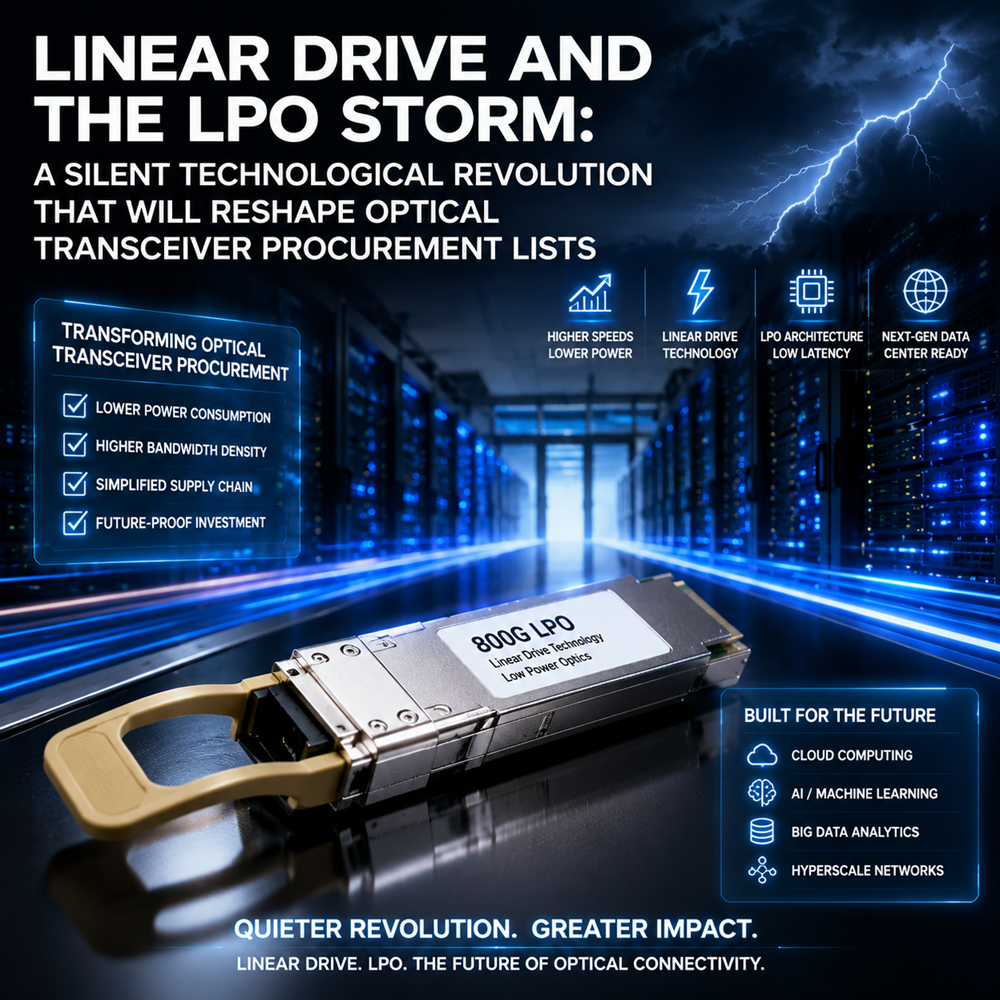

In the procurement decision chain of the North American data communications market, a once-dormant topic is hurtling into the shared line of sight of chief technology officers and procurement directors at astonishing speed: the heat output of optical transceivers. This topic may not sound as electrifying as 800G speeds or silicon photonics integration, but its economic impact is painfully real in the financial statements of every hyperscale data center operator. According to industry estimates, the annual cooling electricity cost of a mid-sized data center already accounts for nearly 40% of total energy consumption. And as AI clusters push single-rack power density toward the critical threshold of 20 kilowatts or even 30 kilowatts, every incremental watt is being mercilessly scrutinized. In this context, the optical transceiver is no longer that negligible little milliwatt-scale gadget. Picture a switch fully loaded with 32 QSFP-DD800 ports. If each module hovers around 14 watts of power consumption, the optical modules alone in a single device will dissipate nearly 450 watts of heat — equivalent to a small space heater running continuously.
For buyers, this heat conceals a dual cost burden. The first layer is the explicit electricity bill: for every watt consumed to drive the laser and the digital signal processor, the data center needs to expend roughly 0.3 to 0.6 additional watts on cooling, a multiplier effect that is dramatically amplified at scale. The second cost is more insidious but equally lethal: long-term reliability degradation induced by thermal stress. When the internal temperature of a module lingers near the high-temperature limit for extended periods, the defect growth rate in the laser chip accelerates, and intermetallic compounds at the solder interfaces thicken. The module may not fail immediately, but its bit error floor is creeping upward at a rate invisible to the naked eye. This "chronic illness" will eventually erupt in the form of intermittent link failures, leaving operations teams tearing their hair out in frustration.
HaloWill's engineers realized three years ago that optical transceiver thermal management cannot stop at adding a few heat sink fins to the metal housing. It is a systems engineering challenge encompassing materials science, thermodynamics, and signal integrity. Our latest generation of 800G silicon photonics modules employs a design concept we call "gradient thermal conduction topology." In conventional modules, the heat dissipation path is relatively monolithic: heat generated by the laser is conducted through the ceramic substrate to the metal casing, and then dissipated into the airflow channel of the switch faceplate via the cage connector interface. Multiple thermal resistance bottlenecks exist along this path, especially given the differences in thermal expansion coefficients between various materials. After prolonged operation, micron-scale air gaps can form at the contact interfaces, causing a sharp drop in thermal conduction efficiency. Our approach has been to introduce, inside the package, a phase-change thermal interface material with high compressive resilience. When the module's operating temperature rises, this material undergoes a compliant phase transition, seamlessly filling the microscopic voids between the chip and the housing, thus creating a low-thermal-resistance conduction channel. Concurrently, we have embedded an intelligent thermal throttling algorithm into the module's firmware. This is not a crude over-temperature shutdown protection mechanism; it is a dynamic, fine-grained power regulation strategy. When the module detects that the case temperature is approaching the warning threshold, it makes nearly imperceptible adjustments to the tap coefficients of the equalizer inside the DSP and to the transmitter pre-emphasis level, trading a minimal amount of signal quality for several hundred milliwatts of power savings. This prevents the switch from triggering forced speed reductions or port shutdowns, thereby maintaining the overall throughput stability of the network.
The implications this brings to North American procurement decisions are profound. When you are evaluating two optical transceivers with nominally identical performance specifications, the difference between a module with superior thermal design and one with mediocre thermal design will not reveal itself on the first day of network insertion; it will gradually become apparent in the 18th month, the 24th month of operation. HaloWill is willing to transparently share our thermal simulation models and long-term accelerated aging test data with strategic partners, because behind those unglamorous curves and data points lie potentially hundreds of thousands of dollars in annual savings on your data center cooling system operating expenses, the extra GPU servers you can fit into your cabinets, and most importantly, the intangible promise of stable network operation for your customers. The next time you review an optical transceiver quotation sheet, you might want to factor the full lifecycle cost per watt of power consumption into your calculation. You will find that the truly cheap module is often not cheap at all.