
If chips are the brain of AI, then optical modules are the neural fibers connecting countless brains. Over the past two years, hyperscale data centers across North America, in supporting the training of models such as ChatGPT, Gemini, and autonomous driving systems, have seen switching silicon capacity surge from 12.8 Tbps to 51.2 Tbps, with the deployment volume of 800G ports climbing at an unprecedented rate. Against this backdrop, the quality of a single optical module can sway the utilization of an entire GPU cluster. For procurement leaders, optical module selection has long transcended the stage of mere price comparison; it has become a strategic decision that directly impacts training timelines, power budgets, and supply chain security.
When an AI training job runs continuously for dozens of days, any link flap, temperature drift, or intermittent bit error can force the system to fall back to a degraded speed state or even trigger a recalculation, squandering precious GPU hours. More troublingly, many standard off-the-shelf optical modules on the market have not undergone deep signal integrity optimization for specific switching environments such as Broadcom Tomahawk 5 or NVIDIA Spectrum-X, causing field engineers to spend weeks troubleshooting random packet loss before finally pinpointing the compatibility chasm between the module and the switch. Meanwhile, the sensitivity of North American data centers to power consumption has reached an exacting level — every single watt shaved from a module's power draw means more electricity freed from the cooling system for compute itself, shifting the entire cluster's TCO structure in a meaningful way. At the same time, over-concentration of supply keeps many CIOs vigilant, haunted by memories of chip shortages and logistics disruptions. They urgently need second and third suppliers with multi-region inventory and rapid-response capabilities to build a genuinely anti-fragile network physical layer.
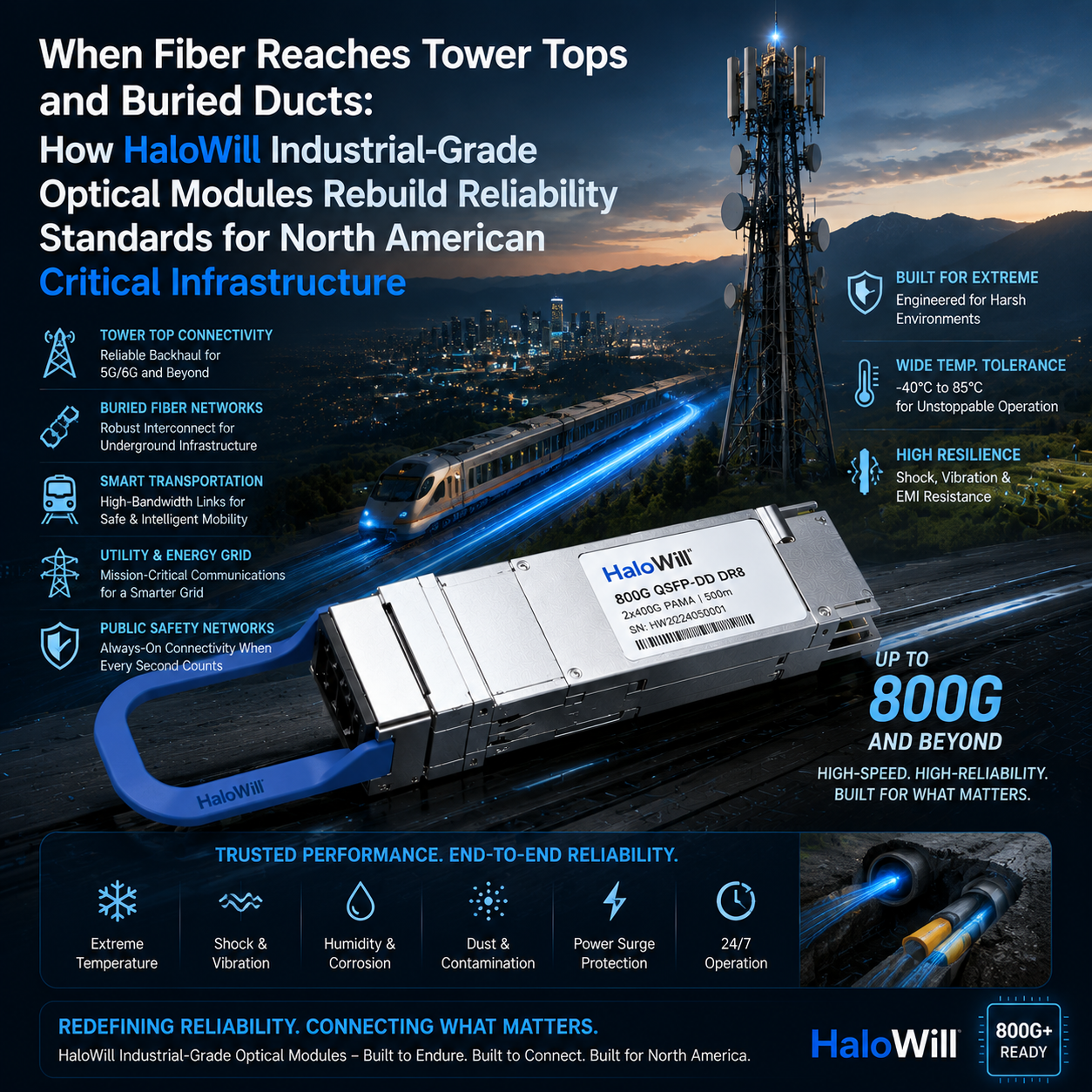
HaloWill was born precisely to address these deep-seated anxieties. In the brand name, "Halo" signifies a halo of stable, lossless transmission within the torrent of data, while "Will" represents our iron resolve in delivery commitment and quality assurance. Unlike generic modules circulating in the gray market, HaloWill's 800G SR8, DR4, and FR4 families are co-tuned with mainstream switch silicon platforms from the design stage. During volume production, end-to-end bit error rate screening is introduced, ensuring that the actual BER of every factory-released module vastly exceeds the IEEE 802.3 standard of 1E-12 and enters the safety zone of 1E-15 or even lower. This is not a rhetorical flourish; it directly translates into fewer link retrains and failovers for AI customers under full-load training. Our firmware also embeds an intelligent link tuning algorithm that automatically identifies the host port type upon module insertion and fine-tunes parameters such as de-emphasis and pre-emphasis, dramatically reducing the time field engineers spend opening racks and repeating plug-and-test cycles. For AI data centers where every second counts, this plug-and-stabilize capability is nearly a new form of currency.
HaloWill's brand value extends well beyond factory-gate performance. We deeply understand the North American engineering teams' desire for autonomy and predictability, which is why we have established local spare-part depots in Dallas, Texas, and Delaware, supporting 48-hour emergency delivery. We also provide a three-year global advance-replacement warranty: the replacement module is dispatched from our North American warehouse even before the customer has shipped back the suspected faulty unit. Behind this seemingly straightforward service lies an entire supply chain's willpower. Last autumn, a newly built AI inference cluster in Oregon urgently needed 2,000 units of 800G SR8 modules during a capacity expansion, only to find its original supplier caught in customs clearance delays. Within 24 hours of receiving the request, HaloWill delivered 50 test samples from a consignment stock near Portland and cooperated with the switch vendor in a week-long extreme-load stress test, during which no single link went offline. Ultimately, the full batch lit up all GPU nodes on time, under the dual pressure of budget and construction schedule. The operator subsequently added HaloWill to its core AVL and has been placing repeat orders ever since.
Every real-world North American case like this reinforces one fact: HaloWill does not sell mere "optical modules." Instead, we compress reliability, compatibility elasticity, and localized service into a single procurement unit. For agents and system integrators, this integrated capability means they can deliver lower operational costs and fewer production interruptions to end users, thereby significantly enhancing customer stickiness and project margins. HaloWill also offers customized optical firmware services to high-volume channel partners — such as locking specific flow-control thresholds, fine-tuning transmit eye diagrams according to customer link budgets, and even pre-burning designated asset-tag information. These deeply "tailored" services allow agents to sell not a standard SKU but a unique solution that competitors find extremely difficult to simply displace. Meanwhile, our focus on green metrics — 800G silicon photonic modules typically consume about 15% less power than the industry average — helps customers score on both ESG disclosures and operational costs simultaneously, an aspect that has aroused strong interest among several sustainability-focused Tier II data center groups across North America.
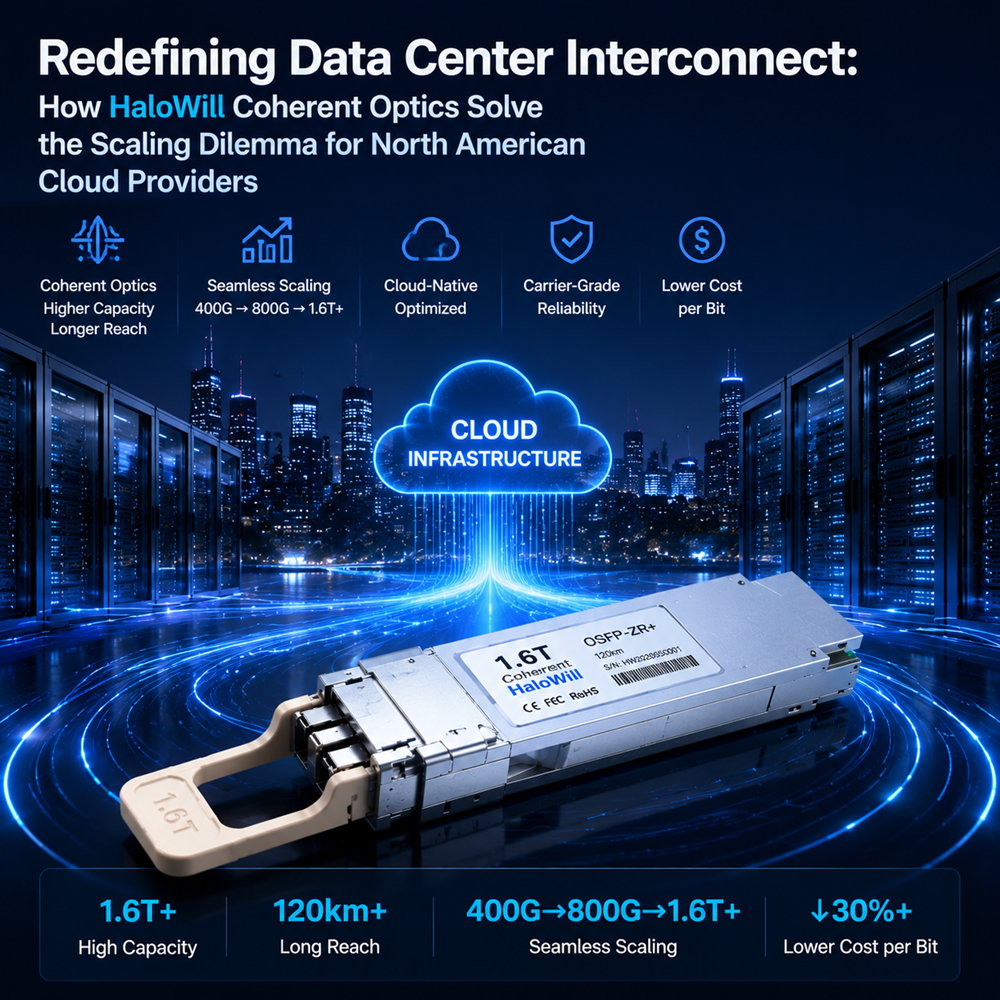
On the forward-looking technology front, HaloWill is already collaborating with leading North American AI chip companies to validate 1.6T OSFP-XD silicon photonic modules. Leveraging a microring modulator architecture, these modules double the single-port data rate while capping power consumption, paving the way for next-generation 100T switching fabrics. We are also developing enhanced link diagnostic features, enabling optical modules not only to transmit data but also to sense fiber aging and connector contamination, proactively issuing alerts, and thus becoming active probes within the network observability framework. All of this springs from the commitment to continuous evolution embodied in "Will" — HaloWill has no intention of remaining on a static product list but aims to be a long-term co-evolutionary partner for North American AI infrastructure.
If you are spearheading the interconnect architecture of a hyperscale or colocation data center, or if you are a North American channel partner searching for an optical module brand that meets stringent technical specifications while possessing the warmth of local service, exploring HaloWill may well be your critical step toward reducing risk and sharpening your competitive edge. We have readied a full suite of 400G and 800G sample kits and a local technical team, standing by to replicate that confidence-building journey of the Oregon case. Under the halo of HaloWill, let every bit arrive with will.