
When the U.S. federal government infused hundreds of billions of dollars into rural broadband, smart grids, and intelligent transportation through the Infrastructure Investment and Jobs Act, the endpoint of fiber deployment no longer stopped at temperature- and humidity-controlled telecom central offices. Instead, it continuously stretched into deserts, coastlines, elevated roadsides, and snow-capped ridges. The optical modules inside these edge nodes must endure extreme daily temperature swings of dozens of degrees Celsius, withstand low-frequency vibrations from wind turbine towers, and resist the corrosion of metallic contacts by salt spray and hydrogen sulfide. Any optical link that fails to synchronize its clock in the -30°C dawn light could trigger a grid protection switching failure or delay V2X traffic safety messages. North American system integrators and operators are beginning to widely recognize that although commercial-temperature-grade optical modules may have a slightly lower upfront cost, the chain-reaction failures and truck-roll maintenance expenses they trigger in edge scenarios are more than enough to devour all short-term savings.
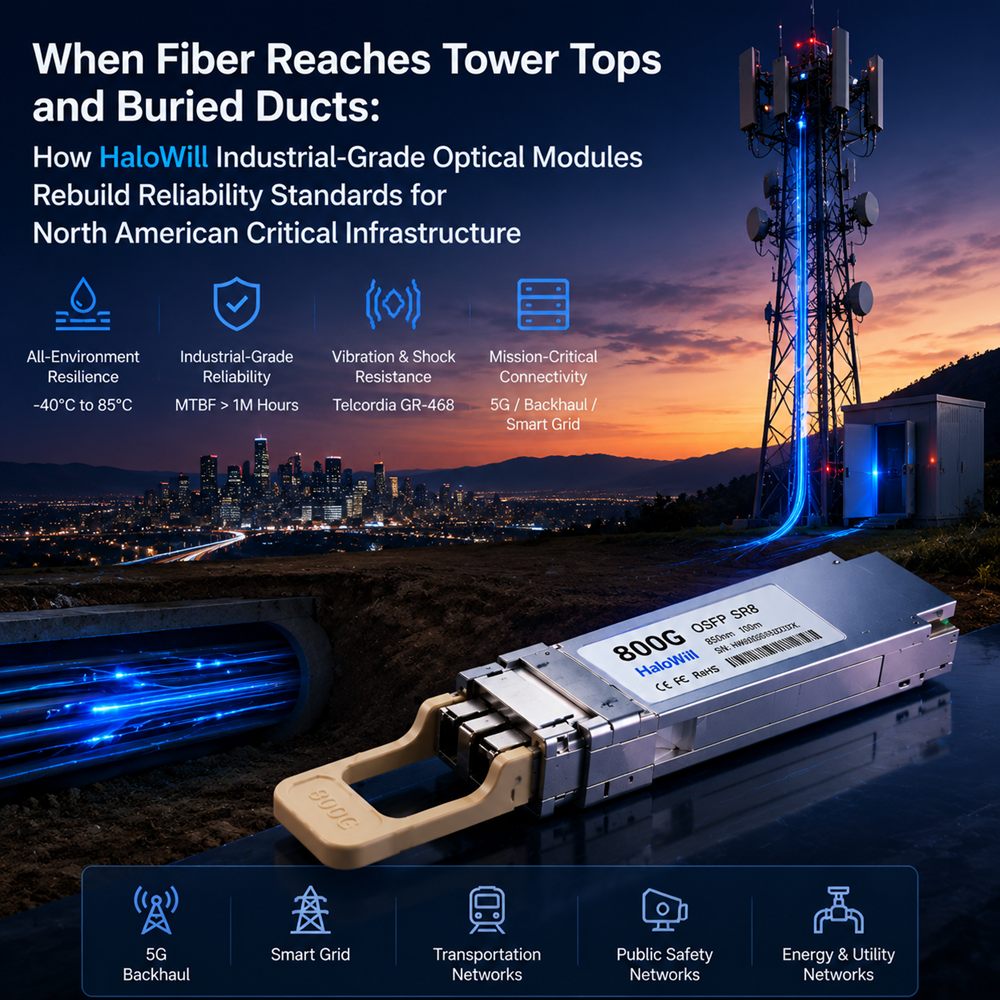
HaloWill's family of industrial-grade optical modules was born precisely to end this "edge fragility." We infuse the brand's "Will" spirit into every SFP, SFP+, SFP28, and even 25G/50G SFP56 industrial-temperature module. Before leaving the factory, every product not only passes full-temperature-range bit error rate testing from -40°C to +85°C case temperature but also undergoes over 500 hours of thermal cycling burn-in and HALT (Highly Accelerated Life Testing) screening. This standard far exceeds baseline specifications because we understand: when powering up a remote radio unit on a Dakota winter morning, you cannot count on a module that barely meets the lower threshold. Beyond the hardware tenacity, HaloWill also embeds enhanced digital diagnostic monitoring (DDM) into the microcontroller firmware, enabling the operations center to remotely read each module's internal temperature, supply voltage, laser bias current, transmit and receive optical power in real time, and calculate link margin trends. In this way, network managers can catch slowly drifting degradation signals before a fault occurs and implement predictive maintenance, rather than dispatching a service truck into a blizzard.
Let us shift our gaze to a real-world application site. A smart grid distribution automation project in the Great Lakes region needed to backhaul monitoring signals from over 1,200 pole-mounted switches to a substation center. These nodes are exposed to the region's damp cold and scorching summer sun, with some locations experiencing vibration levels reaching the IEC 60068 railway lineside standard. The project integrator initially trialed various generic modules, only to run into repeated winter startup failures and optical interface loosening. After switching to HaloWill industrial-temperature SFPs, our enhanced locking mechanism ensured that the optical connector and module cage remained tightly coupled under continuous micro-vibration, while the wide-temperature-range laser driver paired with an intelligent heating strategy allowed the link to stably establish itself even on a bitterly cold -38°C night. Over two years of project operation, that batch of modules has maintained a record of zero field failures, prompting the integrator to designate HaloWill as the specified brand for all subsequent outdoor OT networks.
For North American agents and channel partners, what the HaloWill industrial series provides is far more than just the ledger advantage of a low return rate. We deeply understand that in government procurement and utility tenders, compliance and customization capabilities are often more persuasive than mere product specifications. That is why HaloWill offers pre-configured firmware services for industrial modules. Even for small and medium-batch orders, the module firmware can be tuned at the factory to perfectly match specific Ciena, Infinera, Juniper, or Dell edge gateways, achieving true plug-and-play right out of the box. This service significantly reduces the workload for field crews in flashing configurations, a benefit of immense practical significance for the labor-expensive North American market. Simultaneously, we provide TAA (Trade Agreements Act) compliance options and conflict minerals reporting, helping channel partners smoothly enter federally funded infrastructure projects and clearing procurement hurdles from bureaucratic processes.
In the edge domain, power consumption is not just about electricity bills; it also affects backup battery runtime and enclosure thermal design. Especially at photovoltaic energy storage sites and remote mountaintop base stations, every single watt is precious. By optimizing the laser driver architecture, HaloWill makes the typical operating power consumption of its industrial-temperature optical modules about 15% lower than the industry average. When a project accumulates thousands of nodes, this difference directly translates into smaller solar panels and fewer battery banks, thereby reducing overall capital expenditure. We open this green design philosophy to long-term partners through the "HaloWill Edge Partner" program, offering project price registration protection, joint-branded technical seminar support, and a free sample revolving fund, equipping local agents with sufficient ammunition to win the trust of electric cooperatives, traffic management agencies, and regional telecom operators.
Looking ahead to the next evolution of North America's edge ecosystem, 5G MEC (Multi-access Edge Computing) and Wi-Fi 7 backhaul are driving industrial optical modules to leap from 1G/10G to 25G/50G PAM4, while still maintaining the same harsh environmental tolerance. HaloWill has already launched industrial-grade 50G modules compliant with the SFP56 standard and completed interoperability validation with multiple DU/RU vendors under the Open RAN architecture. Their ultra-low latency and clock recovery performance have earned the endorsement of tower operators' test reports. We also observe that the "Buy America" policy framework in the U.S. is posing increasingly profound questions about supply chain transparency. HaloWill's compliance testing processes and independent laboratory verification system established in North America can ensure the traceability of every material batch, thereby giving customers full confidence during compliance audits. This is an extension of the commitment symbolized by our "Will"—whether on paper or in the wind-swept, sand-blown field, HaloWill optical modules stand up to scrutiny.
Edge computing is a movement to bring intelligence to where data is born, and the physical-layer foundation of this movement tolerates no sloppiness whatsoever. HaloWill's industrial optical modules inherit the enduring protection implied by "Halo"; no matter how rough the external environment, they can extend a stable optical path into it. For system integrators and operators seeking an ideal module partner for smart cities, grid modernization, or rural 5G coverage, HaloWill delivers not only hardware specifications but also a will of reliability that can be projected onto any latitude and longitude. We have readied an industrial-grade sample kit and a localized support team, looking forward to working with you to ensure that the light of the last mile shines with the same quality as the first.