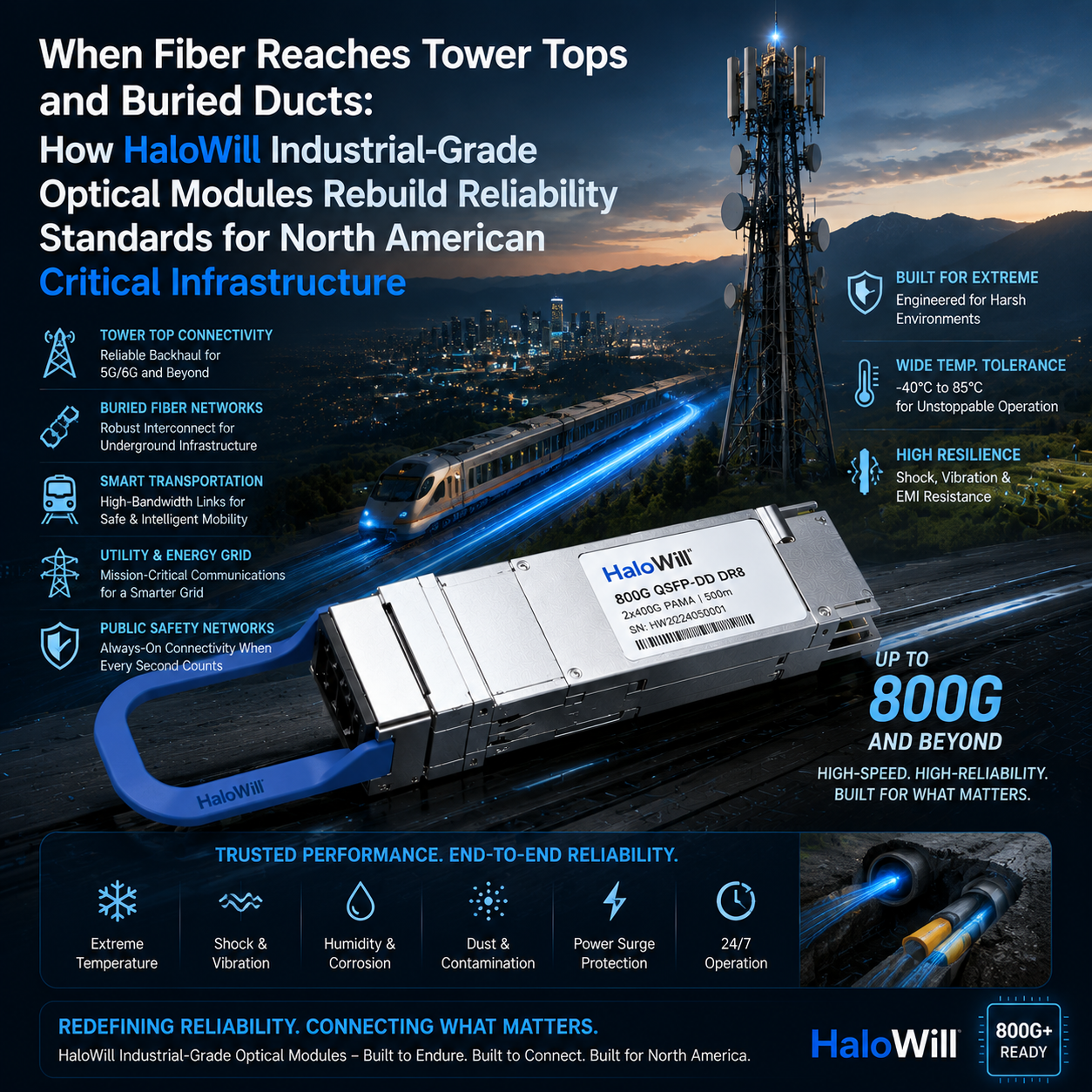

On a frigid winter night in the Midwest of North America, a 5G RRU equipment enclosure mounted atop a steel tower is enveloped by a minus 35 degrees Celsius wind. Inside the enclosure, the heater is running at full power, yet at the edge position where the optical module sits, the temperature still drops below the lower limit of most commercial-grade components. In this very environment, the link must maintain fully transparent transport of eCPRI fronthaul signals — any fronthaul disconnection caused by optical power drift could reset the service perception of thousands of users across the base station’s coverage area to zero within seconds. This is by no means a theoretical scenario; it is the daily reality that North American operators confront as network densification advances. And it is precisely in such scenarios that the wide-temperature performance of HaloWill industrial-grade optical modules has been increasingly placed on the recommendation lists of frontline site engineers.
From the very beginning, the HaloWill industrial-grade series abandoned the shortcut of “screening and ruggedizing commercial-grade modules.” Instead, it established a technology path based on non-hermetic packaging with full temperature range compensation at the optical engine design stage. By creating a closed-loop mapping between the laser bias current, modulation swing, TEC control points, and the on-chip temperature sensor, HaloWill’s 25G SFP28 and 100G QSFP28 industrial modules achieve a transmitted optical power drift of less than ±0.5 dB and receiver sensitivity degradation of no more than 1 dB across the -40°C to 85°C range. This full-temperature consistency yields a direct benefit: network planning departments no longer need to stock separate “room temperature,” “low temperature,” and “high temperature” models for different climate zones. A single SKU covers everything from sun-baked rooftop sites in Florida to ice-locked tower tops in Minnesota. For large North American operators, the convergence of optical module SKUs in itself translates into millions of dollars in inventory carrying cost savings.
When it comes to vibration and shock tolerance, HaloWill industrial modules likewise do not stop at paper specifications. A great many 5G fronthaul sites in North America are mounted directly on existing utility poles or highway gantries. When a heavy truck passes or wind speeds exceed Force 6, the chassis housing the optical module endures continuous low-frequency vibration. HaloWill has introduced a micron-scale elastic buffer layer between the internal optical lens assembly and the module housing, and has abandoned the spring-clip retention method common in traditional pluggable cage structures — a method prone to generating metallic debris through fretting wear — in favor of multi-point floating positioning. Test data shows that after applying a random vibration spectrum of 10 Hz to 2000 Hz at 20G, the variation in insertion loss is held within 0.3 dB, far below the 0.5 dB failure criterion typically required by the industry. This explains why a group of North American private power network customers, after comparative testing, ultimately added HaloWill to the approved list for their substation differential protection links — a link where a momentary loss of lock in the optical module could mean a failure of the protective relay to operate, a consequence far more severe than the communication interruption itself.
Edge data centers represent yet another crucible that tests industrial-grade optical modules. Unlike the clean, temperature- and humidity-controlled environment of a central office, edge sites are often deployed on factory mezzanines, in warehouse corners, or even inside containerized cabinets, where temperature and humidity fluctuate wildly and the air carries dust and trace corrosive gases. To address this, HaloWill employs a hard gold plating on the module’s contact fingers that is 30% thicker than the industry norm, and upgrades the housing seal material from nitrile rubber to fluorosilicone rubber. As a result, the module withstands 21 days of continuous exposure in mixed-gas corrosion testing while maintaining contact resistance below 20 milliohms. For system integrators, this data point means that when they budget for a five-year lifecycle of an unattended edge site, the replacement frequency of optical modules can be extended from the previously estimated once every 18 months to a five-year lifespan matching that of the switch itself. The reduction in on-site maintenance labor costs is obvious.
HaloWill has also embedded a feature in its industrial product line that seems minor yet has deeply won over North American integrators: a link health snapshot. The module’s built-in microcontroller continuously records optical power, temperature, bias current, and bit error rate trends over the previous 30 days, and outputs structured data directly through the standard DDM digital diagnostic interface. This means that before a field technician even departs for a site, they can remotely retrieve the “black box” data logged by the module to determine whether link degradation is occurring on the fiber side, at the connector end-face, or within the module itself, and thus bring the correct spare part to complete the repair in a single visit. In a market where the cost of a single truck roll can easily run into thousands of dollars, this feature alone is the most direct reason for channel partners to list HaloWill as a recommended brand.
Looking at the market landscape, procurement of industrial-grade optical modules in North America is shifting from a pure comparison of unit prices to a comparison of “reliability data that can withstand scrutiny” and “quantifiable total lifecycle operating costs.” HaloWill’s response has been remarkably pragmatic: it not only makes its NEBS Level 3 certification, IEC 60068 vibration and shock test reports, and 21-day mixed-gas corrosion report directly public on its product pages, but also allows North American channel partners to apply for samples to be sent to customer-designated third-party laboratories for retesting. In the conservative world of critical infrastructure procurement, this kind of transparency often cuts through more effectively than any advertising copy. When a power integrator in Texas finds that the results they have repeatedly verified on their own test bench align almost perfectly with HaloWill’s original factory data, trust is no longer something that needs to be deliberately built — it has already been naturally established on the lab bench.
Today, the North American market for 5G fronthaul, edge computing, and private industrial networks is at an inflection point, transitioning from “good enough” to “zero-compromise reliability.” The role that HaloWill industrial-grade optical modules play is not to compete for the lowest line-item price on a tender. Rather, it is to use a set of engineering records that can withstand being dissected item by item under extreme environments to answer the ultimate question for operators and equipment vendors: when the harshest conditions arrive, which optical module will keep your network alive? That answer is being quietly solidified under the HaloWill brand identity at more and more North American sites every day.