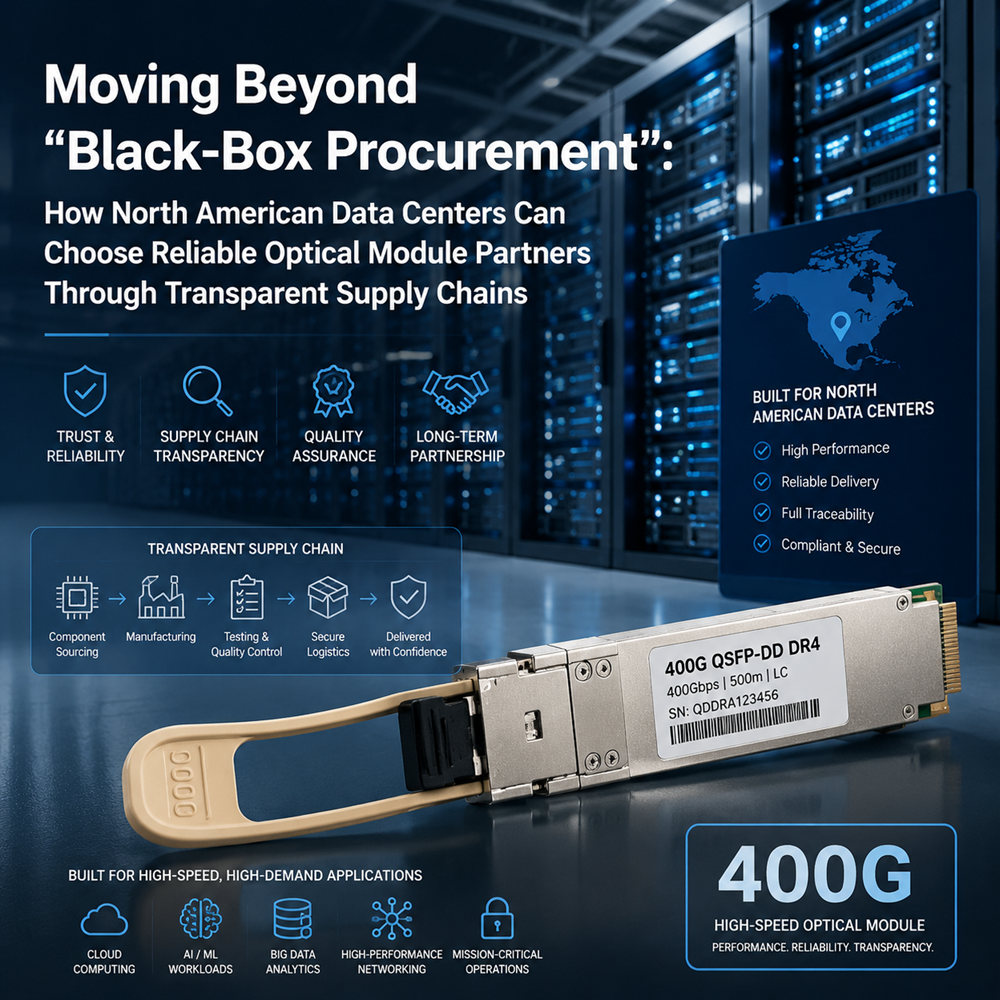

If you are a procurement director for a North American data center, making optical module purchasing decisions in 2026 is far more complex than it was just three years ago.
Not long ago, procurement considerations were largely limited to price, performance, and lead time. Today, however, supply chain compliance, transparency, and geographic diversity carry the same weight as product specifications themselves. The procurement focus for AI data centers is moving decisively from “cost‑driven” to “compliance and supply chain security,” with non‑China production capacity and supply chain transparency emerging as necessary prerequisites for accessing the North American market.
This shift did not happen in a vacuum. North America’s four cloud giants—Google, Amazon, Microsoft, and Meta—have become increasingly cautious in their supplier selection. Geographic concentration of supply chains, exposure to geopolitical risks, and the availability of alternative production capacity are now core elements of procurement decision matrices. At the same time, tariff policies affecting optoelectronic components continue to reshape cost structures.
Against this backdrop, “China+1” is no longer a strategic option but is gradually becoming the default configuration for North American buyers. The challenge, however, lies in finding an optical module supplier that truly possesses global manufacturing capabilities while maintaining technological leadership and cost competitiveness—a task easier said than done.
This is precisely the unique value that HaloWill brings to the North American market. With four manufacturing bases in China, Thailand, and the United States, HaloWill has built a production network spanning Asia and North America. This footprint not only provides customers with geographically diversified supply assurance but also delivers significant advantages in tariff compliance, logistics efficiency, and localized service.
More importantly, HaloWill covers the entire value chain—from optical chip design and fabrication to optical module assembly and testing. This means customers do not have to deal with the coordination costs and quality risks associated with multiple layers of suppliers. HaloWill can undertake end‑to‑end delivery responsibility, from components to finished modules, with full accountability. For North American buyers seeking supply chain transparency and simplification, this full‑stack capability is itself a strategic asset.
The optical module market in 2026 is rewarding those enterprises that have proactively invested in supply chain resilience. HaloWill’s global manufacturing network and full‑value‑chain capabilities were built precisely to serve the procurement needs of this new era.