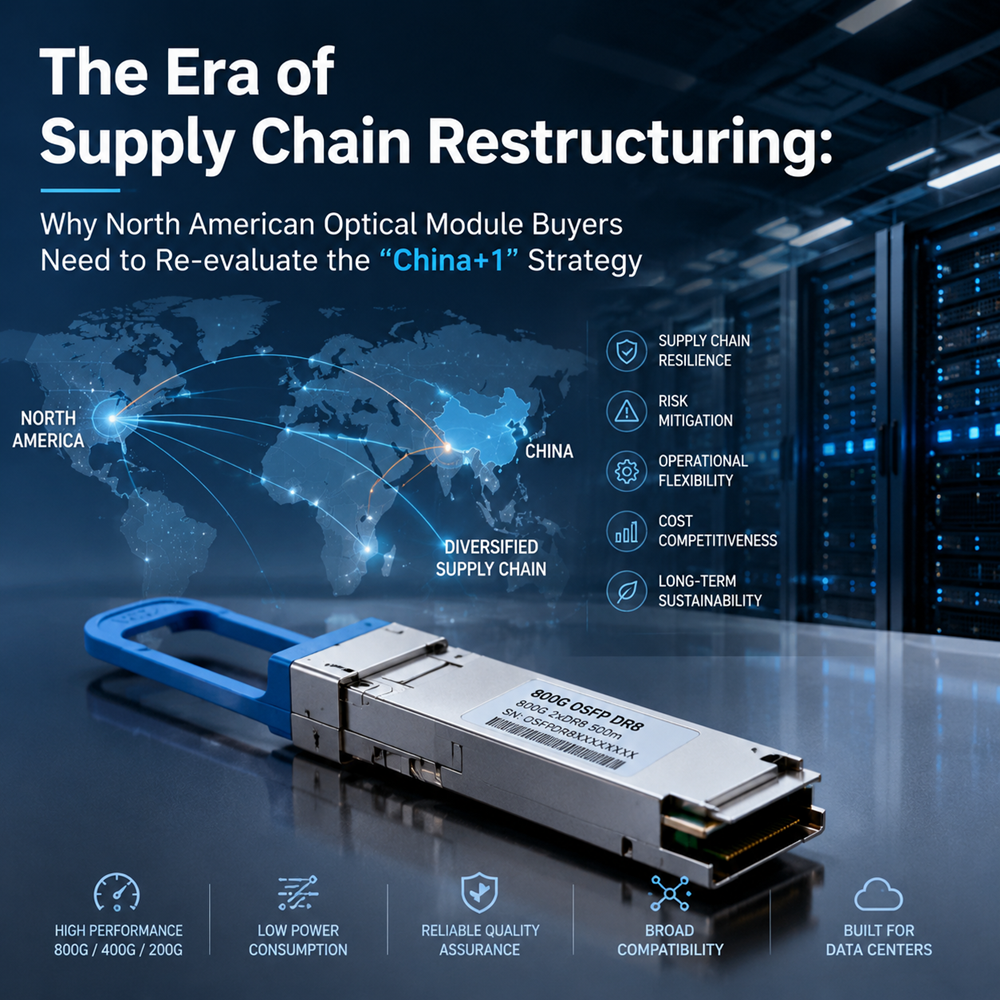

Anyone who has spent years in the optical module industry will tell you an unspoken truth: the most expensive cost in a procurement decision is often not the module price itself, but the price paid after choosing the wrong supplier.
When your AI training cluster stalls because of an optical‑module supply interruption, when newly deployed links require endless debugging due to compatibility issues, when a supplier’s capacity commitment falls through at the delivery deadline—these hidden costs far outweigh a few percentage points of price difference. North American data center operators are moving away from a “product‑comparison” procurement model and toward a “partner‑selection” model that evaluates suppliers across the full spectrum of capabilities.
So what defines a trustworthy optical module supplier?
Capacity authenticity and verifiability come first. In an environment of tight core‑chip supply, whether a supplier has its own optical‑chip capabilities, whether it operates diversified manufacturing sites, and whether its capacity planning is transparent and auditable—these factors directly determine the credibility of delivery commitments. HaloWill’s manufacturing capabilities span the entire value chain from optical chips to optical modules to optical network terminals, and its four manufacturing bases across Asia and North America provide customers with verifiable, traceable capacity assurance.
Sustainable technology iteration is equally critical. 800G is scaling up, and 1.6T is already under way. Whether a supplier continues to invest in next‑generation technologies determines whether customers will have to endure the long process of supplier re‑qualification within the next 12 to 24 months. HaloWill’s ongoing R&D in 1.6T optical modules, along with its dedicated focus on cutting‑edge technologies such as silicon photonics, LPO, and CPO, provides customers with certainty along their technology evolution path.
Quality systems and reliability guarantees are non‑negotiable baselines. The 7×24 uninterrupted operation of data centers imposes stringent demands on the long‑term reliability of optical modules. HaloWill has successfully completed process qualifications for its 400G/800G high‑speed optical modules with multiple international equipment integrators, confirming that its products have passed the rigorous validation of major global customers.
Last but equally important is supply‑chain transparency and compliance. In North America’s regulatory and tariff environment, a supplier’s manufacturing geographic footprint, raw material sources, and export‑compliance status have all become essential information for procurement decisions. HaloWill’s global manufacturing network offers customers inherent advantages in supply‑chain geographic diversification and compliance.
Choosing an optical module supplier is, at its core, choosing a reliable “data transmission pipeline” for unleashing data‑center compute power. What HaloWill provides is not just a specification‑compliant product, but a partner that withstands scrutiny across the four dimensions of capacity, technology, quality, and supply‑chain transparency. For North American buyers evaluating next‑generation optical module suppliers, this just might be the name worth a serious conversation.