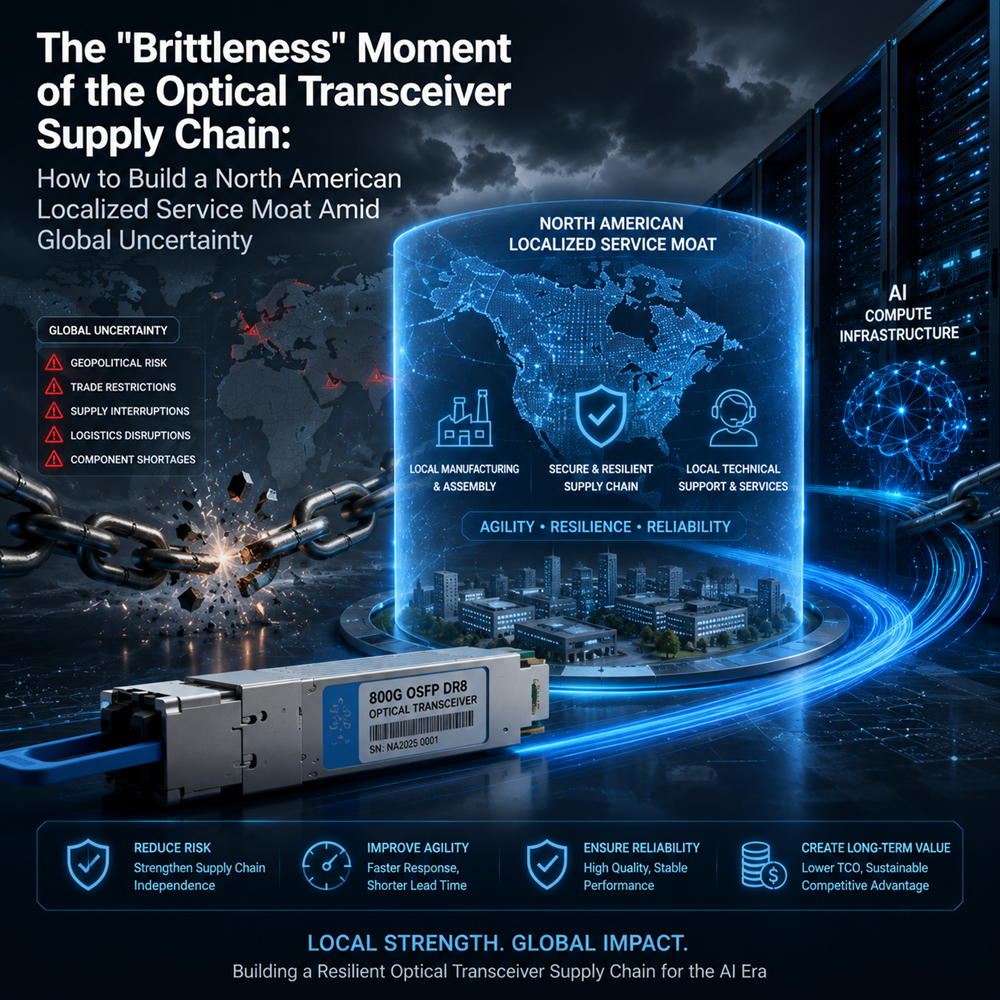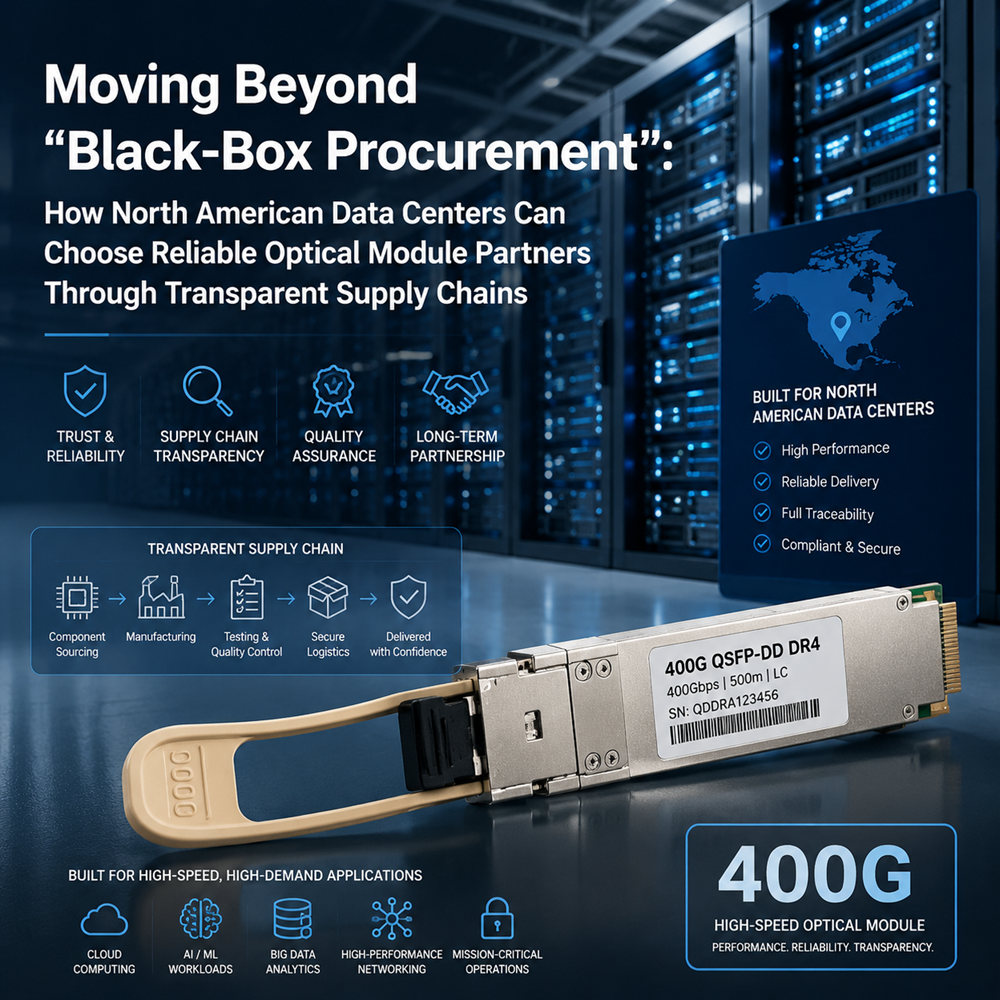

In the North American data communications market, if the past decade saw cloud computing steadily pulling optical transceiver speed iterations forward, the explosion of generative AI now resembles a violent mountain-building event that has fundamentally reshaped the landscape of procurement decisions. Walk into the network architecture department of any Tier 1 cloud service provider today, and you will find the conversation is no longer simply about “migrating from 100G to 400G.” Instead, it revolves around the extreme balancing act across single-point failure domains, tail latency, and the energy consumption of optical-to-electrical conversion for the entire cluster. For you on the procurement side, this means an entirely new set of rules: every optical transceiver you choose must have the ability to "look three generations ahead."
Traditionally, procurement decision cycles were anchored to clearly defined IEEE standards. Once a standard was ratified, optical transceiver manufacturers would sequentially roll out samples, small batches, and then volume production, while buyers conducted compatibility verification step by step. However, the sheer parallel computing scale of AI training clusters—involving hundreds of thousands of GPUs—has caused network bandwidth demands to swell far beyond the pace of standards development. When a leading cloud vendor begins deploying 51.2T switching capacity on its custom-designed switches, the demand for 800G optical transceivers at the port level becomes immediately urgent. Yet if you procure based solely on port speed at this moment, you fall straight into the first trap: the thermal power dilemma posed by the port density wall.
Picture a 1RU switch faceplate densely packed with 32 QSFP-DD800 ports. If per-port power consumption lingers at the traditional level of 14W to 16W, the overall thermal design of the device will face enormous stress, forcing the system to initiate protective frequency scaling—an entirely unacceptable outcome in a high-performance computing cluster. Consequently, savvy buyers have already shifted their focus toward silicon photonics integration and linear-drive solutions. This is precisely where HaloWill is continuously strengthening its engineering efforts. Our latest generation of 800G DR8 silicon photonics transceivers, by integrating modulators and detectors on the same platform, significantly reduces link insertion loss, thereby keeping typical power consumption within a lower envelope while dramatically improving case temperature tolerance. This fundamental physical-layer advantage cannot be captured by a paper "compatibility" label. It directly determines whether your customers enjoy smooth operation at a 25°C ambient temperature or suffer frequent port failures during deployment.
The second invisible battlefield in procurement decision-making is the coordination of forward error correction strategies. As signal rates climb above 112Gb/s per lane, the link's signal-to-noise ratio budget becomes extremely tight. Different switch ASICs impose subtle yet stringent requirements on FEC gain allocation. A 400G FR4 optical transceiver that appears nominally identical on the datasheet can exhibit vastly different end-to-end error floor performance when paired with a Broadcom Tomahawk 5 versus a custom in-house chip. This is no longer a standalone physical-layer issue of the transceiver; it is a systemic challenge demanding optical-electrical co-optimization. When developing firmware for every high-speed module targeting the North American market, HaloWill's R&D team performs precise adaptations to the DSP interface characteristics of mainstream switch chip platforms—a process we call "deep handshake protocol tuning." This ensures that when you insert our modules into your customer's network, you will not encounter those maddening ghost failures such as "random link flapping" or "sudden bursts of uncorrectable FEC codewords." For buyers, this certainty of compatibility is the greatest cost saving of all.
Finally, we must confront a prospect that many are still cautiously observing from the sidelines: the commercialization of linear-drive pluggable optics (LPO) and even co-packaged optics (CPO). While CPO can eliminate certain signal integrity bottlenecks at the system level, pluggable solutions retain immense vitality in terms of maintainability and supply chain flexibility. Looking ahead to 2026 and 2027, as the 1.6T era arrives, SerDes technology operating at 200Gb/s per lane will push the power consumption and signal integrity challenges of traditional pluggable modules to their absolute limits. The path HaloWill has charted is one of "amphibious evolution": on one hand, we deliver low-power LPO 800G solutions that meet the extreme latency sensitivity of AI clusters, eliminating the DSP to compress power consumption to the bare minimum while jointly debugging with switch SerDes; on the other hand, building on our deep silicon photonics platform expertise, we are collaborating with industry leaders to pre-research mass-production processes for 1.6T pluggable solutions. This means that by choosing HaloWill as a strategic supplier, you gain not just one or two part numbers, but a technological alliance capable of shepherding you through the fission period of optical-electrical architectures. In the relentlessly fast-moving North American data communications market, this procurement vision of "looking three generations ahead" delivers far greater long-term value than any short-term price discount could ever provide.